Despite Damning Details, Media Interest In the New York Times Defamation Ruling Is Lacking

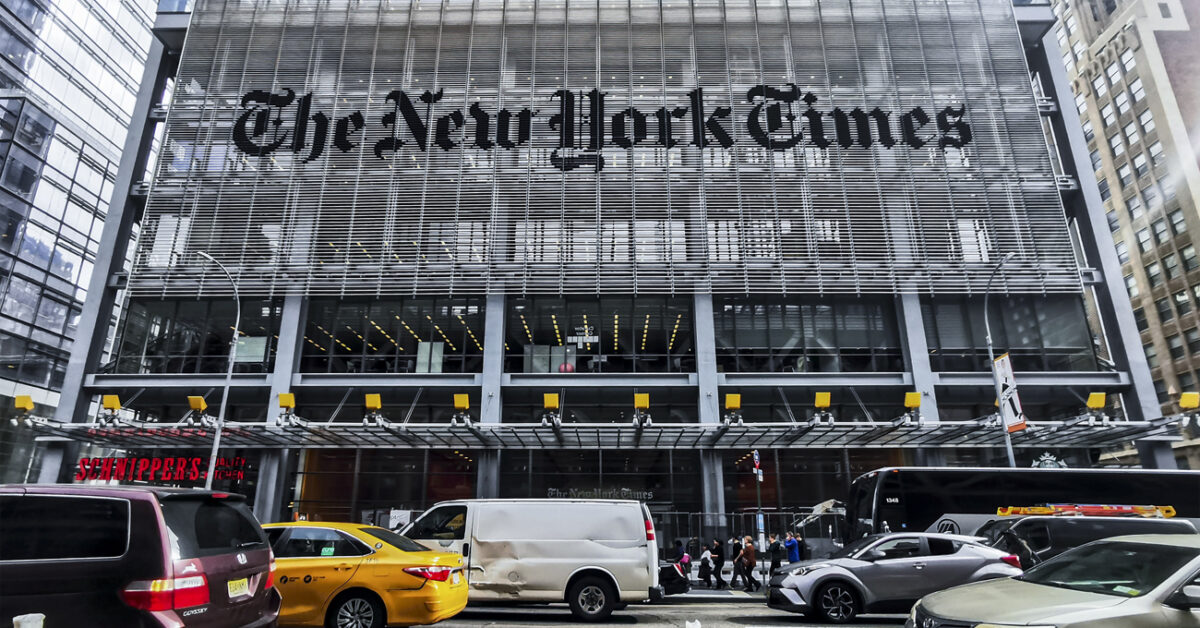
Beata Zawrzel/NurPhoto via AP
Years ago, the media was excited when Fox News settled out of court with Dominion Voting Systems over a defamation suit brought in response to reporting over the 2020 general election. Many outlets were gleefully reporting on the settlement, with commentary that it served as proof of Fox delivering flawed journalism. Yet we now see that when the New York Times suffers a similar indignity, few in the media show interest.
As we covered, the New York Times was ordered by a jury to pay out nearly $10 million to former University of Alabama basketball player Kai Spears. The paper had inaccurately reported that Spears had been present in a vehicle that was connected to a shooting in 2023, leading to the death of a 23-year-old mother.
A shootout had taken place between vehicles in Tuscaloosa in January of that year, with various members of the Crimson Tide team involved. One teammate of Spears was charged with capital murder, but in its reporting on the incident in March of 2023, sports writer Billy Witz had placed Kai Spears in one of the vehicles that evening.
This was an erroneous detail, one that Spears and his family contested, and the particulars behind the reporting are rather damning. It is shown that putting Spears in the passenger seat of one car involved was based on a solitary anonymous source. After the family and Alabama’s athletic director contested this claim, their quotes were later added to the report, but the Times did not recant the reporting until months later – when the suit was filed.
The reporting by local Alabama outlet The Patch showed Witz, on the witness stand, explained that his source had been highly placed with authorities, who had intimate details and evidence on the case. He had one other unnamed source who only stated that they felt the passenger was a white member of the basketball team.
This error in publishing cannot be dropped entirely in the lap of Witz. He testified how he had been working on the story for weeks, with various staffers and fact-checkers. Alabama was playing in the SEC tournament at the time, and then the National Championship. During this period, he spoke with several people involved with the team and the university.
At one part of his testimony, it was explained that he had spoken with some players and the head coach, Nate Oats. But when later denied a private interview with the coach, Witz had made a small threat to bring up pointed questions during a live post-game press conference.
Witz also approached Kai Spears at an open locker room press event. During that interaction, he tried to pin down the player’s presence the night of that shooting, asking Spears what it was like to be in the car that evening.
This was a detail that came to light when University of Alabama journalism instructor Mark Mayfield was on the stand. Mayfield impugned the practices of the Times regarding this story, including Witz’s questioning of Spears, and the paper operating on what he described as a “rushed deadline.” There was no time pressure to get the story out, so it is possible the Times wanted things reported during the tournament for added gravity.
Mayfield also criticized the use of a lone anonymous source. He noted that both the Society of Professional Journalists Code of Ethics and the New York Times itself stipulate that anonymous sourcing should only be used as a last resort. (We have seen over time that this type of sourcing has become the primary method of reporting these days.)
After nine days, the jury deliberated for only five hours before coming back with its verdict. Spears was awarded $9.25 million in damages. And now another major news outlet has joined those sporting a black mark of being found to have committed defamation in a court of law. The telling aspect is how few in the press are trumpeting this ruling.
This is a stark departure from the near celebratory nature of the reactions in the press when Fox made its settlement. Numerous networks covered the Fox settlement energetically, with days of coverage impugning its credibility. Yet, when other networks are found by a court to actually be guilty of defamation and libel, the crickets are deafening.
The New York Times joins CNN, which in January of last year was found by a jury to be liable for malicious defamation in the case involving the career of a Navy veteran, and (then) MSNBC settling a case where it maligned a doctor it accused of performing hysterectomies on immigrants in custody. But much like those recent cases, there is not much in the way of widespread media attention as seen with the Fox-Dominion case.
Scanning through the transcripts of numerous news outlets in the media monitoring platform SnapStream, reports of this ruling were not found. The only mention of defamation to be seen involves cases surrounding President Trump, and that is a telling detail right there. In the cases of the NY Times, CNN, and MSNBC found to have committed the same grievous journalism violations, none of those involved cases brought by the president. They committed those ethical violations involving the gentry, outside of politics.
The Times, in its case, probably had little defensive recourse after Witz was unable to defend the content of his reporting. During his testimony, Witz asserted that he had made the error when asked directly if he had wrongly placed Spears in the vehicle. He plainly admitted that was the case.
“Yes, [the story] had a mistake, no question,” he said.
This is an opinion piece. The views expressed in this article are those of just the author.
New: The Mediaite One-Sheet "Newsletter of Newsletters"
Your daily summary and analysis of what the many, many media newsletters are saying and reporting. Subscribe now!




Comments
↓ Scroll down for comments ↓