The Mediaite Obligatory This Week’s Biggest Movie of All Time Post: Avatar Edition

 Snowstorm aside, it’s hard to deny that Avatar is the big movie story right now. James Cameron rumored-to-have-cost-on-the-order-of $500 million giant blue kitties vs. space marines mega-predetermined blockbuster made something like $77 million domestically and $242 million worldwide, a good but not earthshaking result, given the range of industry projections (see above re: snow).
And while some people think it blue, the general consensus was that it was pretty ok (or, for Roger Ebert, “extraordinary” and “sensational entertainment” and “a technical breakthrough” that “recrowned” Cameron king of the world). It has earned an impressive 84% fresh rating on Rotten Tomatoes (though our own Robert Quigley noted that “the plot and characters were dull.”) But what Quigley did note — and what everyone is noting — is that what was really ok was the tech. That, we can all agree, is and will be a big deal. Upshot: Avatar was visually impressive, is the consensus, if a bit thin on plot.
So for a little while, Avatar gets to be the most expensive movie of all time, and it will likely get its turn as the highest grossing as well.
But how did a movie that no one other than handful of prematurely blue-painted fanboys was all that excited about get there? ($500 million aside.) Simple: it got there by playing the expectations game.
If you haven’t seen Avatar (yet?), but have been tracking its coverage over the past year or so, you already know all you need to know about the film’s success. Actually seeing it is, at best, superfluous to understanding why this one never had any chance but doing anything but packin’ em in and stuffing ’em with popcorn and soda.
Let’s recap. First, Avatar was a rumor, James Cameron’s next project, his passion project, the one he had been working up to. Little was known, but the ComiCon and Ain’t It Cool News set was guardedly hopeful. The man behind the two good Terminator movies, Aliens and The Abyss was returning home to sci-fi. He was making the film he always wanted to. We were excited.
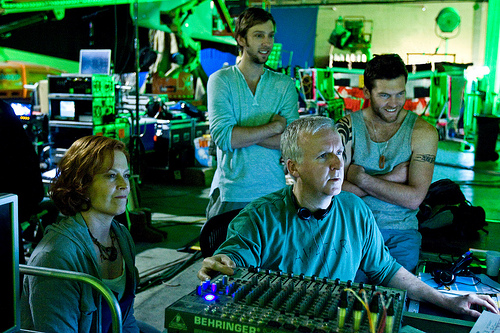
As production details began to (be) leak(ed), spirits generally remained high. Giant blue kitties aside, the tech and concept looked cool. The viewing public had the promise of a real sci-fi departure in store. A big budget no-holds barred trip to another world. Cameron was the man with the plan, and, as one of Hollywood’s (still) biggest names and draws, with all the resources and creative control a megalomaniacal Stewie Griffin of a filmmaker could desire. Avatar was his game to lose.
Then came the inevitable pre-backlash. With the release of Avatar‘s 30 second spot in August, the film’s outlook became somewhat less rosy. Lots of trees, lots of giant blue kitties, not much else. Sure it looked good, but the overall feeling was that it did not impress. Bloggers took note, and people worldwide prepared themselves for Avatar to suck.
But that is probably the best thing that could ever have happened to this cinematic whale. In a media culture where anything big inevitably generates backlash, why not get it out of the way ahead of time? As Cameron himself noted in the New York Times: “It worked out well because it generated this cycle of controversy… Let everybody in the world know this movie exists and think it sucks is a better condition than having a few people think the movie’s great before it comes out. So actually, if we had been smart enough, we would have orchestrated it to be exactly the way it was.”
It’s my guess that that is exactly what they did.
Avatar‘s teaser lowered expectations to the point that the definition of the film’s success became the lack of failure. So when the generally positive, if not always glowing reviews of the film in its entirety started to come in one after the other over the past weeks and months, the battle of the box office was effectively won before the first screening rolled. Dangling the prospect of failure hedged the $500 million bet, making pretty good as good as great.
And it is pretty great, not a failure by any measure. Visually, technologically, Avatar is one of the most impressive things you will ever see, even if the plot is a bit thin. But there may be an element of backlash-to-the-backlash in exactly how glowing the reviews have been. Avatar has won the war of expectations.
Ash Kalb is the general counsel of a New York-based telecommunications and technology company and an instrument-rated pilot. He writes about geeky things for Mediaite.
This is an opinion piece. The views expressed in this article are those of just the author.
New: The Mediaite One-Sheet "Newsletter of Newsletters"
Your daily summary and analysis of what the many, many media newsletters are saying and reporting. Subscribe now!








Comments
↓ Scroll down for comments ↓