Facebook Open Graph: Social Metadata For Everything

In 2006, Facebook unveiled a “controversial feature” – sharing changes users made to their profiles with the users’ friends. This was the feature that made Facebook, well…Facebook, the change that created the first truly social network. It’s what made people keep coming back to the site, and what made Facebook the most popular website in America.
In subsequent years, Facebook unveiled other ground-breaking tools. First, Beacon, a system for pushing notifications from advertisers to users’ walls; then, Facebook Connect, which allowed users to use their Facebook identity at other websites. Connect was a success, implemented at sites seeking to facilitate (and improve) interaction with visitors. (On Mediaite, for example, you can add comments through your Facebook account.) Beacon was less warmly received.
The primary concern about Beacon was that people found it intrusive. Third-party sites were asking to publish content on users’ walls and Facebook had done a middling job of explaining how the changes worked. And, frankly, it was too soon – for a user base still getting accustomed to the now-expected shared updates, this felt intrusive.
There are two key lessons in this history, leading up to yesterday’s bombshell unveiling of Open Graph. The first is Facebook’s efforts to build a true social web infrastructure, something Slate’s Farhad Manjoo put his finger on last year. The second is their willingness to push people outside of their comfort zones.
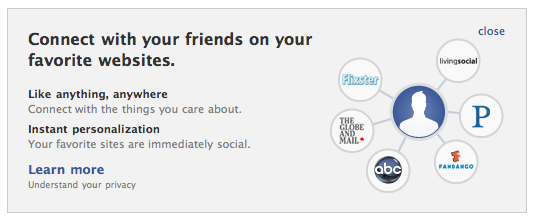
If you haven’t heard of Open Graph, you’ve at least heard of the system Facebook is implementing in some context, or seen an unusual message upon logging in to Facebook. The upshot is this: Facebook has created a tool that provides social metadata for everything. Websites, photos, anything with a fan page – everything will have an array of likes, friends, and recommendations that are stored within what Facebook calls the social graph. (The fairly tech-heavy Graph API page nonetheless gives a good look at how the data is stored and shared.)
An example of how it works is the easiest explanation. Say you visit a music site, and click the “like” button that now appears next to a particular song. Your “liking” that song draws a connection between that song and you, a connection that Pandora, for example, can make note of and use to play other music that is related to it. None of this, you’ll notice, has anything to do explicitly with Facebook, except that they are providing the infrastructure for this interaction to take place. Of course, your “liking” that song will also appear on your wall.
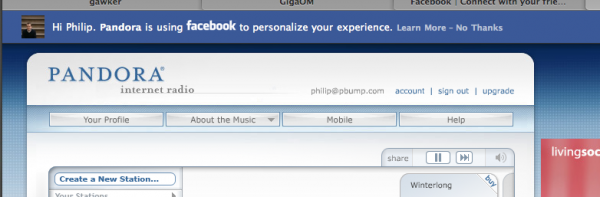
But, you EFF supporters will have noted, this also means that Pandora has access to your likes. If you give Pandora the ability, it can see deep into that web of connections, knowing what you like and what your friends like, for example, in its efforts to play the music you’ll find most enjoyable. Or Company X, if authorized by you, can look within that web to see which widget it will try to sell you.
Which brings us to that second point – pushing us outside of our comfort zones. Facebook is betting that cracking open the privacy of your information is a change that you are ready for, that this won’t be a Beacon debacle. For one thing, they played the privacy concerns a bit more intelligently this time. After unveiling the changes a few days ago (such as switching fan pages from becoming a fan to “liking” and changing the terms of service), they quickly moved to demonstrate why they were doing this – to build a web-wide system for sharing information about what you like and what you don’t.
Reactions to this move are mixed. Web veteran Dave Winer thinks the move is genius, but that we ought to oppose it. The folks at GigaOm, in a great recap of the announcement, seem a bit more cautious. Some see certain components like the partnership with Microsoft on a document-sharing tool as huge challenges to established industry players.
In my view, this structure was inevitable. Facebook got there first. Google, after stumbles with the perplexing Wave and pursuant Buzz blunder could have beaten them to it, but didn’t. It’s a space ready-made for Facebook and its structures, one greatly facilitated (as noted in yesterday’s announcement) by their acquisition last fall of FriendFeed.
There’s a nearly infinite amount of information out there about what people like and don’t like, and deep, fascinating patterns that result. Think of the Netflix Prize, but for everything, built on social metadata we create. That’s the future of information on the web, and it appears Facebook got there first.
If we let them.
New: The Mediaite One-Sheet "Newsletter of Newsletters"
Your daily summary and analysis of what the many, many media newsletters are saying and reporting. Subscribe now!








Comments
↓ Scroll down for comments ↓