Joe Rogan-Fueled Conspiracy Theory About ‘Eyes Wide Shut’ Epstein Connections Gets Torpedoed By Director’s Daughter

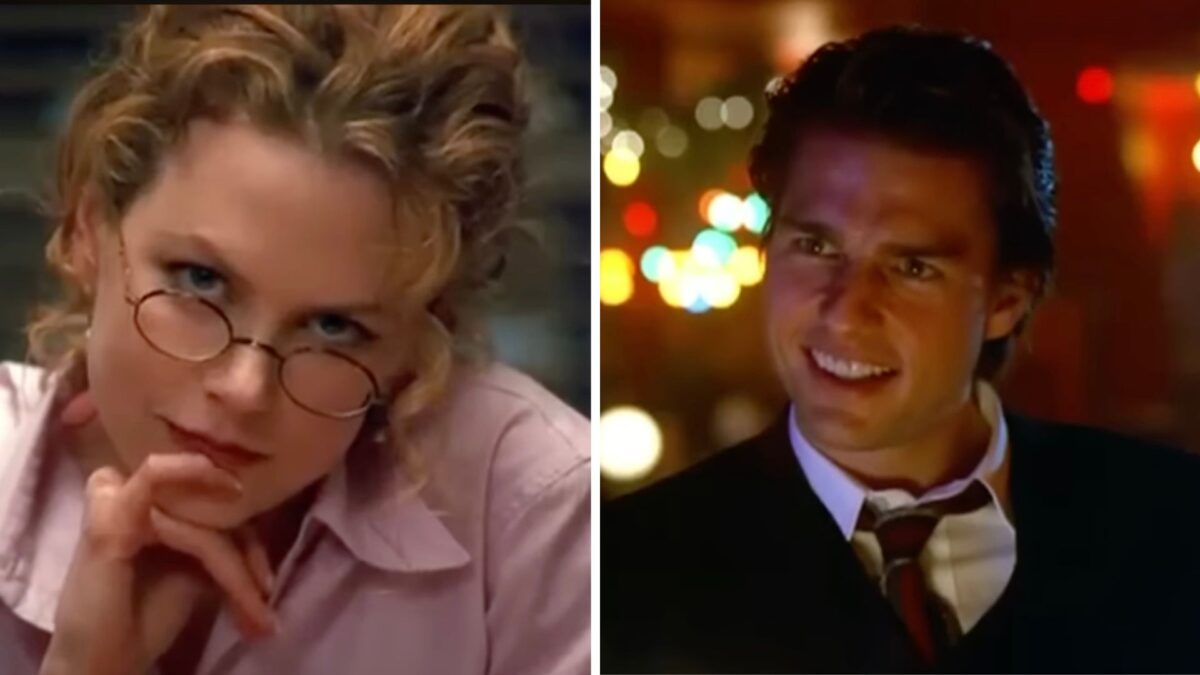
Screenshots via YouTube.
Joe Rogan has peddled in numerous conspiracy theories over the years, but his boosting of claims about Stanley Kubrick’s final film, 1999’s Eyes Wide Shut, led the late director’s daughter to publicly smack down the tin-foil-hatted chat.
Eyes Wide Shut starred Tom Cruise and Nicole Kidman, then still married to each other, in a psychological thriller that drew sharply divided opinions. Some reviewers praised it as thought-provoking and one of Kubrick’s masterpieces; others panned it for what they felt was overly slow and repetitive pacing and for failing to live up to the erotic expectations set by the innuendo-filled trailer and casting two of Hollywood’s hottest actors at the time.
For those who haven’t seen the movie, what’s relevant about the plot is that Cruise and Kidman play a married couple in New York City grappling with feelings of jealousy and temptation, with Kidman’s character confessing she fantasized about cheating, both of them having other characters attempt to seduce them with varying degrees of success, and Cruise’s character finding out about a secret society that holds private sex parties where the attendees all wear masks and managing to bluff his way into one of the events.
The Hollywood Reporter covered the conspiracy theories about the film, noting that it “involves unreleased footage, a different ending, and even Jeffrey Epstein,” and was amplified by an episode of Rogan’s podcast where screenwriter and director Roger Avary, who worked on films including Pulp Fiction but not Eyes Wide Shut, claimed he had “heard such reports secondhand”:
First, here’s the rumor, which basically combines a couple different ideas that have been making the rounds for years: Kubrick’s original cut supposedly contained an additional 20 minutes of footage (for a runtime of 179 minutes instead of 159 minutes) and a much darker ending. In this version, the sex cult that ensnares Tom Cruise’s character is revealed to be a child sex ring, and Cruise and Nicole Kidman’s characters sacrifice their daughter to the cult. As the theory goes, Warner Bros. objected to this ending, and re-cut the film after Kubrick died suddenly (and, in some tellings of the tale, suspiciously). The idea was that Kubrick either knew about Epstein’s crimes, or knew about a similar group.
In other words, the conspiracy theory is that Kubrick made a film that was too close to the sordid child sex abuse schemes perpetrated by Epstein and his accomplices, revealing he “knew too much” — insinuating that he was offed.
Kubrick died of a heart attack at home in his sleep on March 7, 1999. He had just screened a final version of Eyes Wide Shut for his family and the starring actors six days prior.
Kubrick’s youngest daughter Vivian Kubrick, apparently had enough of the resurfacing chatter about his last film and dropped several lengthy posts on social media smacking down various elements of the conspiracy theories. In one of her posts, she tagged both Rogan and Alex Jones, another conspiracy theorist, and added a bunch of hashtags for Epstein-related topics.
Vivian Kubrick also shared a link to an interview last year with the film’s editor, Nigel Galt, in which he said flat out that there were “a lot of myths” about Eyes Wide Shut due to the timing of Kubrick’s unexpected death, and rejected rumors that there had been a chunk cut out of the film:
I can tell you that nothing in the film that happened—and this includes after his death—involved anything that Stanley wasn’t aware of, or wasn’t aware that was going to happen. The difficulty that happened with Stanley’s sudden demise—and this was, remember, three days after I showed the film in New York: shown it to Terry Semel and Bob Daly at Warners and then, same night, showed it to Tom and Nicole—when I got back to London, Stanley was jubilant with the reaction. And we had a long, long-ish conversation, and the only thing that had to be done was mundane editing stuff. We had establishing shots to put in the film—you know, exterior buildings—and that was it.
There was nothing missing. That cut is Stanley’s cut the day he died. And nothing was over-edited. There was no Illuminati. [Laughs] I mean, I don’t know where these things came from, these ideas or concepts—because they’ve always built up around Stanley. It’s just the fact.
In her posts, Vivian Kubrick wrote that she “certainly did not hear anything about a missing 20 minutes at the time, nor have I heard anything since that would confirm such a section ever existed,” and provided other behind-the-scenes details about the film production that led her to be confident there was no basis for these rumors.
She concluded by declaring that she was “certain” of one thing: “if indeed 20 minutes had been removed, I definitely would have found out about it eventually,” because “[o]nce the fog of agony had lifted, I involved myself very closely in protecting my father’s work and took that responsibility extremely seriously.”
The full text of her posts is below:
You know, this is as good a time as any to finally address the missing 20 minutes from Eyes Wide Shut. It’s a story that has been circulating for many years, so let me tell you what I actually know and don’t know.
For context, my father always had his outtakes incinerated once a film was finished, specifically to prevent the studio from later re-editing his work or creating alternative versions.
There has been a lot of speculation that some 20 minutes were removed from Eyes Wide Shut after he died. This will be very disappointing to many people, but I certainly did not hear anything about a missing 20 minutes at the time, nor have I heard anything since that would confirm such a section ever existed. I guess you could stop reading right here. But if you’re interested in the details, please read on.
Of course, I was not in a position to know everything that may have happened before or immediately after my father’s death. At the time, I was living in Los Angeles, writing the score for a different movie. I flew to England, utterly traumatized, to be there for the preparations for my father’s funeral and burial. But I had to return to LA the day after his burial—stricken with grief and exhaustion—to complete the score I was contractually obligated to finish, which I barely managed. So I wasn’t there, in more ways than one, for whatever discussions may have followed.
The only alteration I heard about at the time was the use of CGI—computer-generated figures—to obscure some of the nudity in the orgy scene, which Warner Brothers wanted in order to secure an R rating for the film. But I did not hear that any shots or scenes were removed.
When my father died, Eyes Wide Shut had reached picture lock and was moving through the final stages of post-production. It had just been shown to the studio heads, I assume with a temporary music track, while the final sound mix and some of the music work were still to be completed.
This was 1999, in the era of physical film distribution. The film was edited on Avid, but that should not be confused with the kind of permanent digital archive people imagine today. The Avid material consisted of standard-definition video transfers made from the rushes—720 × 576 pixels—and used for editing. They were working copies, not a high-resolution digital preservation of the original negative. There wasn’t a high-resolution digital version of every take sitting on a server somewhere, as people might reasonably imagine today.
There were, of course, all the 35mm rush prints, as well as the original camera negative containing the outtakes. Eventually, long after the film was finished and released, the 35mm rush prints and the original negative of outtakes were incinerated. The original master negative of the finished film and the intermediate film elements made from it were, of course, kept in storage.
Once the picture was locked, the original camera negative would have been physically cut to match the final Avid edit. Once the negative itself had been cut, you couldn’t simply undo those cuts and rearrange the film: each cut destroyed a frame at both the head and tail of the shot. The master negative of the finished film was then used to make interpositives, from which internegatives were made, and those internegatives would have been used to make the 35mm theatrical release prints. The original negative of the outtakes never went through that process because, of course, those shots were not part of the finished film.
Someone might say, “But then, if the missing 20-minute edit exists, it would be preserved on the Avid!” But editing the film on Avid does not mean all of that material was preserved indefinitely. This was not an era in which every piece of editorial media was automatically retained on servers for decades, and I have no knowledge of whether any of the Avid editorial material from the production still exists. That’s a question for the University of the Arts London. They hold the official archive of my father’s surviving papers, production materials and other records, spanning his entire career, including Eyes Wide Shut. But to my knowledge, there is no surviving cache of Avid rushes from the film.
So even if 20 minutes had in fact been removed after his death, I seriously doubt we should expect a surviving video or digital copy, unused negative or other obvious physical record of it to be sitting somewhere today. But the absence of such material cuts both ways: it does not prove that those 20 minutes ever existed in the first place.
That is as far as I can honestly go. I never heard of a missing 20 minutes at the time, I have never subsequently seen or been shown any evidence that such a section existed, and I know of no surviving material that establishes that it did.
I cannot tell you what may or may not have happened during the 30-some hours immediately after my father’s death; I was not there. But unless substantive evidence emerges—and I do not regard stories from certain people who, in my opinion, are inventing them after the fact as evidence; people often want to sensationalize their part in a story, if indeed they even had a part—the story that 20 minutes were removed from Eyes Wide Shut after his death remains, to my mind, an actual conspiracy theory, not an established fact.
Finally, this much I’m certain of: if indeed 20 minutes had been removed, I definitely would have found out about it eventually. Once the fog of agony had lifted, I involved myself very closely in protecting my father’s work and took that responsibility extremely seriously.
In followup replies, Vivian Kubrick shot down other rumors, calling stories Kubrick had been overheard “yelling” that he would not change his film a “total fabrication” because he wasn’t at the New York screening where that supposedly happened, citing the archived records for the film that are kept at the University of the Arts London, and noting that Warner Bros. had digitally added to an orgy scene “to secure an R rating” but “did not remove scenes from the film.”
New: The Mediaite One-Sheet "Newsletter of Newsletters"
Your daily summary and analysis of what the many, many media newsletters are saying and reporting. Subscribe now!





Comments
↓ Scroll down for comments ↓