Trump’s Claim He Can Send Out $5K Checks Without Congress Draws Loud Skepticism

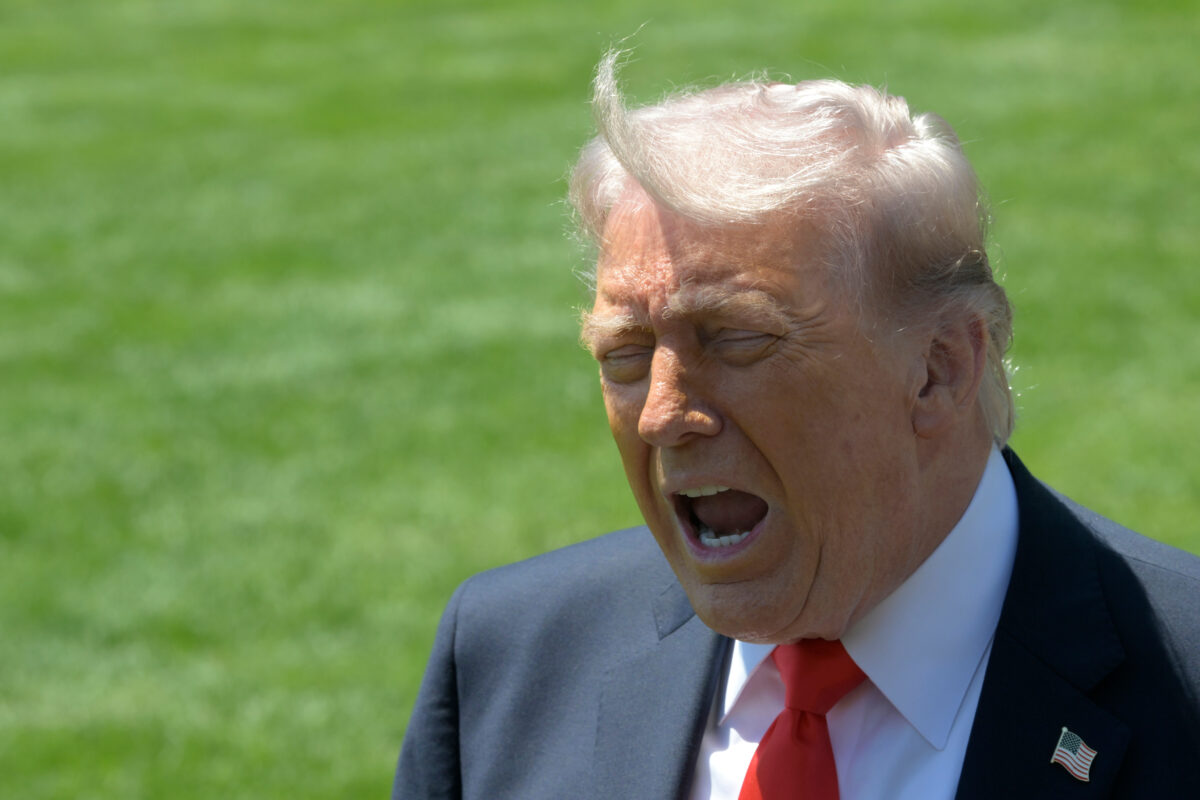
(Lenin Nolly/Sipa USA)(Sipa via AP Images)
President Donald Trump’s claim that he can send out $5,000 “Trump dividend” checks without congressional approval was met with swift and loud skepticism that it was both constitutionally impossible and fiscally irresponsible.
During his remarks at the GOP midterm convention in Dallas on Wednesday, Trump promised he would send out the “Trump Dividend” checks to every adult U.S. citizen if the GOP keeps its majority in the House and Senate in the November elections.
The plan was immediately denounced by commentators across the political spectrum, with Democrats mocking it as “socialism for the rich,” fiscal conservatives bemoaning the more than $1.2 trillion price tag, and reporters noting the numerous times Trump has promised “over and over again” to send checks out to Americans.
On Thursday, CBS News Texas political reporter Jack Fink asked Trump if Congress would need to approve these checks.
“Well, we think not,” Trump replied. “I think they will do it if we needed it. But we think not.” The president also made multiple inaccurate claims about the math behind how he thinks the checks would be funded.
As numerous legal experts have pointed out, this is directly contrary to both the plain text and legislative history of the U.S. Constitution’s Appropriations Clause, found in Article I, Section 9, Clause 7:
No Money shall be drawn from the Treasury, but in Consequence of Appropriations made by Law; and a regular Statement and Account of the Receipts and Expenditures of all public Money shall be published from time to time.
The official Congressional website on the historical background of this constitutional provision highlighted how the view of having the legislature “solely endowed” with the power to appropriate public funds had a centuries-long “pedigree” at the time of America’s founding, as a longstanding rule in British Parliaments dating back to the late seventeenth century, and this likely contributed to why “the Appropriations Clause itself attracted little debate at the Constitutional Convention of 1787.”
Each original state constitution contained an appropriations clause, as did the Articles of Confederation that preceded the Constitution; state constitutions have continued to include such clauses. There has never been a moment in American history where our government has been structured any way other than to grant the appropriations power solely to Congress.
Supreme Court precedent is well-established that this clause means exactly what it says, that the federal Treasury cannot pay out any money without first being directed to do so by an appropriations act passed by Congress.
Trump’s claims about revenues coming in from tariffs and “investments” in the U.S. do not magically create an exception to this rule of law, even if they were accurate, which they are not.
Mediaite reached out to Sen. John Cornyn (R-TX) for his reaction to the president’s claim he could spend over a trillion dollars without congressional approval. Cornyn served for years as a Texas Supreme Court Justice and Texas Attorney General before being elected to the Senate, where he has been an influential force on the Senate Judiciary Committee, as well as Subcommittees on the Constitution and Criminal Justice; he is unquestionably well-versed in constitutional law matters.
“He would need approval,” was Cornyn’s blunt reply.
Trump and his allies may shrug off Cornyn’s critique as lingering bitterness over losing his primary to the Trump-endorsed and scandal-plagued Ken Paxton, but Texas’ senior senator was far from the only Republican not on board with Trump’s $5,000 checks idea.
According to a report by The Washington Sun, Republicans were “blindsided” by Trump’s proposal to send out these checks, and “the consensus on Capitol Hill was that Trump’s proposal was a last-minute political ploy with no chance of advancing even if Republicans do hold on to both branches of Congress.”
Stephen Moore, an outside economic adviser to Trump and longtime ally, dissed Trump’s check proposal, telling the Sun it was “not a very good idea” and likely to further spur inflation.
Florida Gov. Ron DeSantis (R) bashed the idea as something that “will lead to more debt and more inflation,” according to a report by Politico.
“If you are getting surplus revenue, you should cut people’s tax and return it to the people,” the governor said when a reporter asked about Trump’s checks during a Miami press conference. “What I don’t think you want to do is borrow another $1.5 trillion, and then just try to flood that into the economy, because that will lead to more inflation.”
Rep. Chip Roy (R-TX), a member of the House Freedom Caucus, was not at the convention but tweeted his vociferous opposition to the checks, highlighting the enormous cost, which he calculated as enough to “almost ZERO out taxes for married parents of dependents up to $200,000 [for] over 10 years!”
“I think it’s a far stretch to claim [Trump] could do it without authorization from Congress,” base on a “plain reading of the Constitution,” a former Republican congressional staffer told Mediaite. The former staffer spoke on condition of anonymity and said they weren’t claiming to be an appropriations expert but had worked for years for GOP members.
“However, his team has been very clever in finding existing grants of authority to the president by prior statutes, so I wouldn’t put it past them,” the former staffer added. “I’d just be surprised. But then again, I was genuinely surprised by the strength of the arguments some of the originalist justices accepted on the tariff case — I think they’re wrong, but I was surprised there was a leg to stand on.”
This article has been updated with additional information.
New: The Mediaite One-Sheet "Newsletter of Newsletters"
Your daily summary and analysis of what the many, many media newsletters are saying and reporting. Subscribe now!







Comments
↓ Scroll down for comments ↓