

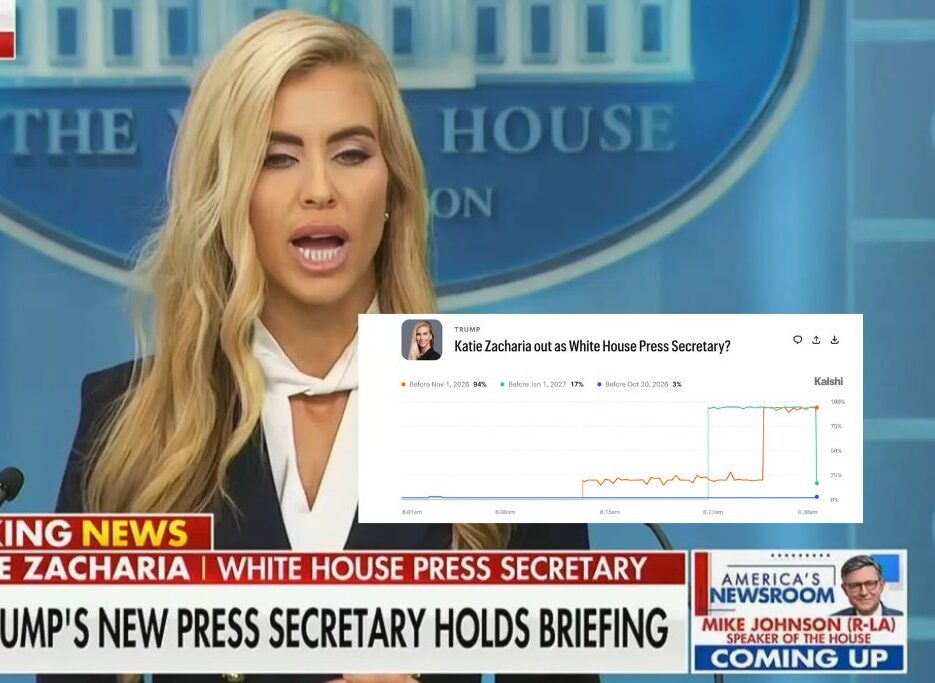
The prediction market platform Kalshi is investigating three suspiciously-timed bets tied to the selection of the White House’s new press secretary, Katie Zacharia. When the bets were placed–two within an hour of Zacharia being announced–the Kalshi marketplace gave her just a 1 percent chance of getting the nod. Those small bets (from $10 to $80) were set to pay out thousands. (If you saw her first press conference, you may not be surprised to learn there is already a healthy Kalshi market for when she’ll be dismissed, and the odds for pretty soon are not long.)
The Zacharia machinations are not the first hints that someone who appears to have inside knowledge of the administration’s workings are making a profit from what they know. Earlier this year, we learned that his teleprompter minder pocketed over $100,000 by buying positions on what Trump might actually say. Last spring, an analytics firm revealed data showing nine Polymarket accounts taking in $2.4 million on trades relating to the specific events in Trump’s war with Iran.
The Trump Administration holds that prediction markets are legitimate financial instruments rather than gambling, thus they can only be regulated (or not regulated) at the federal level, by the Commodity Futures Trading Commission. The CFTC chairman, Trump appointee Michael Selig, has gone to bat for the industry repeatedly, fighting against state and tribal attempts to find legal purchase against the prediction market onslaught.
Last week, a bipartisan coalition filed amicus briefs asking the Supreme Court to reconsider a district court decision that blocked the state of New Jersey from prosecuting Kalshi under their state gaming laws. The group includes 39 state attorneys general, gaming associations, tribal governments, the National Football League. Two officials once involved in federal securities oversight spend their brief laying out how Congress never intended the CFTC to govern swaps on who’s going to be eliminated on week six of Dancing With the Stars.
The state agencies would like to be able to, among other things, collect taxes on the billions sloshing around in Kalshi’s cup. The NFL is appropriately concerned that bets on game minutiae (player injuries, officiating calls, individual plays) are more difficult to detect and susceptible to manipulation in a way that wagers on a game outcome are not. Most everyone points out that the markets allow bettors as young as 18, whereas traditional gambling age restrictions start at 21. (Users under 21 made trades worth $5 billion dollars just this year.)
A Supreme Court decision against Kalshi could pop the prediction market bubble, creating a sudden vacuum in a media that has normalized the monetization of life itself. Their sponsorships have become integrated with organizations across the pop culture spectrum, from CNN (Kalshi) to the MLB (Polymarket) to the Golden Globes (Polymarket again) to The Weather Channel (Kalshi).
But I suspect the ruling, as so many others under this court, will go in the direction of the Trump administration’s interests–and, conveniently, the interests of the Trump family as well. Don Jr. has an equity stake in Kalshi and, through his investment firm, is an investor in Polymarket. But I don’t think the prediction market platforms need to grease palms. The Trump administration and prediction markets go together like cigarette smoke and slot machines; they share similarly cynical worldviews and enthusiasms for exploitation.
The first step in the process to either cracking down on markets or letting them continue to metastasize is getting on the SCOTUS docket. Will that happen? You can bet on it.
——
This is an opinion piece. The views expressed in this article are those of just the author.
New: The Mediaite One-Sheet "Newsletter of Newsletters"
Your daily summary and analysis of what the many, many media newsletters are saying and reporting. Subscribe now!

Comments
↓ Scroll down for comments ↓