JUST IN: Appeals Court Blocks Construction of Trump’s White House Ballroom Without Congressional Approval

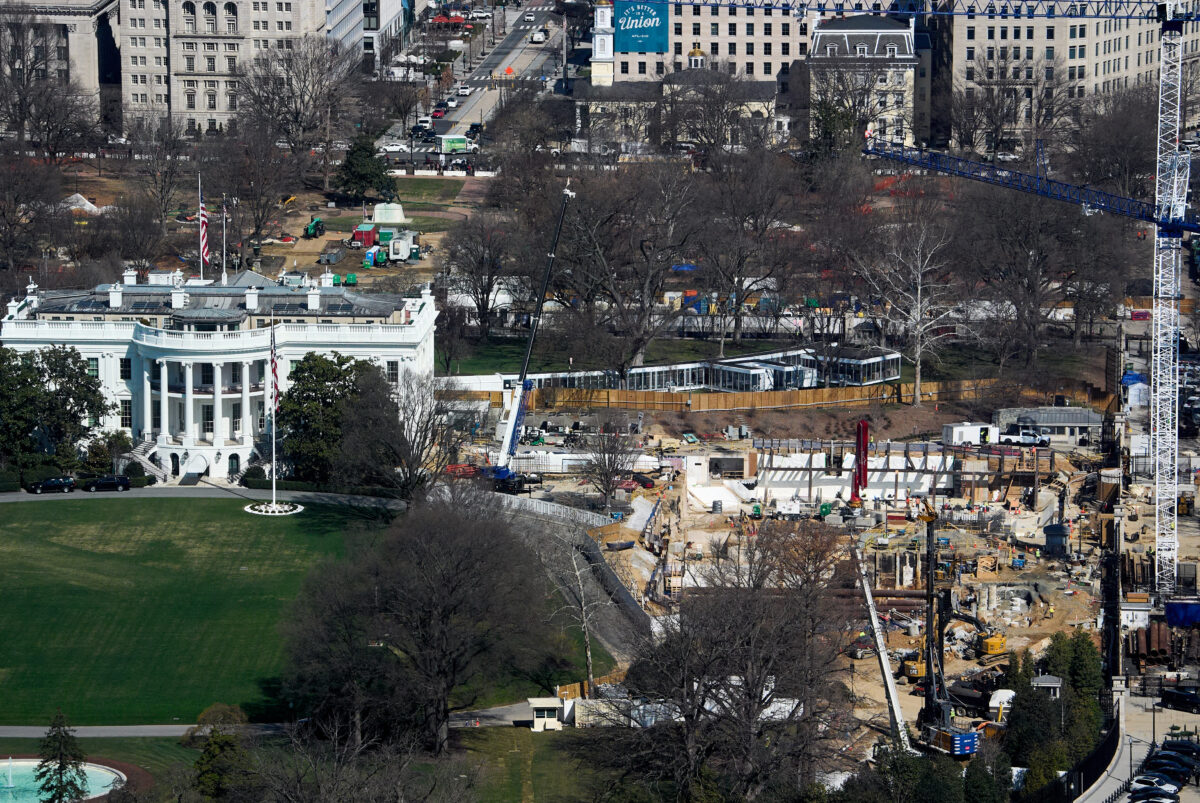
(AP Photo/Jacquelyn Martin)
President Donald Trump’s ballroom project is illegal because the administration failed to get congressional approval, a federal appeals court ruled.
The 2-1 decision by the U.S. Court of Appeals for the District of Columbia saw Judges Patricia Millett, an Obama appointee, and Brad Garcia, a Biden appointee, voting to block construction and Judge Neomi Rao, a Trump appointee, dissenting.
Politico senior legal affairs reporter Kyle Cheney flagged the ruling and noted a section of the opinion that highlighted the historical significance of the White House as the “People’s House”:
The White House is the People’s House, and under the Constitution’s Property Clause, Congress exercises plenary control over the building and its surrounding land. The White House is also the centerpiece of President’s Park, a National Park stewarded by the National Park Service. According to the government, as the oldest public building in the District of Columbia, the White House is the crown jewel not just of President’s Park, but also of the Lafayette Square National Historic Landmark District, a site listed for preservation in the National Register of Historic Places. See Finding of No Significant Impact, White House East Wing Modernization & State Ballroom Environmental Assessment (“FONSI”), ECF No. 14-2, at 5. The founding architect of the Nation’s capital, Pierre L’Enfant, designed the capital city’s layout to focus on the towering Capitol building the gleaming palace of the people in the new democracy— and to contrast it with the simple humility of the White House. See SCOTT W. BERG, GRAND AVENUES: THE STORY OF PIERRE CHARLES L’ENFANT 112 (2008) (“Where the king’s bedroom was placed on the central axis of Versailles, enshrining the rule of divine right transferred via primogeniture, here in L’Enfant’s plan the home of Congress took center stage.”); FONSI at 5 (“Situated on a high point within the city, the White House is a focal point on the principal north-south axis of L’Enfant’s plan.”).’
However, the court did take pains to not it was not ultimately ruling on the merits of the construction itself:
This holding has nothing at all to do with whether the proposed ballroom is desirable, or not, as a matter of policy. This ruling does not even necessarily mean that the Defendants may not ultimately construct the ballroom. What it does mean is that the Defendants may not do so during the district court’s expeditious litigation without securing Congress’s authorization, as the Constitution and laws require. At this preliminary stage, the National Trust has shown, compellingly, that Congress has not ceded unfettered authority to the Executive Branch to dramatically redesign, reshape, and reconstruct the White House — the People’s House — to fit a particular President’s desires.
Procedurally, Friday’s ruling affirmed a preliminary injunction issued by the district court blocking the construction. The decision is stayed for 14 days to allow the Trump administration to appeal the ruling to the Supreme Court.
The ballroom has been a pet project for the president, who boasted last year it would be “absolutely magnificent construction” and “one of the best anywhere in the world.”
But the project has sparked significant controversy, chiefly Trump’s broken promise that the construction “won’t interfere with the current building” and would be “near [the East Wing] but not touching it.”
Instead, very soon after Trump made that public vow, the façade was demolished, then an additional major section, and eventually the East Wing was demolished in its entirety.
The president also initially touted the project as being funded by private donors, but the specifics remained murky, and the endeavor has raised ethical questions about conflicts of interest.
After the attempted shooting at the White House Correspondents’ Dinner, Trump and other Republicans pushed for hundreds of millions of dollars of taxpayer funding for the ballroom.
The lawsuit was filed by the National Trust for Historic Preservation in December, and argued the Trump administration had violated federal law by failing to obtain congressional approval and failing to submit plans to the National Capital Planning Commission and the Commission of Fine Arts.
The group also argued the project was a violation of the National Environmental Policy Act, because the White House did not conduct and publish the required environmental assessment before demolishing the East Wing and disposing of the construction debris.
“No president is legally allowed to tear down portions of the White House without any review whatsoever — not President Trump, not [former] President Joe Biden, and not anyone else,” the complaint declared.
This is a breaking news story and may be updated.
New: The Mediaite One-Sheet "Newsletter of Newsletters"
Your daily summary and analysis of what the many, many media newsletters are saying and reporting. Subscribe now!









Comments
↓ Scroll down for comments ↓