Raft of Pro-Alabama Apologists Defending Bad CFP Committee Decision Represents the Worst of Sports Journalism

Sports journalism showed its absolute worst side following the College Football Playoff committee’s curious decision to include a one-loss Alabama team in the CFP over an undefeated Florida State.
The argument is easy enough to follow: Alabama defeated the defending champ and previously undefeated number one ranked team, Georgia, and unbeaten Florida State had lost their starting quarterback to injury, which makes them less formidable than previously considered.
The subjective “eye test” has been cited many times in the last 48 hours as the reason why Alabama was chosen as a top four school — overlooking objective measurements like schedule and “strength of record,” which considers all data and leaves bias and opinion out of the process.
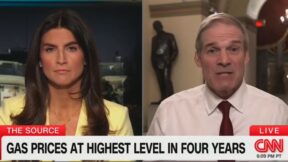
Alabama super fan Kaitlan Collins had Paul Finebaum — SEC media guru and chief apologist for Alabama coach Nick Saban — on CNN to discuss and, lo and behold, they entirely agreed with the committee’s decision. I don’t blame Kaitlan at all — this is a big story. She disclosed her fandom at the outset, and I’ve long admired her college football interest as a “one of these things that’s not like the other” quality that differentiates her from the typical DC/Manhattan CNN hosts.
Earlier in the morning, Alabama super fan Joe Scarborough had on three guests, Pablo Torre, Mike Lupica, and Finebaum, and guess what? Each agreed with the Morning Joe host that “the committee got it right, boss!” with a level of sycophancy we usually see when Trump imagines an aide calling him “sir!”
The Crimson Tide is a good football team, and Saban is a legendary coach. But the “eye test” that found Alabama a top-four team willfully ignores evidence undermining the claim.
Finebaum repeatedly stated that Alabama’s defeating the number one team proves they deserve a playoff spot. Well, logically, that argument doesn’t quite hold, given that if Georgia is, in fact, the best team in the nation, then they should be considered a top-four team. But going even further, anyone who watched the SEC championship game knows it was evenly matched. Georgia even outgained Alabama and got more first downs, though marginally.
But the biggest issue was a really bad official’s call on a clearly dropped pass on a fourth and long at the end of the first half, which was not reviewed for reasons we can only wonder. That bad call led to a touchdown and, eventually, the victory. Take away that seven points, and it’s a different result.
But it’s not just the most recent game. Alabama very nearly lost to a remarkably mediocre Auburn team the week before, if not for a prayer 4th and 31 pass play, literally called the “gravedigger.” Yes, the Iron Bowl is a great rivalry that brings the best out of both teams, but that poor performance was hardly a one-off. Look at how Alabama struggled mightily against a very bad South Florida team. Surely, if the “eye test” is at play, one would need to consider these examples as well, right?
Wrong. As is the case in so much of sports journalism — with notable exceptions —making the right calls is less important than the groupthink or herd mentality at play. Like lemmings following one another over a cliff, many sportswriters care more about sitting at the cool kid’s table at the middle school cafeteria than making calls that stand out.
But that’s not even the worst of it. Finebaum is a classic example of access journalism in the sports world, which is at its worst in college football. And I’m being tough on him — he did call out Alabama for not being that good earlier in the season when that was the conventional wisdom. But one can sense the concern in saying anything Nick Saban and the Alabama Sports Information Director don’t want to hear will limit their access to the storied program moving forward, which is a big penalty.
Losing access to a coach, players, or a program makes life as a reporter much more challenging. So does losing a seat at the press table or getting denied an interview request: these are the consequences that “sports journalists” will never admit to but keep top of mind, especially in the vengeful world of sports communications.
None of this makes any sense. Just look at the cocksure nature of sports reporters opining on the latest poll. After Georgia housed a top 20 Tennessee team in Knoxville, the conventional wisdom is that they are the clear number one team. Two weeks later, not so much. Or, as Jay Bilas noted on X:
My favorite part of the illogical, nonsensical CFP rankings: Florida State isn’t as good as Alabama…but the ‘Noles are better than Georgia, which was the “best team” last week. That makes perfect sense.
— Jay Bilas (@JayBilas) December 4, 2023
I’ve worked in the sports media racket before, and as a huge sports fan, I was excited to produce a college basketball special for CBS Sports. I considered it the first step in a career path I would love.
And then I met the sports journalist world face-to-face and found that the vast majority of people covering the sports I loved so much were the exact sort of jocksniffing losers who only wanted to elevate their social standing by sucking up to sports figures. It was gross.
It is gross, and it’s in evidence today with how shameless so many in the college football world are amplifying a controversial decision to give Alabama a leg up and a spot in the playoffs because they deserve a break of some sort — just like the Death Star deserved some journalistic support in Star Wars.
This is an opinion piece. The views expressed in this article are those of just the author.
New: The Mediaite One-Sheet "Newsletter of Newsletters"
Your daily summary and analysis of what the many, many media newsletters are saying and reporting. Subscribe now!






Comments
↓ Scroll down for comments ↓