Mehdi Hasan Explains His Relentless Interview Style and How to Resist the Unstoppable Force of Political Misinformation

This column marks the debut of The Follow-Up, a series aimed at examining the high-profile journalists and standout press moments shaping our media ecosystem and setting examples of quality journalism.
In are era where politicians and the powerful feel increasingly emboldened to act like unstoppable forces of misinformation, Mehdi Hasan strives push back against this trend by being an immovable object of fact-checking and accountability. One that refuses to simply “move on” in the face of lies or misconduct.
Even if you don’t recognize Hasan’s name, you’ve likely seen a clip of him on Twitter or YouTube provoking dazed looks or fumbling answers from interview subjects as they grapple with the blunt questions throw at them in the 41-year-old’s clipped, British accent. His hour-long, head-to-head clash with former Blackwater CEO Erik Prince was a worldwide viral hit last year—and appeared to catch Prince having lied to a Congressional investigation about the infamous 2016 Trump Tower meeting with Russians. It could be that someone retweeted into your timeline his brutal rhetorical takedown of President Donald Trump’s many lies in a conversation with one of the president’s staunchest supporters, Steven Rogers — which Hasan has still keeps up as his pinned tweet, nearly two years later. Or maybe you saw his relentlessly bird-dogging of former Bush-era National Security aide John Bolton earlier this month, where Hasan pressed the hawk for five straight minutes to get him to answer a simple question about having any regrets over his role in disastrous Iraq War.
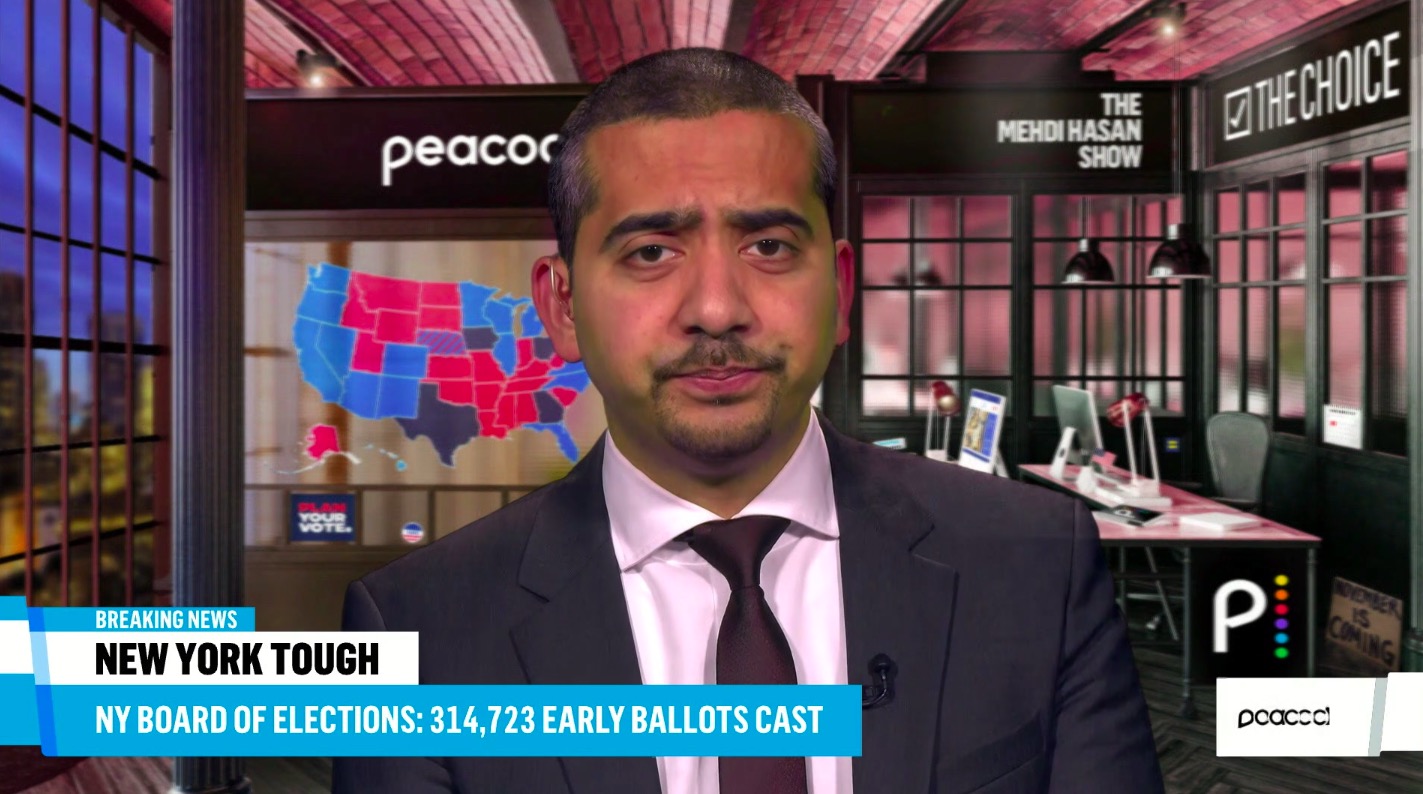
That last example took place on Hasan’s hour-long, daily show for NBC’s new streaming service, Peacock, which debuted two weeks ago (Monday – Friday, 7:00 p.m. ET). And it’s part of his wholesale career shift into U.S. journalism. Previously, Hasan had been the host of Al Jazeera English’s weekly interview show, UpFront, and was a senior columnist at Pierre Omidyar’s The Intercept. But Hasan has left both of those gigs to consolidate his media profile under the umbrella of NBCUniversal, where he is also an online commentator for MSNBCDaily and maintains a contributor role on its cable network, MSNBC.
To launch this new Peacock show, Hasan issued something of a mission statement on Twitter. And while his firm pledge of nonpartisanship likely sounded familiar to most American news consumers, Hasan’s unapologetic, no false-equivalence-here stance toward favoring science and democracy stands out.
“To be clear: this show has a bias. Not a party political bias, we’ll call out both Republicans & Democrats on here… No, a bias in favor of cold hard facts. In favor of blunt truths. In favor of basic science. A bias in favor of democracy” – me, tonight, introducing my new show https://t.co/r81dKSKiSC
— Mehdi Hasan (@mehdirhasan) October 6, 2020
“I moved to the U.S. in 2015, and like everybody else, I got sucked into Trump World and Trump took over my professional life,” Hasan explains of the journey to how he got here. Based in Washington, D.C., Hasan’s progression toward an increased focus on U.S. news seemed natural when, as he puts it, “Donald Trump is the number one news story in the world.”
But it wasn’t always this way — and that is big reason why Hasan’s interviews look and sound like little else on American cable TV news.
“I started out working eight years for Jonathan Dimbleby,” Hasan says of his formative years in T.V. journalism. Dimbleby, though not well known here, was a legendary BBC presenter, who retired last year after having spent 32 years on air making British politicians of every stripe squirm in their seats. In a telling comment last year, Dimbleby offered a broad critique of T.V. news that Hasan shares and that could certainly be applied on this side of the Atlantic, lamenting that “The forensic long-form interview has virtually disappeared.”
This marrying of a very different news DNA into U.S. cable news is also evident when Hasan cites some of the most influential moments that have guided his approach to interviewing. Among them is an iconic grilling by BBC interviewer Jeremy Paxman of a former British Home Secretary, Michael Howard. Though the stakes of the interview may appear small — they revolve around an alleged threat Howard made to have a lower-level government official removed — Paxman simply would not budge when given a series of evasive non-answers. In all, Paxman asked Howard the same, simple yes-or-no question more than a dozen times. It ends up being riveting T.V. and teases out the truth even though Howard never actually answers the question.
“There is this sort of chumminess within the American media,” Hasan acknowledges, when comparing his past and present media ecosystem. “There is definitely more deference to politicians here.”
As an example, he cites the symbolism in how the White House press corps interacts with the president.
“I think it is absurd that the American press stands when the president enters the room,” Hasan says. “It’s also absurd that American politicians continue to carry their title after they’ve left office. We don’t call former Prime Minister Tony Blair, ‘Prime Minister’ in interviews now. He’s just Mr. Blair.”
As someone steeped in the journalistic power of the “forensic, long-form interview,” Hasan has little patience with the rigid, narrow structure of the White House’s daily press briefings, where a president can typically dodge or filibuster a tough or embarrassing question and then elude answering by calling on a more friendly news outlet.
“This is what is so frustrating about White House press conferences, they never follow up,” he explains. “Also, there is no solidarity among them. When Trump fails to answer the question and simply moves on to another reporter, they never give their time back to the previous reporter or ask the same question.”
By contrast, Hasan prefers to take a much more meticulous approach to his extended interviews.
When he was hosting Upfront, Hasan said he and his producers would try to game out much of the interview with a flow chart starting from the very first question, poring over their subject’s past public statements to determine the most likely dodges and lies.
“So if he says A, then we go here, and so on,” Hasan explains, noting that he and his team spent days prepping for the Erik Prince interview. This lead time is a luxury, he concedes, American TV journalists typically don’t enjoy — and he is included among that list. “Now that I’m doing one hour of live TV tonight five days a week, I don’t have the kind of time to do that,” Hasan acknowledges. “But we did look at past interviews of Bolton to see what he’d said.”
The Bolton interview was another case study in the journalistic power of simplicity and following up — and not giving up.
“I knew I wanted to talk about Iraq and Iran. But I choose to focus on Iraq by asking whether he’d had any remorse or regrets about the war,” Hasan explained. Of the roughly 20-minute interview, Hasan spent more than a quarter of it on that single question. Every time Bolton would wander away or engage in absurd semantical argument — like the U.S. occupation of Iraq should be considered distinct from the invasion — Hasan would address it but then circle right back to the unanswered question.
“I knew he likes to engage in tough interviews,” Hasan recalled of his interview strategy with Bolton. “He thinks of himself as very sharp intellectually and he is very sharp intellectually. But he refused to answer my question.”
The moment when someone in power repeatedly refuses to answer a simple yes-or-no, true-or-false question is incredibly clarifying and it’s an interviewing tactic Hasan strongly believes in, as it gives subjects fewer routes for escape.
“I strongly believe less is more,” he explains. Couple that with his imported British-news stubbornness and it makes for a robust adversarial journalism that doesn’t swallow pat answers only to meekly “move on” to a new subject.
In what almost passes for a mantra, Hasan proudly declares: “Others move on, I refuse to move on.”
After four-plus years suffering under Trump’s deluge of lying and misinformation, there appears to be a (belated) recognition among American T.V. journalism that what once passed for normal simply isn’t good enough anymore. The Washington Post on Tuesday identified this as a growing shift toward “smackdown interviews,” where TV news hosts and presenters aggressively rebut, fact-check, and, if need be, pre-emptively shut down segments if their subjects traffic in rampant falsehoods, conspiracy theories, or ad hominem attacks. The Dimblebys, Paxmans, and Hasans of the world would likely just call them “interviews.”
“I have seen greater pushback on Trump in recent years by the mainstream press,” Hasan says, praising recent, news-making interviews from figures like CNNs Jake Tapper, Fox News’ Chris Wallace, and Axios’ Jonathan Swan. But when asked if he thinks the media might backslide if Trump loses, reverting back to a more passive stance toward power and the presidency if Joe Biden wins, he admits that is a concern.
“But I will treat the Biden administration no different than Trump’s,” he insists, before pointing out that even if Trump disappears, his political antecedents like QAnon — with their penchant for extremist views and bizarre conspiracy theories — will remain. “We will still be dealing with Trumpism, and there will still be a need to call out the Marjorie Taylor Greenes of the Republicans in Congress.”
No matter what happens after Election Day next week, in other words, there will still be a need for immovable objects of journalism, refusing to “move on” when the powerful try to hide from the truth.
New: The Mediaite One-Sheet "Newsletter of Newsletters"
Your daily summary and analysis of what the many, many media newsletters are saying and reporting. Subscribe now!

Comments
↓ Scroll down for comments ↓