Judge Orders Temporary Halt to Construction at ‘Alligator Alcatraz’

AP Photo/Evan Vucci
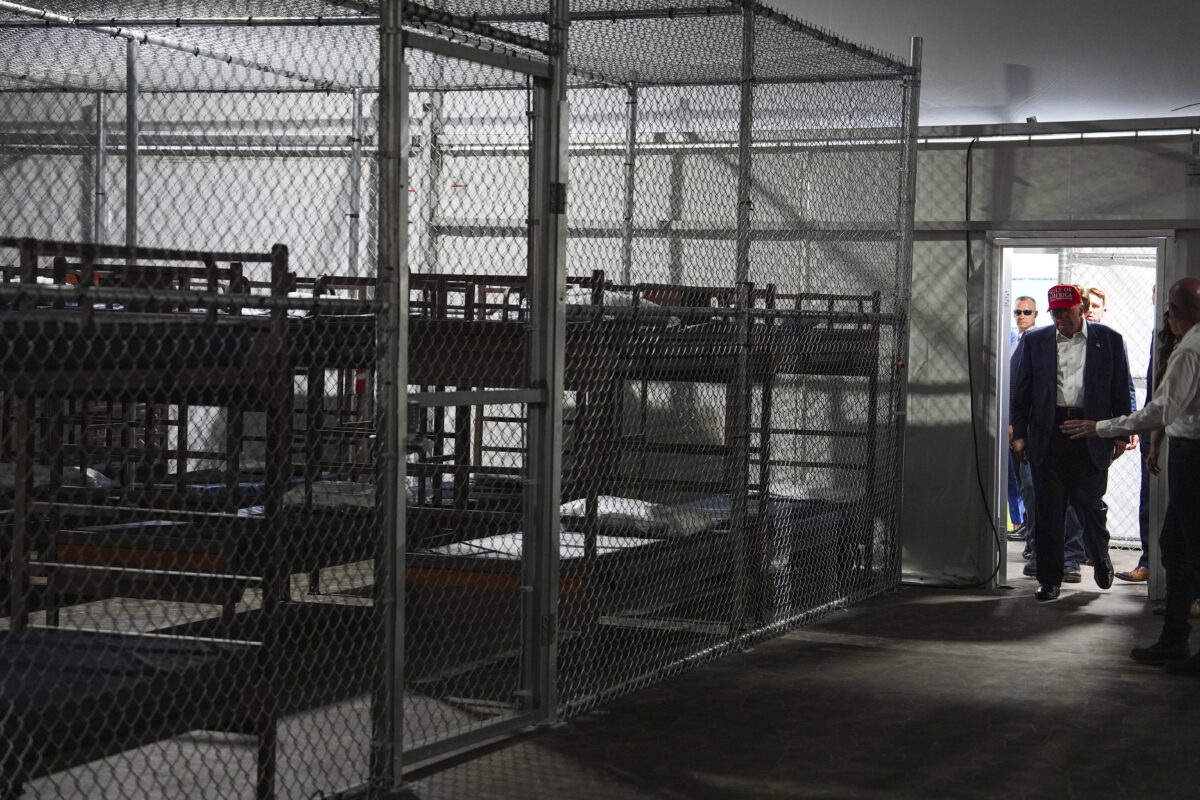
A federal judge has ordered a temporary halt to construction at the controversial ICE detention facility in the Everglades known as “Alligator Alcatraz,” allowing it to remain operational but prohibiting any new filling of land, paving, or other infrastructure for the next 14 days.
Alligator Alcatraz has been extremely controversial after multiple reports of abuses of detainees, hundreds of millions of dollars in lucrative contracts going to GOP donors and other allies of Florida Gov. Ron DeSantis, lack of audits and other Florida law-mandated transparency, environmental harm to a national park’s fragile ecosystem, and impact on local Miccosukee and Seminole ceremonial sites and tribal lands.
The facility flooded after a summer thunderstorm on its opening day, shortly after President Donald Trump, DeSantis, Homeland Security Secretary Kristi Noem, and other government officials and media toured the site. According to the National Weather Service in Miami, the storm brought only an inch-and-a-half of rain. When the Miami Herald filed a public records request for the facility’s hurricane plan last month, a spokesperson for the Florida Department of Emergency Management replied that there were “no responsive records to this request.”
Thursday’s order was issued by U.S. District Judge Kathleen Williams with the Southern District of Florida in a lawsuit filed by Friends of the Everglades and Center for Biological Diversity in June. The Miccosukee Tribe’s request to intervene was granted a month later.
The complaint argued that the detention center threatens the fragile ecosystem of the Everglades (including multiple endangered species), violated federal law by failing to pass an environmental review, did not allow the public opportunity to comment, threatens to undermine or reverse billions of dollars’ worth of Everglades restoration work, and improperly converted county preserve land into a federal detention facility.
Among the relief requested by the plaintiffs was an injunction stopping any further construction at the site and blocking the state and federal government from using it as an immigration detention facility.
Paul Schwiep, an attorney for the two environmental group plaintiffs, presented their arguments in favor of an injunction Wednesday and Thursday, as well as a temporary injunction so that the federally-required environmental study could be conducted, according to NBC6 Miami.
Jesse Pannucio, an attorney for the state of Florida, argued that the federal environmental law should not apply because the construction and operation of the facility were being handled by the state. Upon questioning by Judge Williams, Pannucio acknowledged he could not guarantee the state would agree to stop all work until the parties had argued the injunction issue and a ruling had been issued.
With the state not willing to halt construction, Williams agreed with Schwiep that “the detention facility was at minimum a joint partnership between the state and federal government,” reported NBC6, and issued an order from the bench to halt construction for 14 days, allowing the facility to remain open and operational but not excavate or fill any additional land, pave any new areas, install new tall lighting, building any new fencing, or add any new infrastructure. The judge told the parties she would issue a written order later in the day.
DeSantis has insisted that the detention facility would have “zero impact” on the Everglades, but critics of the facility have found that claim to be impossible, due to the influx of vehicle traffic, machinery, construction at the isolated airstrip, roughly an hour from any other infrastructure. Running the detention facility requires drinkable water and food to be driven in, numerous generators to run constantly to provide power, and waste to be collected and transported away.
The increased light pollution from a rarely-used airstrip to an operational detention facility with thousands of detainees and staff present is another concern, as it can disrupt local species used to natural daylight and nighttime cycles, like the nocturnal Florida panther, an endangered species known to be present in the area.
Less than two weeks after the Friends of the Everglades lawsuit was filed, the plaintiffs submitted sworn declarations from Christopher McVoy, a wetlands ecologist and soil physicist who co-authored a book on the Everglades, and Ralph Arwood, a private pilot who took aerial photographs of the area around the facility on July 5 “showing ‘newly paved (asphalted) area’ and ‘several areas of new road construction.'”
McVoy also toured the facility on June 28, and told NBC6 in a phone interview that he was “surprised” DeSantis claimed there would be “zero impact” and that he said it “with a straight face.” Citing what he had observed about the heavy vehicular traffic going in and out of the facility, he scoffed at the governor’s claims as “ludicrous.”
This is a breaking news story and has been updated with additional information.
New: The Mediaite One-Sheet "Newsletter of Newsletters"
Your daily summary and analysis of what the many, many media newsletters are saying and reporting. Subscribe now!








Comments
↓ Scroll down for comments ↓