Columbia ‘Not Able to Come to an Agreement’ with Student Protesters, Demands They Disperse by 2 PM

The president of Columbia University issued a statement Monday stating that the university “will not divest from Israel” and was “not able to come to an agreement” with negotiators for the student protesters, asking them to “voluntarily disperse” from the encampment. Shortly after that statement was emailed to the university community, a new statement was issued demanding the protesters disperse by 2 pm ET or face suspension.
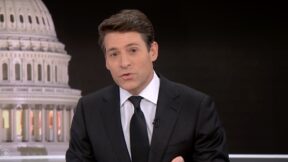
CNN correspondent Omar Jimenez reported on the email from President Minouche Shafik that went out to the university community on Monday morning’s episode of CNN Newsroom, anchored by Jim Acosta.
Shafik’s message began by stating that the university was “committed” to “core principles” that included keeping everyone “physically safe on campus,” “academic freedom,” and “ensuring that all members of our community have the right to speak their minds.”
These core principles included respecting that “everyone at Columbia has the right to express their views,” but “they also must respect the rights of others to do the same.”
“As a result, protests must comply with time, place, and manner restrictions which, for example, prevent loud protests at night when other students are trying to sleep or prepare for exams,” Shafik continued. “One group’s rights to express their views cannot come at the expense of another group’s right to speak, teach, and learn.”
She added that Columbia’s “values—as well as our duties under civil rights laws—compel us to condemn hate and to protect every member of our community from harassment and discrimination. Antisemitic language and actions are unacceptable and calls for violence are simply abhorrent.”
Shafik addressed how many students, especially Jewish students “have found the atmosphere intolerable in recent weeks,” and many had left campus, which she called “a tragedy.”
“To those students and their families, I want to say to you clearly: You are a valued part of the Columbia community,” wrote Shafik. “This is your campus too. We are committed to making Columbia safe for everyone, and to ensuring that you feel welcome and valued.”
The president explained that university leaders had been “in constructive dialogue with student organizers to find a path that would result in the dismantling of the encampment and adherence to University policies going forward,” but “[r]egretfully, we were not able to come to an agreement.”
According to Shafik, Columbia had wanted “a collaborative resolution with the protestors that would result in the orderly removal of the encampment from the lawn” and asked the students “to commit going forward to following the University’s rules, including those on the time, place, and manner for demonstrations and events.”
She declared that Columbia “will not divest from Israel,” but added that the university had “offered to develop an expedited timeline for review of new proposals from the students by the Advisory Committee for Socially Responsible Investing, the body that considers divestment matters” and “to publish a process for students to access a list of Columbia’s direct investment holdings, and to increase the frequency of updates to that list of holdings.”
Columbia had also “offered to make investments in health and education in Gaza, including supporting early childhood development and support for displaced scholars.”
Shafik then addressed how the protests and encampment had “created an unwelcoming environment for many of our Jewish students and faculty,” and “a noisy distraction for our students studying for exams and for everyone trying to complete the academic year.”
She emphasized the “interim demonstration policies” that would be enforced, allowing that peaceful protests would be allowed on campus after the exam period and commencement, “by application with two-days’ notice in authorized locations.”
Columbia fully intended to hold a graduation commencement, Shafik wrote, noting that many of the graduating students missed their high school graduations because of the pandemic.
“For all of the reasons above, we urge those in the encampment to voluntarily disperse,” she concluded.
According to the Columbia Spectator, one of the protesters’ demands was amnesty for students disciplined for violating university policy related to the protests, but that issue was not addressed in Shafik’s email.
Jimenez just reported that the university issued a new statement demanding students clear the encampment by 2 pm or they will face suspension.
From the statement:
Please promptly gather your belongings and leave the encampment. If you voluntarily leave by 2 p.m., identify yourself to a University official, and sign the provided form where you commit to abide by all University policies through June 30, 2025, or the date of the conferral of your degree, whichever is earlier; you will be eligible to complete the semester in good standing (and will not be placed on suspension) as long as you adhere to that commitment. We want to do all that we can to allow our graduating students to finish their studies.
It is important for you to know that the University has already identified many students in the encampment. If you do not identify yourself upon leaving and sign the form now, you will not be eligible to sign and complete the semester in good standing. If you do not leave by 2 p.m., you will be suspended pending further investigation.
The statement added that that any students who were placed on interim suspension would be “restricted from all Columbia University campuses, facilities and property, including all academic, residential and recreational spaces,” their student IDs would be deactivated, they would have to contact the Dean of Students to make arrangements to obtain personal belongings, plus losing the semester:
You are not permitted to complete the Spring 2024 semester, including participate in classes or exams in-person or remotely or otherwise submit assignments or engage in any activities affiliated with Columbia University. You may lose the semester: If you are scheduled to graduate, you are no longer eligible.
Watch the clip above via CNN.
New: The Mediaite One-Sheet "Newsletter of Newsletters"
Your daily summary and analysis of what the many, many media newsletters are saying and reporting. Subscribe now!






Comments
↓ Scroll down for comments ↓