
Media Mostly Omits the Late Desmond Tutu’s Troubling Comments About Israel and Jews

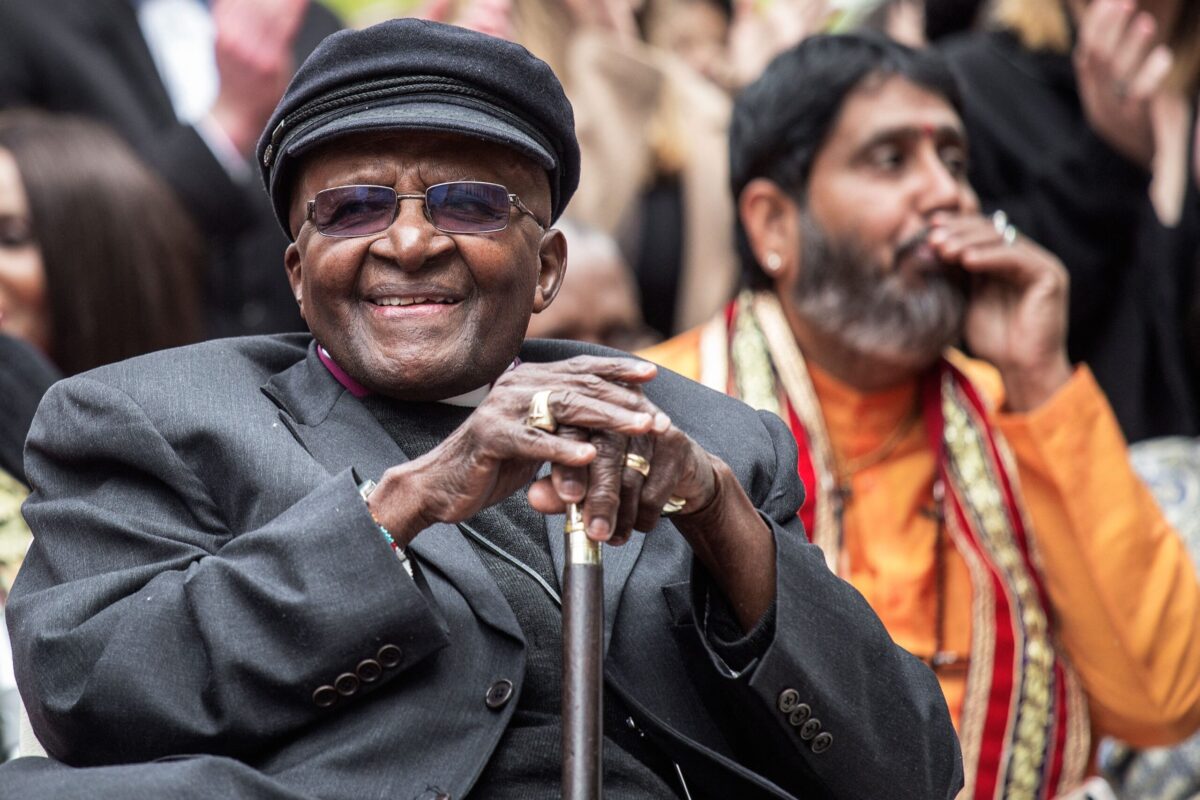
Gianluigi Guercia/AFP via Getty Images
Desmond Tutu, the prominent archbishop, died on Sunday at the age of 90. While his legacy in fighting apartheid in South Africa was rightly heralded in media coverage of his death, his history of troubling comments about Jews was mostly omitted.
Outlets including the Associated Press, NBC News, the BBC, NPR, and CBS News omitted any mention of Tutu’s comments. Those outlets and others also failed to mention that Tutu’s support for the Boycott, Divestment and Sanctions, or BDS movement against Israel. BDS is anti-Semitic, according to the Anti-Defamation League and the American Jewish Committee.
Tutu also minimized and distorted the memory of the Holocaust. He once said that “the gas chambers” during the Holocaust made for “a neater death” than South Africa’s apartheid policies. Such rhetoric is anti-Semitic, according to the International Holocaust Remembrance Alliance, whose working definition of anti-Semitism has been adopted by dozens of countries including the United States.
In 1984, Tutu compared Israel to Nazi Germany by accusing the Jewish state of “collaboration” with South Africa’s apartheid government, which is “carrying out policies that are so reminiscent of Hitler’s Aryan madness.” While Israel unfortunately had ties with the apartheid regime, what was happening in South Africa, while immoral, was nothing remotely close to the Holocaust, which, unlike apartheid South Africa, had concentration and death camps. According to the IHRA, “drawing comparisons of contemporary Israeli policy to that of the Nazis” is an example of anti-Semitism.
In the same speech, Tutu doubled down on comments that were decried as anti-Semitic.
“I was immediately accused of being anti-Semitic,” he said. “I am sad because I think that it is a sensitivity in this instance that comes from an arrogance — the arrogance of power because Jews are a powerful lobby in this land and all kinds of people woo their support.” Alleging that there is, to paraphrase, “a Jewish lobby” echoes the anti-Semitic trope of the Jews controlling institutions and people.
He made similar comments in 2002.
“People are scared in [America] to say wrong is wrong, because the Jewish lobby is powerful, very powerful. Well, so what? Hitler, Mussolini, Stalin were all-powerful, but, in the end, they bit the dust,” he said.
In 1989, at Israel’s Holocaust Remembrance memorial museum, Yad Vashem, Tutu said that the Nazis should be forgiven for the Shoah. “We pray for those who made it happen, help us to forgive them and help us so that we, in our turn, will not make others suffer,” he said.
This rightfully incensed fellow Nobel Peace Prize laureate Elie Wiesel, a Holocaust survivor, who responded, “For anyone in Jerusalem, at Yad Vashem, to speak about forgiveness would be, in my view, a disturbing lack of sensitivity toward the Jewish victims and their survivors. I hope that was not the intention of Bishop Tutu.”
Yes, Tutu should be remembered as a central figure in the struggle against South African apartheid. However, his history of anti-Semitism must not be forgotten.
This is an opinion piece. The views expressed in this article are those of just the author.
New: The Mediaite One-Sheet "Newsletter of Newsletters"
Your daily summary and analysis of what the many, many media newsletters are saying and reporting. Subscribe now!






Comments
↓ Scroll down for comments ↓