Can Gary Johnson Win Over Evangelical Voters Disappointed With Trump?

 III. “I don’t think it’s the government’s job to protect Christianity…”
Johnson “seems to be a voice of humility, honesty, and integrity. As a Christian I really respect and value that in an individual. And I just don’t see that in Clinton or Trump,” Luke Peets, an evangelical Johnson supporter from Monmouth-Independence, Oregon, told me.
Peets’ concern about Trump’s character was echoed by all of the pro-Johnson conservative Christians that I spoke to. In some cases, Trump’s nomination was merely the last straw, as they had long ago grown disillusioned with the direction the social conservative element within the Republican party had taken.
“American liberty was not founded on social issues or social conservatism,” Scrimshaw explained. “The rally call of our founding fathers was liberty,” he said, adding: “I don’t need Christian law passed. I need the liberty to be a Christian.”
“When you use the law of the land, use the force of law to compel other people to live by your values… that’s not a Christian value. That’s not Christ.”
Andy Mahoney is a 36-year-old pastor at Grace Community, a Foursquare church in Oak Harbor, Washington, about two hours north of Seattle. He grew up “immersed in the evangelical world,” where he says he saw the Republican party as his only option. In the last eight years, he became increasingly disenchanted with the direction the GOP had taken.
Regarding the party’s current presidential nominee, Mahoney said, “I’m heartbroken how many self-professed Christ followers have endorsed a man who seems so very un-Christ-like, who have bought what he’s selling.”
Even voters of faith who had dismissed Trump earlier in the race had caved because of party loyalties, he said. “They are so tied in with that party, they are now finding ways to creatively support him, when they were so adamantly against him in the primaries.”
Paul Addis was born and raised in Georgia. Now 49, he lives in Seattle and works as a senior business analyst at Alaska Airlines. He has been a born-again Christian his entire life. “I grew up in the church,” he said. “I’ve been an elder in many churches.”
He had also been a regular Republican voter, save for the times he punched his ballot for Ross Perot in 1992 and Johnson in 2012. He changed his party affiliation to Libertarian in 2014. In May he attended the Libertarian National Convention as a delegate for the state of Washington. At the convention he met Scrimshaw and enthusiastically supported the nomination of both Johnson and Weld.
Despite Addis’ deeply held faith, Johnson’s purported weakness on social issues doesn’t sway him. He told me that he tried to view God’s kingdom and Man’s kingdom as separate entities, pointing to the Gospels of John (“My kingdom is not of this world”) and Matthew (“Render unto Caesar the things that are Caesar’s, and unto God the things that are God’s”). “My concern with the U.S. Government is how much it protects our given rights,” he said, adding that “keeping manmade laws in check” was a guiding principle for him. “The Johnson campaign is more reflective of that belief.”
“When you take your personal belief and try to impose it on others, it’s dangerous,” Addis said. “Christians should change culture through example, through ‘Love thy neighbor.’ Too many Christians are locked on politics as the first point of engagement. That’s where they’ve fallen short.”
Evan Brown is a 22-year-old marketing professional living in Bowling Green, Kentucky, who describes his faith as “pretty conservative on the spectrum of evangelicals.” He is a member of a local Church of Christ and says his moral compass is steered by the Bible and the Constitution. The First Amendment, he avers, provides “not only freedom for me to practice my religion, but the right of others to be free from my religion in politics.”
Brown was a registered Republican and had supported Sen. Rand Paul (a local) during his presidential run this year. Dissatisfied with Trump, Brown switched his affiliation to Libertarian sometime before the GOP convention in July. He is now a volunteer with the Johnson campaign.
Christians were “clinging to the Republican party,” he said. The social conservative movement that opposed gay marriage, opposed abortion in all cases, and advocated for prayer in schools was “a fairly small group” that is “dragging the Right farther right.”
“I left the Republican party this summer because of it. I just couldn’t cope, one, as a Christian, with the temperament of Donald Trump. And I definitely couldn’t cope with the social policies that we were pushing. It didn’t match up with my Christianity, and it didn’t match up with my interpretation of the Constitution either.”
Brett Clarke is a 33-year-old researcher for an appraisal company who has lived in Kentucky his whole life. He is a “very active member” of the Church of Christ, he opposes gay marriage and abortion, and he will be voting for Johnson in November, just as he did in 2012.
Clarke shares Johnson’s distrust of religious liberty legislation and believes that private business owners — such as the proverbial Christian baker – shouldn’t be given cover to duck anti-discrimination laws. “It’s not an endorsement just because you bake a cake or print a t-shirt,” Clarke told me.
The same went for public officials who tried to use their faith as a pretext to forgo their duties. This included Kentucky county clerk Kim Davis, who was jailed for five days last year when she flouted a federal judge’s order to issue marriage licenses, and Alabama Supreme Court Chief Justice Roy Moore, who is currently fighting an ethics complaint for ordering judges to stop issuing marriage licenses to gay couples.
“I don’t fault [Davis] for standing on her conviction, but what I do think is… trying to make everybody else follow her Christian values, you can’t do that,” Scrimshaw said.
“When you accept the job, that’s what you have to do,” Addis said, referring to Davis and Moore.
(In their respective legal battles, Davis and Moore were both represented by Mathew Staver, founder of the socially conservative legal organization Liberty Counsel. Two weeks ago Staver was a featured speaker at a summit of conservative pastors in Florida. The event was widely condemned by liberals as an “anti-LGBT rally.” Trump was in attendance.)
Many worried about the precedent that could be set if Christians enacted their religious beliefs as law, and then other belief systems came to power and passed legislation undermining or persecuting Christians in turn.
“What’s great for the Christian community is not great for the Jewish community or the Muslim community. And what I can do in the name of Christ, someone else a generation later can do in the name of Allah, or can do in the name of whatever — Santa Claus,” Scrimshaw said.
“If today I don’t like what a gay person is doing, tomorrow I have no grounds on which to stand when someone tries to say that I as a Christian can’t do this or that,” he continued.
Brown said, “When we start limiting other freedoms just because we’re in the majority or we’re in power, what happens when we’re no longer… and the people who were put under these oppressive laws gain power?” He added, “It’s a slippery slope.”
“If you don’t subscribe to the Judeo-Christian worldview, it shouldn’t be forced upon you,” Mahoney said. “If we are limiting freedoms of other individuals, it’s only a matter of time before the freedoms that I cherish and hold dear are infringed upon.”
Perhaps the most imposing deal-breaker, however, is Johnson’s stance on abortion. Scrimshaw seems to understand that Johnson’s pro-choice stance makes him immediately unacceptable to wide swaths of Christian voters.
“I will not make this a single issue presidency,” Scrimshaw writes in his open letter. “If abortion is immoral, it is my job as a minister, as a church, to explain why this is immoral and have them make the decision to not have an abortion, to have them make the decision to care for that child.”
“Governor Johnson is not pro-life. But he is also not pro-death,” he writes. “Both Governors Johnson and Weld are pro-Choice but want a pro-life economy,” meaning an economy that provides for the well-being of mothers and children. “We often feel forced to live in an either/or world. This is not doublespeak. Pro-Birth is not the same as Pro-Life. Pro-Choice is not the same as Pro-Death. […] Governor Johnson is definitely not pro-death.” (All links are in the original letter.)
He asks evangelicals to break out of the mold that compels them to vote for Republican candidates simply because they oppose abortion. He points to what he characterizes as Johnson’s fundamental decency, wisdom, and “presence of character,” but concedes that he is “taking this one on faith.”
Clarke said, “As far as the abortion thing goes, I look at that — it is the law of the land. I do think it is wrong.” He added that people would “find a way to do it regardless” of its legal status. “At least at this point it’s safe and it’s my job as a Christian to go talk to somebody and to convince them why I think this is wrong and help them see that. And it’s not the government’s job to do my job.”
“A government big enough to outlaw abortion is big enough to make me do something that I don’t want to do,” he said.
But how many conservative Christians feel that way, and is it enough to make a difference?
Continue reading: “Very few true evangelicals…”
—
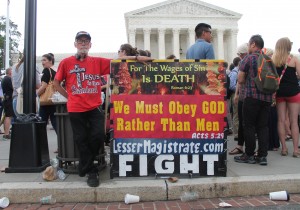
[image: Elvert Barnes, via Flickr]
New: The Mediaite One-Sheet "Newsletter of Newsletters"
Your daily summary and analysis of what the many, many media newsletters are saying and reporting. Subscribe now!








Comments
↓ Scroll down for comments ↓