
Ben Shapiro Actually Blames Philip Seymour Hoffman’s Death on ‘Broken Leftist Culture’

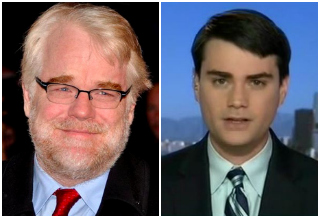
Less than 12 hours after actor Philip Seymour Hoffman was found dead of an apparent heroin overdose in his Manhattan apartment, conservative commentator Ben Shapiro thought it would be appropriate to mark the occasion by attributing his death to America’s “broken leftist culture.” In what could only have been a hastily-produced, 130-word blog post on the National Review’s website, Shapiro briefly praised the actor’s “talent” before using his untimely death to critique those godless Hollywood liberals.
Below is Shapiro’s post in its entirety:
Philip Seymour Hoffman was one of the most talented actors of his generation, a leading man without leading-man looks, an actor whose magnetism onscreen sprang from intelligence and fervor rather than appearance. But his self-inflicted death is yet another hallmark of the broken leftist culture that dominates Hollywood, enabling rather than preventing the loss of some of its greatest talents. Libertarianism becomes libertinism without a cultural force pushing back against the penchant for sin; Hollywood has no such cultural force. In fact, the Hollywood demand is for more self-abasement, less spirituality, less principle, less standards.
No one knows what sort of demons plagued Seymour Hoffman. But without a sound moral structure around those in Hollywood who have every financial and talent advantage, the path to destruction is far too easy.
What is so disturbing about Shapiro’s words is how he admits to knowing nothing about the circumstances surrounding Hoffman’s death and the “demons” that drove him to abuse dangerous drugs. But that doesn’t stop him from jumping to wild conclusions about his “penchant for sin.”
The other major problem with his argument is the way he uses Hoffman to represent “Big Hollywood,” conveniently the name of Breitbart.com’s sister site, where Shapiro serves as editor-at-large. Yes, Hoffman starred in dozens of films, from independent features like The Savages to blockbusters like the latest Hunger Games sequel; and yes, he won a Best Actor Oscar for Capote. But as a dedicated theater artist, he was, in many ways, far removed from “Hollywood” as Shapiro sees it.
RELATED: 8 Unforgettable Philip Seymour Hoffman Scenes
I wonder if Shapiro even knows that Hoffman portrayed the alcoholic Jamie Tyrone on Broadway in Eugene O’Neill’s Long Day’s Journey Into Night back in 2003, a performance I was lucky enough to see live. The director of that production, Robert Falls, told The New York Times how that experience weighed on the actor:
“The theater was very difficult for him. It cost him; there was an emotional cost to the work, having to do it for eight performances a week, and having to rehearse. In ‘Long Day’s Journey,’ a role about an addict who would be dead in a number of years, who was filled with self-loathing, certainly Phil had access to those emotions. But I’m not talking about a method actor. He just brought every fiber of his being to the stage. He was there — with his depth of feeling, depth of humanity — and no other actor I’ve ever worked with ever brought it like that, not at that level.”
Hoffman’s work on stage and screen brought something real and lasting and powerful to all those who watched him work. He clearly struggled with the disease of addiction throughout his short life, for reasons that neither I nor Shapiro nor anyone else who did not know the actor should pretend to understand.
His passing deserves tributes and reflection, not naked political exploitation.
[photos via Wikimedia Commons, screengrab]
— —
>> Follow Matt Wilstein (@TheMattWilstein) on Twitter
This is an opinion piece. The views expressed in this article are those of just the author.





Comments
↓ Scroll down for comments ↓