Time‘s $30 Cover Photo: The Scary Realities of Supply and Demand

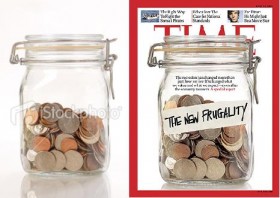
The latest “Destruction of Journalism” debate centers on a Time magazine cover from April announcing “The New Frugality” — a rather meta choice, considering the flap emerging online about the fee Time paid for for the stock photo used: $30.
The photo was taken by one Robert Lam, who goes by “R Studios” on the website Model Mayhem — and that’s exactly what he caused by posting of his cover-shot glory. He says he’s happy — after all, his last paycheck was for $31.50 — but another photog busts the bubble a bit by telling him the going rate for a Time editorial photo:
“…easily $10,000. It may be different now that the economy is in the gutter but Time has a circulation of 3.4 million. Shit, I got paid $500 plus another 10% for a tiny web thumbnail for a single run on the cover of a local rag with a distribution of 70K. My web thumbnail rate was more than your entire 3.4 million cover run which may include foreign editions, reprints, subscriptions cards, and future reproductions. Something is not right about that picture.”
Is $10K really the going rate for a Time cover? Probably not; another photo blog suggested $3,000 and in any case, we’re in leaner times now (alas, a Time spokesperson declined to confirm or deny, saying “we don’t comment on what we pay photographers”). Clearly, $30 is on the, er, lowish end. For an industry used to spending so much on covers that even the focus-group meetings were catered, what does that mean for…now?
Over at Lightstalkers, an online resource site/bulletin board for journalists, photographers, filmmakers, and “professional travelers,” it means be afraid – be very, very afraid. A furious debate is raging over the pittance Time paid for this photo and how that’s a short-term decision undermining the ability of content-providers as a whole to produce — and be paid for — good work.
From the comments:
“Who is the IDIOT that is happy he got paid $30 for a TIME cover? I have had TWO EDITORIAL TIME FRONT COVER STORIES and I can tell you that once the money runs out YOU CAN”T BLOODY EAT THE MAGAZINE! I am sorry but anyone that accepts this kind of payment has absolutely destroyed the viability of this industry.”
…and here, from Photo Business News & Forum:
“Congratulations Robert, you’ve just become the poster-boy for exactly what is wrong about iStockphoto. A stock rate previously known to be $3,000 for the cover of Time Magazine you just sold for $30 – a 99% discount. After all big “wins”, the winner usually gets asked where they’ll go to celebrate. I’d ask you where you’re going with that dough, but you can’t even go to Disneyland, like winners in the past. I know, as I was just in the Disney Store an hour ago buying tickets for the trip I can afford to Disneyland because I don’t make the dream of the profession of stock photography into a nightmare as you have done.
But: Robert pointed out in his initial post that the benefits of a Time cover tearsheet had immense value to him quite apart from a higher payday (even, say, double!). Which is true — the benefits of having a great clip or tearsheet or ongoing platform for visibility are hard to dismiss. More and more, this is becoming institutionalized: On sites like the Huffington Post, Guest of a Guest, Gawker, the Awl (and, yes, this one), certain contributors will gladly offer their content for free in exchange for the platform it gives them (for the eye-rollers out there, NB: Even the New York Times is doing it, via the “Virtual Assignment Desk” for their “The Local” blog). The new realities are different: Barriers to entry are lower, and competition is stiffer in a more crowded field, often with a less-discerning audience. Quality takes money and time; in some cases, it’s just not worth it.
In truth, the new realities in this case aren’t that different than the old realities: It’s not like stock photos have never been used before. That’s why stock photo agencies exist. This photo of a jar full of coins is different than, say, that cover shot of Ann Coulter from a few years back that got almost as much attention as the article. Also, recall that it’s but one element of the cover; as another poster on Lightstalkers says: “This really isn’t a fair discussion unless we know how much Arthur Hochstein, the illustrator who used the stock photo, took home for the cover. I’m guessing it was more than $30.”
Is Time devaluing the worth of photographers? Or is it, like everyone else, straining to find creative ways to maximize budgets that have been slashed to bits? And is this “wrong” or just part of the natural order of things? (Don’t laugh: I remember a similar debate a number of years ago with models griping about the preponderance of celebrity cover girls. They may come with an entourage and an enormous rider, but they don’t cost $10,000 a day. This, according to the NYT just a few weeks ago, is still a big deal.) In the case of a premium model or a premium photograph — or investigative reporting or finely-crafted prose — you’re getting that top-grade quality, but it’s only worth it to you if you want it in the first place. It hurts to hear it, but it’s true, especially these days: sometimes, good enough is…good enough.
This is not to say that it’s acceptable to squeeze content providers just because you can. “Sorry, we just laid off half your co-workers, you’ll have to pick up the slack – if you want to keep your jobs.” I feel like a lot of that went on, especially during that rash of Black Fridays back in the fall (what do you think, Denton?). But – that’s different from being squeezed yourself, or adopting a business model that offers value to contributors apart from money (remember, people upload their videos to YouTube for free, too. It’s a sliding scale from that to video content you’d actually want to pay for).
More to the point, let’s look at who is doing the squeezing here: $30 is an appalling amount for this photo, but that’s an agreement between the photographer and the stock photo agency. (Presumably they charged Time slightly more than that for the shot.) This is not a new business model – marking up your labor is a temp-firm staple – but if there are fingers to be pointed here, they should at least be pointed in the right direction. After that, the question becomes, “should Time be using cheap stock photo images? And how can photographers address that?”
That’s the money question right now: How to find that sweet spot on the supply-and-demand graph between the content you produce and the value it has on the market. There’s a fine – and blurry! – line between paying less for something of lesser value to you, and paying unconscionably low just because you can. In this case, I don’t think Time has crossed it. But hopefully, for his sake, Robert Lam will sign up with stock photo agency that pays a little better.
Time pays $30.00 for cover – Photographer Ecstatic! [Lightstalkers] (via Mike Hudack)
My stock photo on Time magazine cover [Model Mayhem]
Related:
Actresses Are Edging Out Models on Magazine Covers [NYT] (2009)
Models Are Smarter Than Actresses [Slate] (2001)
Cocktails and New Media Dreams [Charitini]
This is an opinion piece. The views expressed in this article are those of just the author.
New: The Mediaite One-Sheet "Newsletter of Newsletters"
Your daily summary and analysis of what the many, many media newsletters are saying and reporting. Subscribe now!







Comments
↓ Scroll down for comments ↓