9 Wildest Accusations Against the DOJ in Comey’s Motions to ’86’ His ’86 47′ Indictment

AP Photo/Andrew Harnik, File
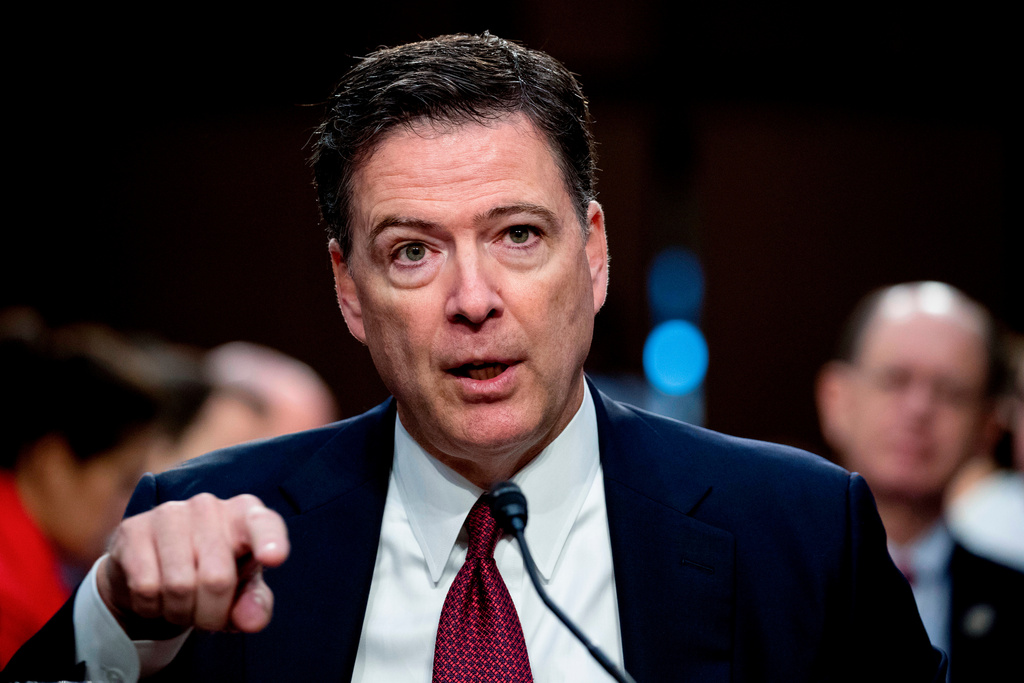
Former FBI Director James Comey is seeking to “86” the indictment for his “86 47” seashell post, listing in court papers numerous examples of allegedly outrageous and egregious behavior by President Donald Trump’s Department of Justice.
A previous 2025 indictment accused Comey of making a false statement to Congress and obstruction of a congressional proceeding. Comey pleaded not guilty and the case was dismissed in November after revelations about the grand jury proceedings — including that the full grand jury never saw the full indictment.
The DOJ took another swing at Comey in April, indicting him a second time for a photo he posted on Instagram with seashells spelling out “86 47.” Legal experts across the political spectrum have panned the case as fundamentally “weak” on both the facts and law.
The meaning of the term “86,” long used in professional kitchens and restaurant lingo as a way to cancel an order or eject someone from the premises, has become a core issue in the case.
Trump and officials in his administration have insisted, both in public statements and in the DOJ’s legal pleadings, that “86” is a “mob term” for committing murder.
The debate over the definition of “86 47” came into sharp focus last month in an unrelated case when federal Judge Randolph D. Moss of the U.S. District Court for the District of Columbia, an Obama appointee, found the National Park Service couldn’t stop a protester from displaying a flag he ordered on Amazon that said “86 47.” Moss issued a temporary injunction, finding the protest flag was protected speech under the First Amendment and it was unreasonable to interpret “86 47” as a “call to violence” against Trump.
Comey’s attorneys similarly invoked the First Amendment in multiple court filings Tuesday evening that the indictment “effectuates a years-long campaign by the President to use the criminal process to punish Mr. Comey for his protected speech and because of the President’s deep-seated animosity,” and listed expansive and detailed allegations that the government investigators and prosecutors involved in his case had crossed many ethical lines.
Below are nine of the wildest accusations in Comey’s motions.
Even former Attorney General Pam Bondi didn’t believe in the case
Former Attorney General Pam Bondi, who was canned in April, reportedly viewed the “86 47” seashells case as weaker than the first, ultimately dismissed, indictment against Comey, and, according to reports, was not on board with pursuing it.
The second indictment was filed within days of Trump appointing Bondi’s second-in-command, Todd Blanche, as acting Attorney General.
“By the time Mr. Blanche became Acting Attorney General, 11 months of investigation into that post had failed to produce sufficient evidence to bring charges,” Comey’s attorneys wrote.
“Investigators had interviewed Mr. Comey and elected not to arrest or charge him, and the Secret Service decided there was no need to open a full investigation. Even Ms. Bondi reportedly believed that the government had no viable case against Mr. Comey.”
The indictment was signed by a rookie
The indictment against Comey was signed by a single prosecutor, Matthew Petracca, “who became an AUSA two days before seeking the indictment,” Comey’s attorneys wrote.
While they noted Petracca had been “at all times professional in his interaction with the defense team, Comey’s attorney’s highlighted his “limited experience in that it is unusual in most circumstances for such a high-profile case to be delegated to a junior attorney.”
The Secret Service was surveilling Comey and tracking his location without a warrant
Comey’s filings included a partially redacted Secret Service report from an agent about tracking Comey’s location via his cell phone as he drove from North Carolina, where he had posted the seashell photo, to his home in northern Virginia.
The agent, whose name was redacted, did not think Comey’s seashells post satisfied the “exigency exemption” — a legal requirement for surveilling someone without a warrant in circumstances of a “threat”:
Since Comey declined to provide his location that night (even though he agreed to meet with us on Friday), [Name redacted] asked me about the possibility of pinging Comey’s cell phone. I said it could be done, but it was a bad idea. To declare an exigency exemption, we needed to believe that there is an imminent threat to life or limb. At that time we did not believe that anyone’s life was in immediate danger and legally it was a bad idea to ping the phone.
The agent described an incoming phone call in which they were “asked how quickly we could ping [Comey’s] phone via exigency if we had to.”
“I said we could do it quickly, but I argued against taking this option,” the agent wrote. “I suggested that pinging the cell phone is legally questionable. [Name redacted] agreed with me but said we might anyway.”
Amazon sells more than 200,000 items with “8645,” “8646,” or “8647”
The prosecution is selective and vindictive, Comey’s attorneys argued, pointing to Amazon to support their argument.
“Amazon’s records show that, from 2017 to May 15, 2025, approximately 209,052 items were available for sale on its ecommerce platform that displayed the numbers ‘8645,’ ‘8646,’ or ‘8647,’” they said in court papers.
The prosecution of Comey “appears to be the first indictment solely for publishing ’86’ in connection with a public official.”
“Indeed, the Secret Service attempted to change its policy regarding ‘8647’ the day after the post precisely because the term had not been treated as a threat to the President before then,” the attorneys added.
The government has declined to prosecute others
Comey’s lawyers highlighted several examples of public figures who “have recently made statements about government officials that were comparable to, or far more violent than, Mr. Comey’s statement here.”
“None was charged,” they added, citing comments from several people including Rep. Paul Gosar (R-AZ); former Trump White House official Steve Bannon, who once infamously described putting Anthony Fauci and then-FBI Director Christopher Wray’s “heads on pikes;” and conservative media personality Jack Posobiec who invoked the “86 46” trope in reference to then-President Joe Biden.
The FBI tried really hard to find evidence and came up empty-handed after multiple search attempts
The FBI searched through its own case file databases and public records seeking to prove a connection between Comey and the use of “86” as a threat, and came up short (citations omitted):
In September 2025, at the request of a prosecutor in the Eastern District of North Carolina, FBI agents searched the Bureau’s Sentinel database — which contains information relating to all FBI open and closed investigations — for any indication of direct association between Mr. Comey and records involving the use of the term “86.” The search yielded “inconclusive results.” In November 2025, the FBI agent who would eventually apply for the at-issue warrants (the “case agent”) requested a review of the FBI’s case file for United States v. John Gambino, a sprawling criminal case involving a six-month trial that Mr. Comey prosecuted in the early 1990s. That file contained no references to the term “86” either…
Meanwhile, FBI agents continued searching for “86” in public records. At the specific direction of the U. S. Attorney, agents searched Mr. and Ms. Comey’s social media accounts for use of the term, which yielded no results. And at the direction of the U.S. Attorney, they also conducted open-source and artificial-intelligence queries of the term “86,” yielding mixed results. For example, an AI-generated search result stated that the theory that the term “86” originated in organized crime was really an “urban legend.”
The key witness against Comey, “Person-1,” showed multiple signs of bias — and thought “86” was a restaurant term”
Person-1 had “immediately perceived” Comey’s Instagram post to convey a violent message, said the DOJ, which portrayed Person-1 “as someone socially connected to the Comeys—and who therefore might have insight into Mr. Comey’s thinking,” Comey’s lawyers wrote, even though Person-1 “had not communicated with Mr. Comey in years.”
Person-1 had an “utter lack of credibility” because of an “express bias against Mr. Comey,” the attorneys argued, noting Person-1 had an admitted wish for “Jim [Comey] goes to jail.” Person-1 also relied on claims made by Rudy Giuliani on his podcast about “86” being found “in transcripts and tapes from organized-crime cases prosecuted by Mr. Comey” that were later “proven untrue” by the very case agent who interviewed Person-1 about Comey’s seashells post.
Person-1 — who also had personal “issues” that led to them having to go to rehab — “first interpreted ’86’ as being ‘out of something on the menu,'” according to the motion.
The FBI turned to a notorious mobster and murderer to bolster their claim “86” was a “mob term”
The FBI “conducted additional interviews and searches to attempt to link Mr. Comey to the claimed organized crime usage of the term ’86′” after Comey was indicted, Comey’s attorneys wrote, even consulting Gambino crime underboss Salvatore “Sammy the Bull” Gravano.
Gambino turned state’s evidence and testified against boss John Gotti; Comey was a prosecutor on one of Gotti’s trials.
Gravano confessed to being involved in at least 19 murders among a long list of other crimes and ended up back in prison for his role in a multimillion-dollar ecstasy drug trafficking ring. Like “Person-1,” Gravano’s comments on “86” were weak proof, Comey’s camp argued:
Mr. Gravano did not recall ever discussing the term “86” with Mr. Comey, or otherwise ever hearing the term uttered in connection with trial. While Mr. Gravano claimed that all law enforcement agents would be familiar with the term’s alternative organized crime meaning referring to murder, he also claimed that a “gangster would never use that term” because they knew that law enforcement knew what the term meant. As with Person-1, Mr. Gravano did not indicate that he understood the seashells post to be a threat by Mr. Comey to carry out violence personally.
That same mobster told the FBI to talk to a former Gotti prosecutor about “86” — and he absolutely stomped on the prosecution’s argument
When the FBI asked Gravano who else might be an “authority” on the use of the term “86,” he urged them to interview former federal prosecutor John Gleeson, who worked two cases involving Gotti before becoming a judge, calling him “brilliant.”
A sworn July affidavit by Gleeson lists his extensive credentials as “an expert on the topic of the jargon used by members and associates of La Cosa Nostra” — more commonly known as the “mafia” — including “the terminology used by such persons to refer to murder.”
As part of his investigations in these cases, Gleeson interviewed “more than 100 members of the mafia,” spent “more than 500 hours with cooperating witnesses,” and reviewed hundreds of hours of recorded wiretapped conversations and secretly bugged conversations between mafia members and associates.
“The claim that ’86’ is mafia jargon for ‘kill’ is preposterous,” Gleeson declared in his affidavit. “If it weren’t made in the context of seeking to deprive a man of his liberty, it would be laughable.”
“The term ’86’ in any form—numerals, letters, written, spoken—is not part of the mafia lexicon at all, let alone used as a reference to killing someone,” he explained. “I have never come into contact with a single recorded conversation where a mafia member uses ’86’ in any way, shape, or form, let alone to refer to killing or murder. Nor have I come into contact with any such reference to ’86’ in my thousands of hours of debriefings and conversations with cooperating witnesses in mafia cases.”
“In short, in my expert opinion, there is literally no support for the central allegation on which the case rests,” Gleeson concluded.
Read Comey’s motions here: Motion to Dismiss for Vindictive and Selective Prosecution; Motion to Suppress and for a Franks Hearing; Motion for Disclosure of Grand Jury Proceedings.
New: The Mediaite One-Sheet "Newsletter of Newsletters"
Your daily summary and analysis of what the many, many media newsletters are saying and reporting. Subscribe now!






Comments
↓ Scroll down for comments ↓