Court Rules Protest Group’s ’86 47′ Flag Is Not Threat of Violence Against Trump

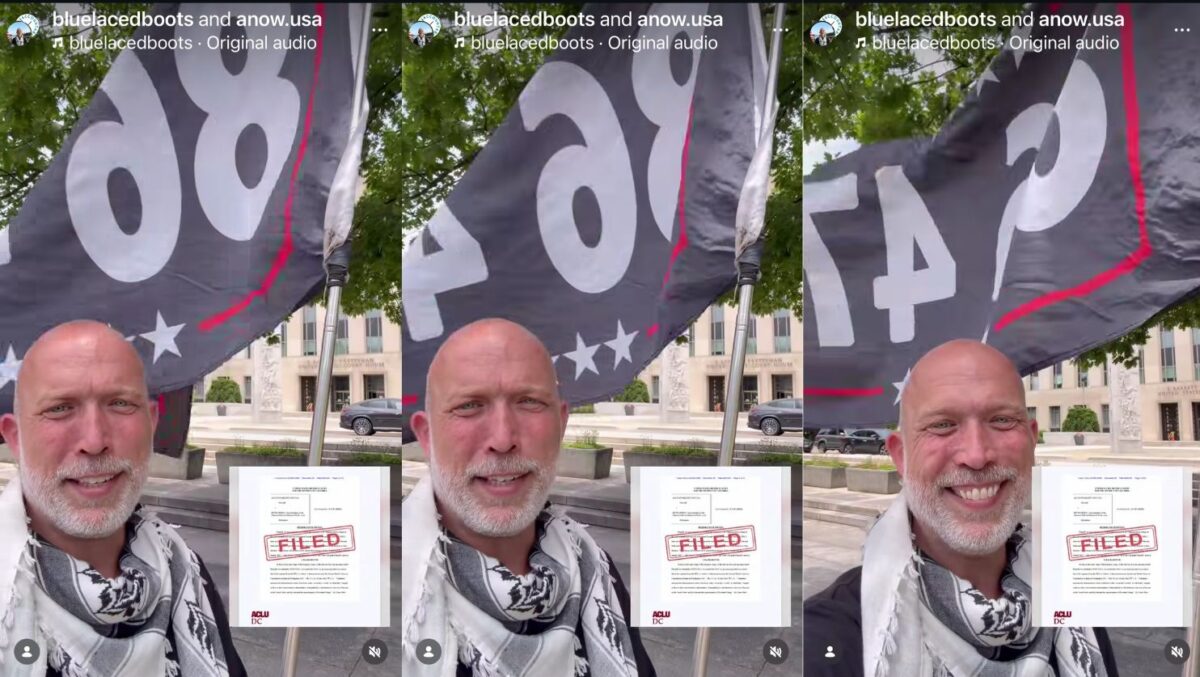
Screenshot via anow.usa on Instagram.
A federal court ruled that the National Parks Service (NPS) cannot block a protest by a group that has been displaying a flag that said “86 47” — the same phrase at the heart of the Department of Justice’s prosecution of former FBI Director James Comey — specifically finding the evidence showed it was unreasonable to interpret it as a “call to violence” against President Donald Trump.
Judge Randolph D. Moss with the U.S. District Court for the District of Columbia, an Obama appointee, issued the 21-page order Monday, granting a temporary injunction to Accountability NOW USA (“Accountability Now”), a group that has been maintaining a 24-7 protest against the Trump administration on Constitution Avenue in Washington, D.C. The group applied for and was granted a permit on April 13, 2026 that was dated as valid through August 12, 2026.
Accountability Now has previously sparred with the NPS over two signs they displayed related to the Epstein Files that had messages saying “TRUMP RAPED LITTLE GIRLS” and “KIDS, IF YOUR PARENTS ARE MAGA, THEY LOVE CHILD RAPISTS.” The group is represented by the American Civil Liberties Union of the District of Columbia and filed a lawsuit against the Trump administration in April, arguing that their First Amendment rights were being infringed and seeking a preliminary injunction to allow them to continue to display the signs while the litigation proceeded.
According to the ACLU’s legal filings, Accountability Now “temporarily removed the signs” to “forestall” any “enforcement action” being taken against them, “including revocation of Plaintiff’s demonstration permit or seizure of [the] signs.”
At some point after filing the lawsuit, Accountability Now’s volunteers began displaying a flag purchased on Amazon that said “86 47” on it.
On April 28, the DOJ indicted Comey for a photo he posted on Instagram with seashells spelling out “86 47.” Legal experts across the political spectrum have panned the case as fundamentally “weak” on both the facts and law. Moss’ opinion does not mention Comey’s case but does point to the common definitions of “86” and similar arguments that have been made to criticize the DOJ’s prosecution.
Moss’ opinion describes a May 12 conversation between a group volunteer holding that flag and a Secret Service officer. The volunteer recorded the conversation; the transcript includes the officer saying that was “fine.”
When the officer asked about the phrase “and what it can stand for,” the volunteer replied that she had “never heard of it standing for anything other than Trump shouldn’t be in office.”
The officer said they had received a call and had to check it out “to make sure there’s no ill-will,” and asked her if she had any “ill-will” towards Trump. She said, “I want Trump to live forever and rot in jail where he belongs.”
About 25 minutes later, two different Secret Service officers approached her and read her the Miranda warnings, which made her worry she was going to be arrested and prosecuted for the flag, Moss’ opinion described. Nothing was done at that time, and the Secret Service investigated for two weeks.
Less than 24 hours after Accountability Now filed the initial injunction motion regarding the signs, four U.S. Park Police cars pulled up to the protest location and an officer read a statement from a clipboard to the group’s volunteer, saying that the government was “looking at the 8647 as a threat against the President” and asked the volunteer to take down the flag. The volunteer did so, was told not to put it back up, and that if the flag was put back up, “then it will be a violation of the permit.”
Accountability Now amended its complaint to add the flag issue and moved for a temporary restraining order to prevent the NPS from “taking enforcement action” against the group for displaying the “86 47” flag.
The judge’s opinion defined the legal issue as a debate between the First Amendment’s requirement for the court to apply strict scrutiny to content-based restrictions to political speech in a public forum, and the lack of such protection for “true threats to the life or safety of government officials.”
“Not every use of the slang phrase ’86’ constitutes a threat of violence; to the contrary, it is most often used to mean that an item is no longer available or that someone or something should be removed, ejected, or thrown out,” wrote Moss. “But it can, in some contexts, mean ‘to kill.'” The opinion cited the Merriam-Webster definition, noting that “86” was “a slang term with no single
meaning” (citations omitted):
The phrase “comes from 1930s soda-counter slang meaning that an item was sold out[,]” and may have been used because it rhymes with “nix.” It was first used as a noun to refer “to an item . . . that had been sold out,” but by the 1950s, the term was used as a verb, at first meaning “‘to refuse to serve a customer,’ . . . later meaning “‘to get rid of; to throw out,’” and still later coming to mean “‘shut out’ or ‘rejected.’”Merriam-Webster further notes that a recent extension of these meanings has included “‘to kill,’” although the dictionary declines to endorse that meaning “due to its relative recency and sparseness of use.” According to Merriam-Webster, “[t]he most common meaning of eighty-six encountered today is the one that is closer to its service industry roots.”
The NPS had provided “no plausible basis to conclude that a reasonable person, aware of the relevant circumstances, would regard the flag to represent ‘a serious expression of an intent to commit an act of unlawful violence to’ the President,'” wrote Moss, and had conceded that “to kill” was not the only meaning of the term.
In this situation, Moss wrote, “the relevant context makes clear that no reasonable observer could have viewed Plaintiff’s display of the flag as a threat to the President’s life or physical safety,” as it was displayed as part of an “ongoing demonstration” advocating for Trump’s impeachment and removal from office via constitutional means, and did not itself contain any “symbols of violence,” as it was “red, white, and blue, and is simply adorned with white stars,” and “contains no knives, skulls, nooses, or other threatening symbols.”
Furthermore, Moss reasoned, there was no evidence that any of the Accountability Now volunteers who had participated in the protests and display of the flag had “engaged in any threatening speech or conduct,” but instead were “cooperative and friendly” when speaking with Secret Service and specifically denied any ill-will.
The Trump administration was trying to “suppress political speech based on nothing more than the unsubstantiated possibility that it might unreasonably be misunderstood as a call to violence,” Moss concluded.
The judge’s order barred the government from revoking Accountability Now’s permit as a result of the display of the “86 47” flag, from ordering the removal of the flag, and from seizing the flag.
“Today, the court recognized that the real threat is a federal government that seeks to punish criticism and trample on our freedoms,” said Laura Follansbee, staff attorney at ACLU-D.C. “Today’s order is a win for everyone’s First Amendment rights. No one should face government retaliation for expressing their political views.”
“We are pleased that the court saw through the government’s baseless accusations about our 8647 flag,” said Anita Carey, organizer with Accountability NOW USA. “We want to lawfully, peacefully, and constitutionally impeach and remove the President from office. We will now resume proudly flying our 8647 flag, and we encourage everyone who agrees with us to do the same.”
New: The Mediaite One-Sheet "Newsletter of Newsletters"
Your daily summary and analysis of what the many, many media newsletters are saying and reporting. Subscribe now!





Comments
↓ Scroll down for comments ↓