Judge Rejects ‘Curious’ Argument from Trump DOJ in Denying Jan. 6 Rioter’s Motion to Get Restitution Fees Refunded

AP Photo/Jose Luis Magana, File
U.S. District Court Judge for the District of Columbia Tanya Chutkan bluntly rejected a January 6th defendant’s argument that President Donald Trump’s pardon should not only wipe out his conviction but also entitle him to a refund of the court-ordered restitution payment he made. The judge’s order also smacked down what she framed as a “curious” argument from the Department of Justice on the issue.
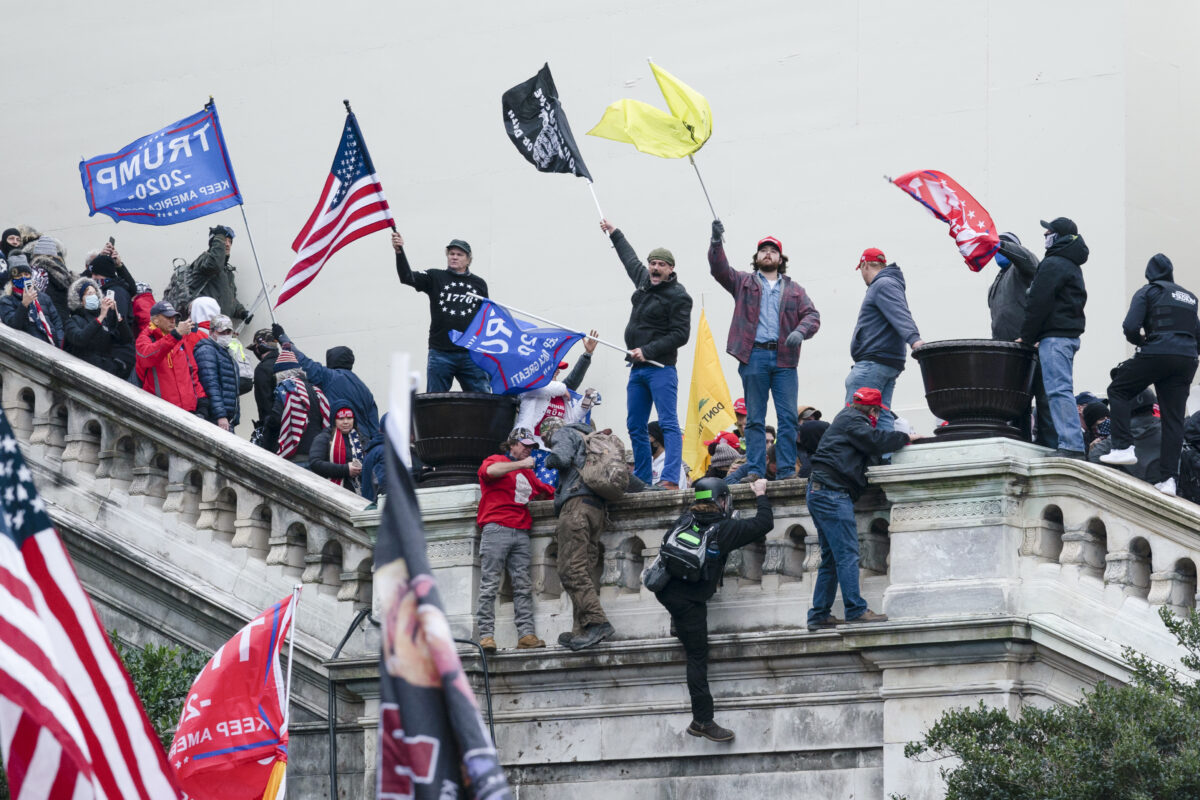
Within hours of his inauguration in January, Trump signed off on sweeping orders regarding those who had participated in the January 6, 2021 attack on the U.S. Capitol, pardoning approximately 1,500 people, commuting the sentences of fourteen more, and directing the Department of Justice to dismiss with prejudice (meaning the cases cannot legally be re-filed) any remaining indictments. The 47th president’s broad grant of freedom applied to nearly all the Capitol rioters, even those charged with or convicted of violently assaulting police officers and the ringleaders of the attack.
According to Chutkan’s three-page opinion and order, Stacy Wade Hager, a resident of Texas, was arrested and charged with four misdemeanors for his actions at the Capitol that day: Entering and Remaining in a Restricted Building or Grounds, in violation of 18 U.S.C. § 1752(a)(1); Count Two, Disorderly and Disruptive Conduct in a Restricted Building or Grounds, in violation of 18 U.S.C. § 1752(a)(2); Count Three, Disorderly Conduct in a Capitol Building, in violation of 40 U.S.C. § 5104(e)(2)(D); and Count Four, Parading, Demonstrating, or Picketing in a Capitol Building, in violation of 40 U.S.C. § 5104(e)(2)(G).
After a two-day bench trial in April 2023, Hager was found guilty of all four count and sentenced to seven months of incarceration for counts 1 and 2, and three months for counts 3 and 4, to be served concurrently. His sentence also ordered him to pay a $70 special assessment fee and $500 in restitution to be disbursed to the Architect of the Capitol, for a total of $570.
Hager appealed his conviction and while it was pending, Trump issued the pardons and so Hager’s case was dismissed pursuant to the president’s executive order.
Chutkan’s order was reported by CBS News justice correspondent Scott MacFarlane.
“Another denial,” wrote MacFarlane. “Judge Tanya Chutkan rejects another Jan 6 defendant’s request for reimbursement of court-ordered restitution to taxpayers.” He highlighted a quote from the opinion in which Chutkan wrote, “A pardon cannot authorize reimbursement once money has been paid to a party.”
Hager’s argument was that since the D.C. Circuit vacated the trial court’s conviction and sentence, he was entitled to a refund of “all restitution and fees” that were imposed under that sentence.
Chutkan noted a “curious position” taken by DOJ prosecutors on this issue not objecting to a refund (citations omitted):
The government concurs, acknowledging that pardons generally do not “make amends for the past” nor do they afford any “relief for what has been suffered by the offender.” But it takes the curious position that in this “unusual situation,” reimbursement is appropriate, id. at 3, and points to Nelson v. Colorado, 581 U.S. 128 (2017) for support. There, the Supreme Court held that “[w]hen a criminal conviction is invalidated by a reviewing court and no retrial will occur, . . . the State [is] obliged to refund fees, court costs, and restitution exacted from the defendant upon, and as a consequence of, the conviction[.]”
This argument was not persuasive, Chutkan decided.
“At least three other judges in this district have denied similar motions where defendants sought reimbursement for fines and fees associated with their now pardoned criminal convictions,” the judge wrote, citing the cases from earlier this year and a Supreme Court case from 1877, Knote v. U.S., in which the nation’s highest court expressly ruled that “a pardoned individual is not ‘entitle[d]’ to payments that have already been deposited into the United States Treasury, absent congressional authorization to withdraw the funds.”
In Knote, Chutkan noted, the Supreme Court held that “a pardon cannot authorize reimbursement once money has ‘been paid to a party to whom the law has assigned them,’ because the party’s ‘rights . . . have become vested, and are as
complete as if they were acquired in any other legal way.'”
“Therefore, this court lacks the authority to order the Architect of the Capitol to refund Hager’s $570,” the judge concluded, stating that “Hager’s Motion for Reimbursement of Fees and Restitution, ECF No. 80, is DENIED.”
New: The Mediaite One-Sheet "Newsletter of Newsletters"
Your daily summary and analysis of what the many, many media newsletters are saying and reporting. Subscribe now!







Comments
↓ Scroll down for comments ↓