SCOOP: Parkland Juror Who Voted Against Death Penalty Wrote Note to Judge Denying She Made Up Mind Before Trial, Called Deliberations ‘Very Tense’

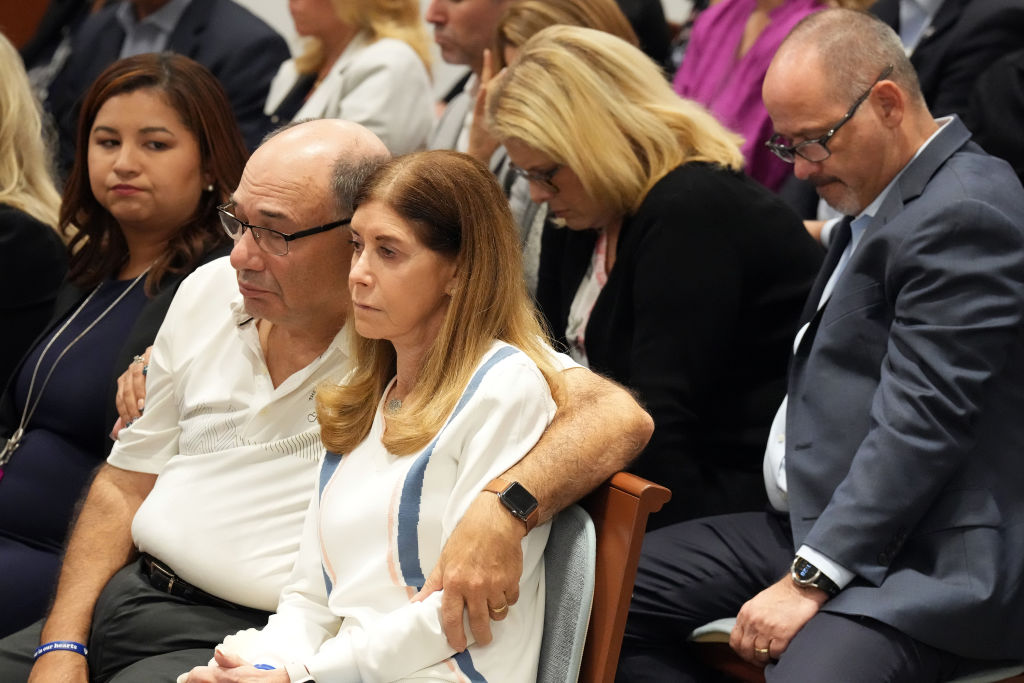
Photo by Amy Beth Bennett-Pool/Getty Images
The jury in the Parkland school shooting case shocked many observers — and outraged the victims’ families — when they issued a recommendation of life in prison without the possibility of parole, forgoing the death penalty for the shooter who killed 17 people and wounded 17 more. A note from one of the jurors that was submitted to the judge reveals some of the tension behind the scenes in the deliberation room, including a denial that she made up her mind before the trial to oppose a death sentence.
Nikolas Cruz was 19 years old on February 14, 2018 when he brought an AR-15 style rifle and multiple magazines onto campus to commit the deadliest shooting at a U.S. high school. [In accordance with the wishes expressed by numerous family members of the victims to not promote the shooter, that is the last time I will mention his name.]
The 17 people whose names should be remembered are, in alphabetical order, 14-year-old student Alyssa Alhadeff, 35-year-old teacher Scott Beigel, 14-year-old student Martin Duque Anguiano, 17-year-old student Nicholas Dworet, 37-year-old assistant football coach Aaron Feis, 14-year-old student Jaime Guttenberg, 49-year-old athletic director Christopher Hixon, 15-year-old student Luke Hoyer, 14-year-old student Cara Loughran, 14-year-old student Gina Montalto, 17-year-old student Joaquin Oliver, 14-year-old student Alaina Petty, 18-year-old student Meadow Pollack, 17-year-old student Helena Ramsay, 14-year-old student Alexander Schachter, 16-year-old student Carmen Schentrup, and 15-year-old student Peter Wang.
The shooter, now 24 years old, confessed and pled guilty to 17 counts of murder and 17 counts of attempted murder, so the trial only focused on the potential sentence. Under Florida law, first-degree murder has two possible penalties — the death penalty or life in prison without the possibility of parole — and the jurors must be unanimous in order to recommend the death penalty, balancing between mitigating circumstances presented by the defense and aggravating factors presented by the prosecution.
In the end, for each count against the shooter, the jurors did find that the crime was eligible for the death penalty and the state had proven the aggravating factors beyond a reasonable doubt but “one or more jurors” had found that the mitigating circumstances outweighed those aggravating factors.
Broward County Circuit Judge Elizabeth Scherer will make the final decision on sentencing at a hearing scheduled for Nov. 1, but cannot legally stray from the jury’s recommendation of life without parole.
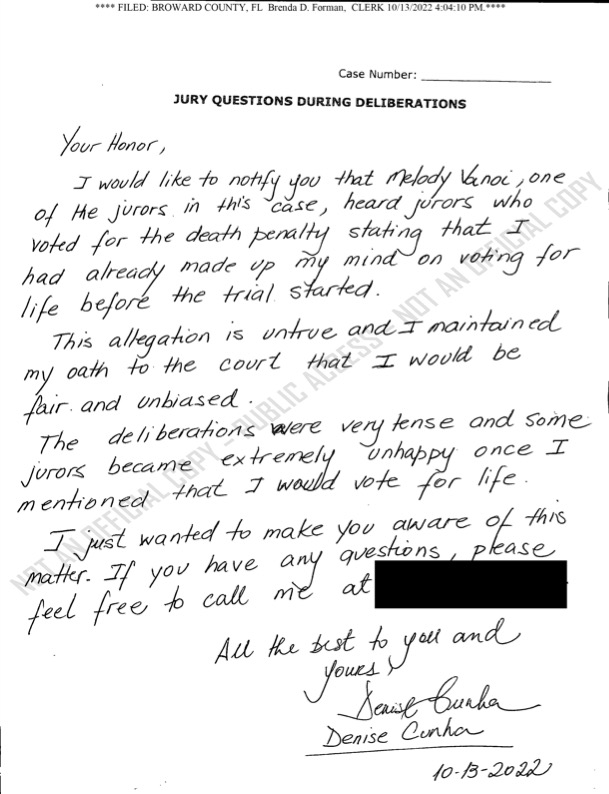
Scherer received a note from juror Denise Cunha after the verdict was issued and filed it in the public court docket Wednesday afternoon after redacting her phone number. The note stated as follows:
Your Honor,
I would like to notify you that Melody Vanoi, one of the jurors in this case, heard jurors who voted for the death penalty stating that I had already made up my mind on voting for life before the trial started.
This allegation is untrue and I maintained my oath to the court that I would be fair and unbiased.
The deliberations were very tense and some jurors became extremely unhappy once I mentioned that I would vote for life.
I just wanted to make you aware of this matter. If you have any questions, please feel free to call me at [number redacted].
All the best to you and yours,
Denise Cunha
10-13-2022
As stated above, Florida law requires the verdict to be unanimous in order to impose the death penalty. Ryan Petty, the father of Alaina Petty, told Mediaite that one of the prosecutors told him that the poll of the jurors revealed that the vote was 11-1 for death, with one sole holdout for life. Cunha’s note indicates she was the sole holdout.
This contradicts a comment by jury foreman Benjamin Thomas to CBS Miami. According to Thomas, there was “a specific juror” who said she believed the shooter was “mentally ill, and she didn’t believe because he was mentally ill that he should get the death penalty.”
“There was one with a hard no — she couldn’t do it — and there was another two that ended up voting the same way,” Thomas added, which may refer to Cunha as that original “hard no” holdout, but he did not identify anyone by name.
“I fully understand” people who were unhappy with the verdict, said Thomas, noting that he himself had voted for the death penalty and was disappointed. “It didn’t go the way I would’ve liked or the way I voted, but that’s how the jury system works.”
Thomas added that the jury had deliberated for nearly seven hours on Tuesday before adjourning for the evening, with the jurors’ minds largely made up but several expressing a desire to “sleep on it” before making a final decision. He described the case as “awful,” and “a lot of things you never wanted to see and you never want to see again,” and expressed his sympathy for the victims’ families. “It hurts.”
Mediaite reached out to the Broward County State Attorney’s Office for comment and will update this article if we receive a response.
UPDATE 6:15 PM ET: The Broward SAO public information officer Paula McMahon replied by email and stated that was “still a pending case and we are not commenting beyond what was stated” in the comments by State Attorney Harold F. Pryor at the media conference. The text of Pryor’s statement is linked on the office website.
Below is an image of Cunha’s note as filed in the court docket:
This is a breaking story and has been updated with additional information.
New: The Mediaite One-Sheet "Newsletter of Newsletters"
Your daily summary and analysis of what the many, many media newsletters are saying and reporting. Subscribe now!





Comments
↓ Scroll down for comments ↓