Trump DOJ’s Own Witness Said Reflecting Pool Had ‘Substantial Preexisting Damage’ Before Alleged Vandal Touched It

AP Photo/Mark Schiefelbein
Lawyers for David Hearn, the former Olympian who was arrested and accused of vandalizing the Reflecting Pool, filed a motion Monday citing key testimony they say supports dismissing their client’s case — from a witness for the prosecution.
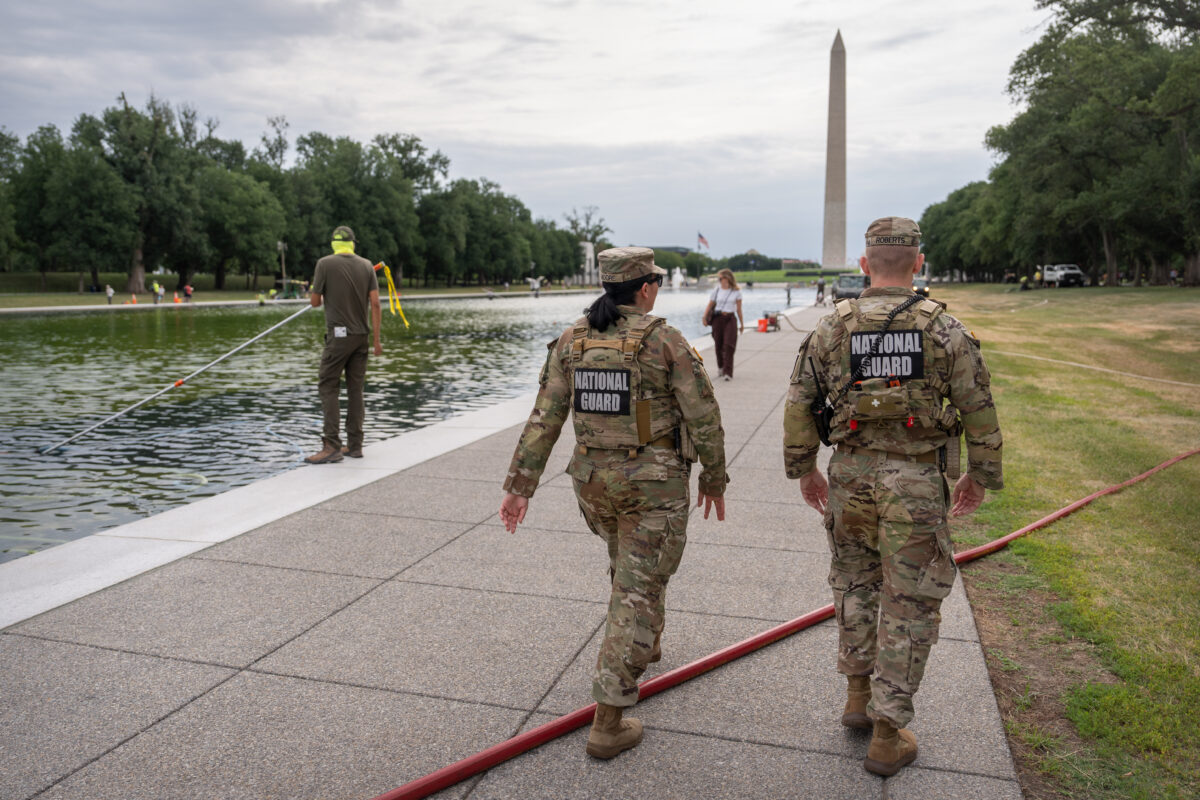
President Donald Trump has been infuriated by the troubles plaguing the work he has directed for the Lincoln Memorial Reflecting Pool, including bright green algae and peeling paint. Trump and others in his administration have claimed the problems have been caused by vandals; these claims have been met with much skepticism by the media and local D.C. residents, but several arrests have been made nonetheless.
One of these arrests was Hearn, who was hit with a charge for destruction of government property when he stopped at the Reflecting Pool to check it out after a bicycle ride.
Hearn has maintained his innocence, telling The Washington Post, “I reached in there, and I was able to grab the end of that flapping piece, the already peeling piece. It was still attached to the bottom. I didn’t remove anything.”
“I didn’t vandalize anything,” he insisted. “I didn’t destroy or break or peel anything. By the time I realized what was going on, I was being put in handcuffs.”
Norm Eisen with the group Democracy Defenders Fund, Mary Dohrmann with the Washington Litigation Group, and Steve Levin from Steptoe LLC are representing Hearn, who pleaded not guilty earlier this month.
In a motion filed on Monday, Hearn’s attorneys sought the disclosure of “the legal instructions provided to the grand jury concerning the elements of the charged offense” against their client, because they were challenging whether the grand jury was given “legally sufficient evidence” and “was properly instructed” on an “essential element” of the charge, specifically the “amount of loss.”
The felony charge against Hearn requires the government to show damages of $1,000 or more, the attorneys noted, and a misdemeanor charge requires showing damage of “some value.”
But that’s not what the witness presented by prosecutors with Trump’s DOJ, a National Park Service official, said in his testimony, the lawyers argued; they were given a copy of his transcript as part of the prosecution’s required document production.
“Here, based on the discovery provided to date, the Government’s sole grand-jury witness on damages testified that the property was already damaged before Mr. Hearn allegedly touched it; that the same repairs would have been required regardless of Mr. Hearn’s conduct; and that he could not quantify any loss attributable to that conduct,” they wrote.
This sole witness’ testimony “raises a substantial question whether the grand jury had legally sufficient evidence of the loss element necessary, to support the indictment and whether the grand jury was properly instructed on that element,” the attorneys continued, adding that “other irregularities in the government’s presentation of the evidence to the grand jury further call into question whether the grand jury was misled in a manner that substantially influenced the decision to indict and prejudiced Mr. Hearn.”
The motion noted that grand jury proceedings are not normally disclosed and are “presumptively secret,” but a defendant in a federal criminal case can move to have them disclosed if it can be shown that “a ground may exist to dismiss the indictment because of a matter that occurred before the grand jury.”
The lawyers clarified they were seeking to determine one issue: “whether the grand jury was correctly instructed on the legal measure of the loss element that elevated this charge to a felony.”
That one issue is a critically important one, because it can be enough to get the entire case dismissed. Hearn’s lawyers cited case law precedent finding that dismissal is warranted if there is a “material error or omission in the legal instructions given to a grand jury…where the error substantially influenced the decision to indict or created grave doubt that the decision was free from that influence.”
The key with a charge of malicious destruction of property, the lawyers argued, is that the damages are calculated based on restoring the property to the condition it was “immediately before” the alleged conduct by the defendant occurred, and not the “cost of remedying every defect found in the property” afterwards.
The National Park Service official who testified before the grand jury was the “sole witness concerning loss,” the lawyers wrote, but “did not identify or quantify such a loss.”
The NPS official testified the pool “had substantial preexisting damage requiring repair before any alleged conduct by Mr. Hearn,” the motion stated — including “leaking more than one million gallons of water per week; its expansion joints had exceeded their service life; and the liner already contained a rip” — but “could not identify the repairs necessary to address damage allegedly caused by Mr. Hearn.”
According to Hearn’s lawyers, the government had claimed an “estimated repair range” of “$6,000 to $15,000,” but the NPS official was not able to attribute any of that to Hearn, or otherwise “identify any additional cost caused by Mr. Hearn’s alleged conduct.”
“Indeed, the witness did not even say or suggest that the alleged conduct had compromised the liner at all,” the lawyers added, and he “never quantified or otherwise testified to the cost of damage allegedly attributable to Mr. Hearn.”
Therefore, the attorneys argued, “[t]he grand jury received no evidence identifying the discrete portion of repair costs — if any — attributable to Mr. Hearn, much less a felony-level loss amount.”
The DOJ also failed to show the grand jury a photo taken by Hearn before he touched the Reflecting Pool, which the government acknowledged was taken beforehand and his attorneys are arguing “proves that he caused no damage to the pool.”
These discrepancies raised “critical questions” about what instructions the DOJ gave the grand jury, Hearn’s attorneys argued, making reference to other recent cases under the “current Executive Branch leadership” (in other words, the Trump administration) where “fatal improprieties” with the government’s grand jury conduct have been found, resulting in the “historic presumption of regularity” the federal courts had previously granted to the DOJ now being “thoroughly eroded by current Department leadership.”
New: The Mediaite One-Sheet "Newsletter of Newsletters"
Your daily summary and analysis of what the many, many media newsletters are saying and reporting. Subscribe now!




Comments
↓ Scroll down for comments ↓