Reflecting Pool Is Now Under Siege by a Different and More ‘Aggressive’ Form of Algae: Report

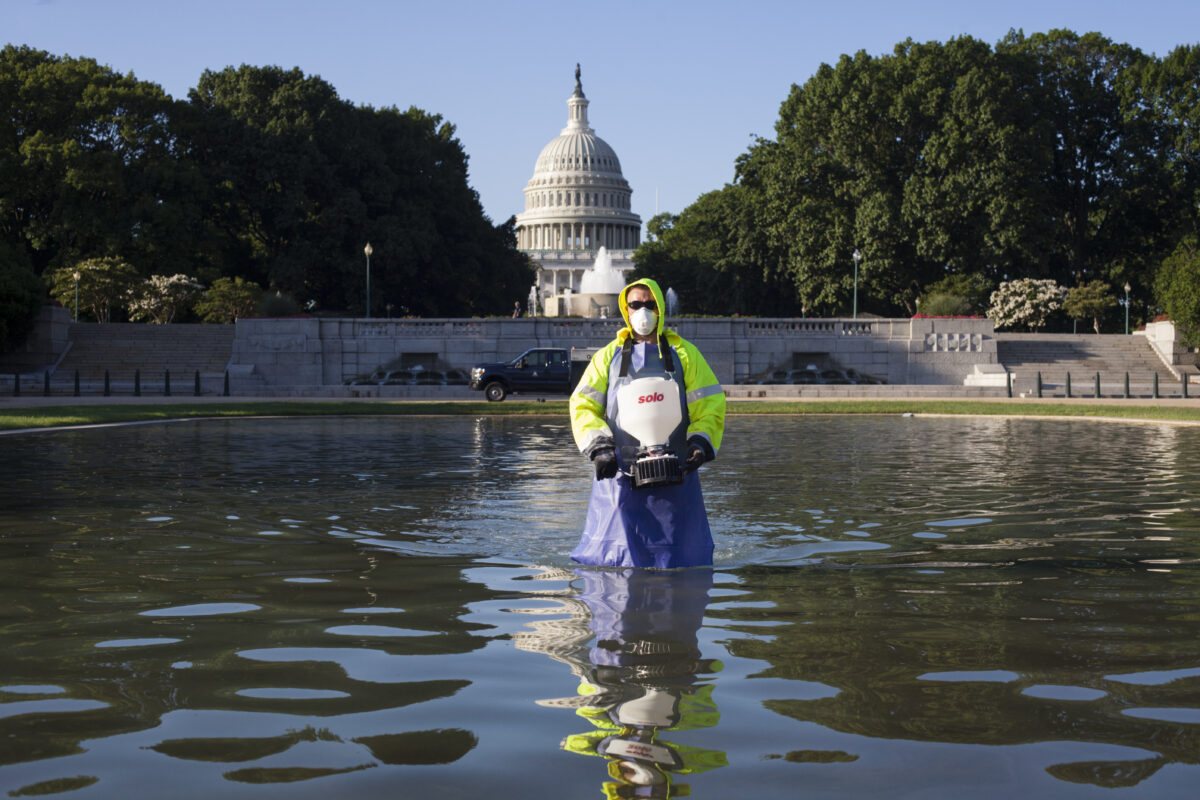
AP Photo/J. Scott Applewhite
President Donald Trump’s $14 million renovation project at the Lincoln Memorial Reflecting Pool is not going well. In fact, the efforts to kill off the algae are apparently helping foster a new, even more aggressive algae, according to tests conducted by a reporter for The Atlantic.
Trump’s decision to drain the pool and paint the bottom “American Flag Blue” has been criticized for its cost, plus the no-bid contract for the work. Since the pool was refilled, bright green algae spread throughout the water and the paint has been peeling away. Reporters have seen tourists tearing off pieces of the paint to bring home as souvenirs.
The government has sent out work crews to try and combat the algae through various means, including “hydro-vacuums” and pouring hydrogen peroxide into the water. That appears to have been an inadequate fix, only killing off some of the algae along the outer edges of the Reflecting Pool and possibly even causing or exacerbating the peeling paint.
But the problems caused by the hydrogen peroxide don’t end there, wrote Matt Viser for The Atlantic on Friday.
Viser had observed the Reflecting Pool on several different days recently, watching tourists grab their souvenirs and government workers wading through the water making various attempts to remove the algae, noting that the water was “relatively clear” in some sections, an “oily sludge” in others, and multiple shades of green from the algae in others.
He asked multiple people with the National Parks Service, official spokespeople and the workers on site, about the progress of the algae removal, and could get answers neither about the work nor if any of the algae species present were toxic — a nontrivial matter, since local wildlife, tourists, and locals have been touching the water.
The Atlantic decided to run its own tests on the water. Viser gathered samples from multiple areas of the Reflecting Pool, and brought them to two different scientists for testing.
“Testing reveals that efforts to suppress one algal bloom seem to be fueling another,” wrote Viser, and the “workers battling against nature” in “the country’s most high-profile science experiment” may actually be making things worse.
“After a week of combat,” wrote Viser, “they have essentially killed off one type of algae infesting the pool, only to create the conditions for a new type to take over. And Scenedesmus, a genus of green algae nicknamed ‘Skinny Dead Mouse’ by scientists, is now flourishing,” according to the tests they ran.
The original algae that showed up in the Reflecting Pool “appeared to be a blue-green cyanobacterial bloom,” wrote Viser, and that type can sometimes produce neurotoxins that are dangerous for humans and animals.
One of the scientists who tested the samples was Hans W. Paerl, a professor of marine and environmental sciences at the University of North Carolina at Chapel Hill. Paerl examined the samples under a microscope and found “remnants of the previous bloom” of the blue-green algae, “but they were too degraded to identify,” wrote Viser, and he believed this was caused, at least in part, by the hydrogen peroxide.
“The guys dealing with peroxide treatment can pat themselves on the back,” said Paerl. “But it doesn’t really solve the overall problem.”
“What’s happened is they’ve just switched the players. And the green algae are just taking over,” Paerl explained, and this new green algae “is a pretty aggressive grower.”
Greg Boyer, a professor emeritus of biochemistry at the State University of New York, concurred, telling The Atlantic he had “never seen it bloom quite this thick.” Boyer’s testing found similar results of “little to no blue-green algae,” wrote Viser, but that could change over the next few weeks. Currently, we were in “peak season for green algae,” said Boyer, and “pretty early in the season for blue-green algae.”
Both scientists also told Viser that the treatments the NPS was using to attempt to fight the algae, hydrogen peroxide and nanobubble technology, were more effective against the blue-green algae, not the green algae that was currently dominating.
The Reflecting Pool itself was already an ideal environment for algae, Boyer said.
“If I was going to design a facility to grow algae,” Boyer explained, “I would probably design a facility that had a lot of surface area and was very shallow, so you have sunlight down to the bottom. And put a lot of nutrients in it. And that’s pretty much what the Reflecting Pool is. It’s just a perfect facility for growing algae.”
The deep blue paint that Trump had added only made it worse, wrote Viser, because it “raised the water temperature and accelerated the growth.”
“The water will probably remain green for the foreseeable future,” said Paerl.
New: The Mediaite One-Sheet "Newsletter of Newsletters"
Your daily summary and analysis of what the many, many media newsletters are saying and reporting. Subscribe now!








Comments
↓ Scroll down for comments ↓