
ONE SHEET: The FCC Responds to US Autocracy Findings — Plus MS NOW Hits Shuffle

The Big Picture
Democracy researchers are sounding alarms about the speed of American democratic backsliding, and the newsletter class is paying close attention — though perhaps not close enough. Meanwhile, MS NOW reshuffles its daytime lineup in a move that has talent agents scrambling and skeptics reaching for Titanic metaphors. Wall Street is souring on the Ellison-Warner Bros. Discovery mega-merger, with analysts calling it “dead money.” And Disney’s baton pass is complete: Josh D’Amaro moves into the sixth-floor office, Bob Iger finally vacates, and a new era begins — for better or worse.
Today’s sources: Status | CNN Reliable Sources | Puck | The Ankler | Page Six Hollywood | Politico Playbook | To the Contrary | Newsbusters | Nieman Lab | Feed Me | Noahpinion | Media Voices | Poynter | CJR | Tubefilter
Top Story
RESEARCHERS FIND AMERICA IS AUTOCRATIZING. THE FCC: HOLD MY BEER.
Two major democracy research outfits dropped their annual reports this week, and the findings landed like a thunderclap across the newsletter world. The Sweden-based V-Dem Institute declared the United States is “rapidly autocratizing,” citing the suppression and intimidation of media and dissenting voices as a primary driver. The US has lost its status as a liberal democracy, V-Dem found, sliding from 20th place to 51st on its liberal democracy index — falling back to 1965 levels. Freedom House, whose annual report dropped Thursday, gave the US a score of 81, its lowest since the organization began using its 100-point scale in 2002, a 3-point decline in a single year. Both reports specifically identify pressure on the press as a central mechanism of democratic decay. Both dropped in the same week that the news obliged with a pair of object lessons.
Brian Stelter in CNN Reliable Sources leaned into the clinical weight of the V-Dem findings, quoting V-Dem founder Staffan Lindberg: the current backsliding is “the most severe magnitude of democratic backsliding ever in the country” in data going back to 1789. Stelter noted that free speech rights are “often the first ‘domino’ to fall when countries autocratize” — and that media self-censorship is a growing concern in nearly 40 countries, including the US. He valued the report specifically because it’s data-driven rather than polemical: “Words like ‘autocrat’ are often thrown around in political contexts, but this is something different.” Stelter also flagged the VOA ruling, in which a federal judge ordered the Trump administration to restore more than 1,000 sidelined Voice of America employees to work by next week — ruling that Kari Lake‘s shutdown of the outlet was “arbitrary and capricious.” VOA’s website has been frozen for a full year. The administration is expected to appeal.
Politico Playbook synthesized both reports with original polling, noting the US lost Freedom House points across three distinct areas: Congressional dysfunction, weakened anti-corruption safeguards, and reduced freedom of expression through the targeting of non-citizens over speech. Playbook quoted democracy scholar Larry Diamond of Stanford’s Hoover Institution: “When they’re all pointing in the same direction… I think you have to take it very, very seriously.” The White House pushed back predictably, with assistant press secretary Olivia Wales calling V-Dem “a ridiculous claim made by an irrelevant, blatantly biased organization.”
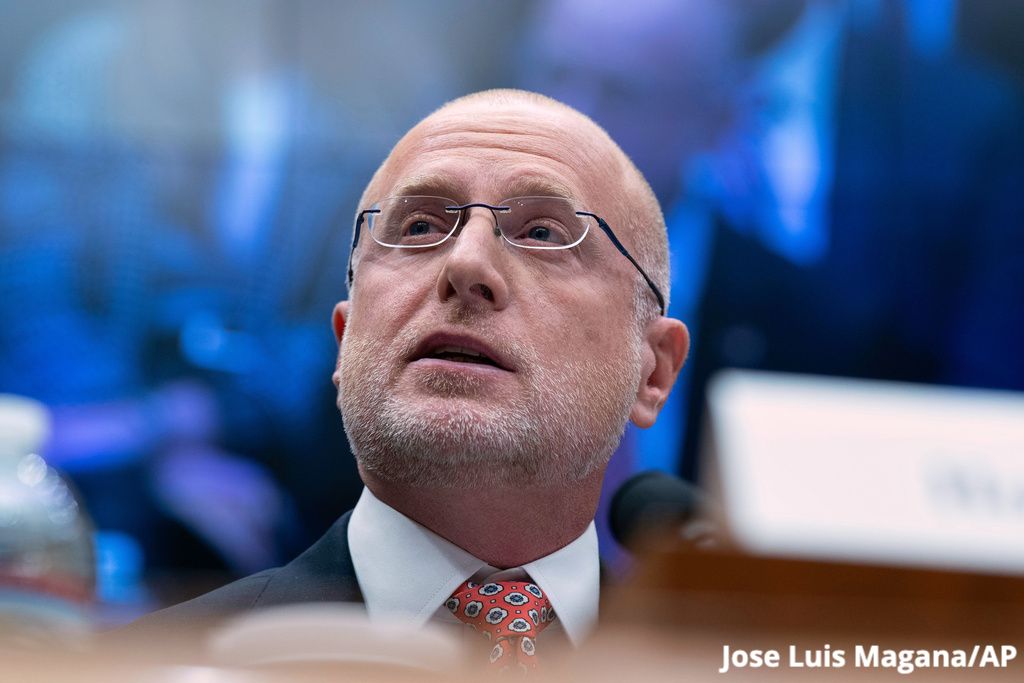
Meanwhile, Poynter’s Tom Jones was documenting the other object lesson in real time. FCC chairman Brendan Carr went on a podcast this week to tout his “Pledge America” campaign — pressuring broadcasters to run patriotic programming, starting with the Pledge of Allegiance — and praised Nexstar and Sinclair for refusing to air Jimmy Kimmel‘s show last year after Charlie Kirk‘s assassination. Carr called it “the first sign in many, many years of a local TV station actually pushing back on New York and Hollywood.” This from the same regulator who days earlier amplified Trump’s social media post appearing to threaten broadcast license revocations over Iran war coverage. Jones called it what it is: state TV by another name. The International Press Institute, cited by Status, called Carr’s license threats “a weaponization of the FCC against the media” and a threat to the First Amendment.
Charlie Sykes in To the Contrary came at the same story from a different angle entirely — using Trump’s furious NATO rant (“WE DO NOT NEED THE HELP OF ANYONE”) as a real-time illustration of what democratic backsliding actually looks like in practice. Where Stelter and Playbook cited the data, Sykes cited the behavior: a president raging at allies he spent a year alienating, losing control of events, bluster substituting for strategy. “This is what America Alone looks like,” Sykes wrote.
TAKEAWAY: The reports land, the White House calls them biased, and the same week the FCC chairman is on a podcast pressuring broadcasters toward state-approved content. The newsletter class covered the indices as a political story. They are also a press freedom story — and the press freedom story is happening right now.
Three Takes
MS NOW HITS SHUFFLE
MS NOW president Rebecca Kutler announced a sweeping daytime overhaul Wednesday, reshuffling anchors across virtually every daypart. Stephanie Ruhle moves to a new 9–11 a.m. block. Ali Velshi takes over The 11th Hour. Morning Joe shrinks back to three hours. Luke Russert joins The Weeknight. Alicia Menendez gets her own midday program. Ana Cabrera announced her exit shortly after. The 11 a.m. slot was conspicuously left unfilled — and within minutes, talent agents were flooding MS NOW’s phones.
Status (Natalie Korach, with Oliver Darcy reporting the initial scoop) had the inside game: leadership fielded more than a dozen calls from agents within hours of the announcement, as talent reps smelled opportunity in the unfilled 11 a.m. hour. Status also had the Kutler memo framing — “Overall, we expect to have more people working at MS NOW by the end of 2026 than we do today” — positioning the overhaul as expansion, not contraction.
Puck (Dylan Byers) was more skeptical. “Sure, it’s all deck chairs on the Titanic, etcetera, etcetera,” Byers wrote, before noting that Kutler is “a programmer at heart” and that this is “perhaps the best way to structure the roster given the available talent.” Byers flagged the real thing to watch: MS NOW’s new licensing deal with Crooked Media, which initially airs Saturday nights but could eventually migrate to weekdays.
Newsbusters (Nicholas Fondacaro) framed the shakeup as damage control for a struggling network, headlining the story “Rating MS DOWN?” Fondacaro noted that after being “cast out into the wilderness by NBCUniversal last year, things didn’t appear to be going well for the rebranded ‘MS NOW,'” and characterized the changes as two anchors losing their seats and Morning Joe “experiencing some shrinkage.”
TAKEAWAY: The real story here isn’t which anchor goes where — it’s that nobody can agree on whether MS NOW is rebuilding or rearranging. Kutler is betting on the former. The ratings will adjudicate.
📰 Top Reads 📰
Puck, Dylan Byers
ALLBRITTON IS BACK, AND D.C. IS SWOONING (AGAIN): Robert Allbritton, the boyishly ebullient heir who bankrolled Politico and sold it to Axel Springer for $1 billion in 2021, is doubling down on NOTUS — his fledgling D.C. political news startup — with plans to double its 50-person staff this year, starting with three reporters poached from The Washington Post. Byers is skeptical: Allbritton was “the money, not the operator” at Politico, whose success was driven by Jim VandeHei, John Harris, and Mike Allen. His two subsequent solo ventures — hyperlocal site TBD and tech-news site Protocol — both folded within two years. “Building a political news business is hard,” Byers notes, and the market that Politico once disrupted is now crowded with Axios, Punchbowl, Semafor, and Puck itself. Meanwhile, Semafor’s Max Tani — cited by Byers — reports Allbritton has applied to trademark “The Washington Sun,” suggesting a rebrand is coming for the unfortunately pronounced NOTUS. … QUOTE (unnamed media executive): “His one digital success was a brainchild of others and his TV success was inherited from his father.” … QUICK TAKE: D.C. loves a billionaire with a checkbook and a grudge. Byers’ actual point is sharper: the market Allbritton disrupted the first time is now full of his former employees doing the same thing better.
The Ankler, Claire Atkinson
WALL STREET TO ELLISON: WE’VE SEEN THIS MOVIE: Paramount Skydance stock has lost nearly 14 percent in the past week and is down 35 percent since the WBD deal was accepted. Investors aren’t treating David Ellison‘s $111 billion mega-merger as a bold vision — they’re treating it as a highly leveraged gamble. The combined company will carry $79 billion in net debt. Fitch has already downgraded Paramount Skydance debt to junk status. One major media investor told Atkinson bluntly: “This should not be a public company. It has too much debt. It’s too hard.” Analyst Hal Vogel used the phrase “dead money for investors” in a note this week, suggesting gold or copper instead. Meanwhile, Gulf state sovereign wealth funds — committed to $24 billion in Paramount — are reportedly reviewing their commitments amid the Iran war’s economic disruption, and Larry Ellison has yet to even schedule an investor roadshow. … QUOTE (Vogel): “How do you cut $6 billion and not destroy the company, the relationships in Hollywood? The whole organization is going to be upset.” … QUICK TAKE: David Ellison convinced a board. He still has to convince a market — and right now, the market isn’t buying.
Status, Natalie Korach
HUFFPOST IN LIMBO AS BUZZFEED TEETERS: After BuzzFeed disclosed it may not have enough liquidity to continue operating over the next year — “substantial doubt about the Company’s ability to continue as a going concern” — Status went inside HuffPost to find a newsroom rippling with anxiety. Staffers told Status the announcement raised fresh questions about ownership and long-term viability, though one noted that “after multiple rounds of staff cuts, the uncertainty is nothing new.” HuffPost cut 30 editorial roles last year — roughly 22 percent of its newsroom. A person familiar with company thinking told Status that HuffPost remains an important contributor to BuzzFeed’s profitability and that leadership is not planning imminent cuts — but that a minority-stake financial partner could be one path forward. … QUOTE (anonymous HuffPost staffer): “I don’t know any journalist who feels particularly great about their job security.” … QUICK TAKE: HuffPost spent a decade telling the media industry that viral was a business model. Now it’s waiting to find out if anyone wants to buy what’s left.
CNN Reliable Sources, Brian Stelter
JUDGE ORDERS VOA BACK ONLINE: A federal judge ordered the parent agency of Voice of America to return more than 1,000 sidelined employees to work by next week, ruling that Kari Lake‘s efforts to dismantle the outlet were “arbitrary and capricious.” VOA’s website has been frozen since March 15, 2025. VOA director Mike Abramowitz — whom Lake tried to fire last summer — told staffers in an overnight memo that “the lawyers are still digesting today’s ruling.” The Trump administration is expected to appeal. … QUOTE (Abramowitz): “It is time for all parties to come together and work to rebuild and strengthen the agency.” … QUICK TAKE: VOA’s website has been frozen for a year. A court order says restore it. Whether a year of silence can be undone with a gavel bang is a different question.
Poynter, Tom Jones
THE FCC WANTS YOU TO PLEDGE ALLEGIANCE: FCC chairman Brendan Carr appeared on the “Pod Force One” podcast this week and outlined what he called a “Pledge America” campaign — inviting broadcasters to run “patriotic programming,” starting with the Pledge of Allegiance, in honor of the country’s 250th anniversary. Carr also praised Nexstar and Sinclair for refusing to air Jimmy Kimmel‘s show last year following Charlie Kirk‘s assassination, calling it “the first sign in many, many years of a local TV station actually pushing back on New York and Hollywood.” Jones didn’t mince words in his assessment: the FCC head is pushing for content that resembles state TV, and using the language of local empowerment to do it. This comes just days after Carr amplified Trump’s social media post appearing to threaten broadcasting licenses over Iran war coverage. … QUOTE (Carr): “We want to empower those local TV stations to actually stand up for their local communities.” … QUICK TAKE: One word for what the FCC chairman is describing, per Jones: un-American.
Newsbusters, Nicholas Fondacaro
MS NOW SHAKES UP LINEUP AS RATINGS PRESSURE MOUNTS: Newsbusters frames the MS NOW overhaul not as a strategic pivot but as a symptom of sustained decline, noting the network was “cast out into the wilderness by NBCUniversal” and has struggled since its rebranding. The conservative media watchdog highlights Cabrera’s exit and Morning Joe‘s reduced footprint as evidence of a network in retreat, not expansion — a counterpoint to Kutler’s optimistic internal framing. … QUOTE (Fondacaro): “After being cast out into the wilderness by NBCUniversal last year, things didn’t appear to be going well for the rebranded ‘MS NOW.’” … QUICK TAKE: Newsbusters is doing what Newsbusters does — but in this case, the skepticism isn’t entirely unwarranted.
CJR, Anika Collier Navaroli
THE LAWSUIT STRATEGY THAT BYPASSES THE FIRST AMENDMENT: A landmark trial is underway in Los Angeles, where Meta and YouTube are being held to account not over content — but over product design. The plaintiffs, representing some 1,600 individuals and 250 school districts, argue the platforms built their products to foster addictive behavior in children, and draw on tort law rather than speech law to make the case. Crucially, the First Amendment and Section 230 are not part of the argument — a strategy that sidesteps the legal shields that have long protected platforms from liability. Anika Collier Navaroli notes this is the first such case to go to trial, with OpenAI and Character.AI facing similar suits in the pipeline. … QUOTE (plaintiff’s attorneys): “What is a lost childhood worth?” … QUICK TAKE: Section 230 has protected platforms from accountability since 1996. This case doesn’t touch Section 230 at all — which is precisely why it might actually work.
Noahpinion, Noah Smith
COULD AI BE THE NEXT WALTER CRONKITE?: Noah Smith makes a counterintuitive case: where social media elevated the Shouting Class by rewarding divisiveness and outrage, AI may do the opposite — pulling public discourse back toward the center by functioning as a kind of epistemic averaging machine. Because LLMs are trained on data from across the political spectrum, talking to one is “getting something closer to the average of the country” rather than the average of your social circle. Smith cites new research showing LLMs are more persuasive than campaign ads, that they meaningfully shift belief accuracy, and that they tend to homogenize opinion. He’s not naive about the risks — homogenization isn’t the same as accuracy — but argues a push back toward consensus beats ten thousand digital Charles Coughlins. … QUOTE (Smith): “Perhaps the only thing that can save us from ten thousand Digital Charles Coughlins is a Digital Walter Cronkite.” … QUICK TAKE: Smith’s case is more rigorous than the usual AI-will-save-us takes — but the uncomfortable implication is that the cure for a media ecosystem that rewards extremism might be a machine that flattens everything toward the middle. That’s not obviously better.
Feed Me, Emily Sundberg
L.A. MATERIAL LAUNCHES WITH LOCAL NEWS AMBITIONS: A new Los Angeles-based media startup called L.A. Material launched this week with a daily newsletter, weekly podcast, and longer-form investigative pieces, aiming to “make Los Angeles legible.” The founding team draws from The Los Angeles Times, New York Magazine, Crooked Media, and the writers’ room of Eastbound & Down. Senior reporter Matt Hamilton, an 11-year LAT veteran, told Feed Me the outlet is funded by more than a dozen private individuals and family offices with “no editorial control.” The outlet is built on beehiiv and includes a members-only Discord for local discussion and celebrity sightings. L.A. Material named Feed Me itself among its inspirations — a disclosure Emily Sundberg handles with characteristic lightness. … QUOTE (Hamilton): “I was itching for a change, especially after the last few years of buyouts and layoffs.” … QUICK TAKE: Every city deserves a sharp local newsletter. Whether L.A. Material has the metabolism to actually build one is the only question that matters.
Publisher Newsletter, Media Voices & Esther Kezia Thorpe
THE ZERO-CLICK ERA IS HERE — BUT IT’S COMPLICATED: Condé Nast CEO Roger Lynch called Google’s AI overviews a “death blow” to search traffic, saying Google referrals have dropped from a majority of traffic to roughly 25 percent. But the picture is more nuanced than a single catastrophe: Chartbeat data shows overall web traffic isn’t collapsing, with declines in Google Search offset by direct traffic and email referrals. Critically, the damage is unevenly distributed — free-to-read tech publications have seen traffic drops of up to 97 percent, while world news and media actually saw a 4 percent increase between 2024 and 2025. SEO consultant Barry Adams warns that much of the hype is misplaced: “When you take your eye off the Google ball, you’re making a colossal mistake.” … QUOTE (Adams): “This is a weeding out. We will lose publishers, there will be casualties, and I don’t necessarily think that’s a bad thing.” … QUICK TAKE: The zero-click apocalypse is real for some publishers and a non-event for others — which means the story is less about AI and more about what you were publishing in the first place.
🎬 SHOWBIZ 🎬
Page Six Hollywood, Peter Kiefer
D’AMARO TAKES THE SIXTH FLOOR: When Josh D’Amaro arrived at Disney’s Team Disney Building in Burbank on Wednesday — his first day as CEO — he walked past the fifth floor where he used to work and headed straight to the sixth, where Bob Iger had finally, fully vacated his office. This matters at Disney, where executive succession has historically been jinxed: when Bob Chapek took over six years ago, Iger refused to give up his office, forcing Chapek to convert a conference room — a slight that did not augur well for a tenure that ended in firing. This time, Iger left no footprint. “It’s a good sign,” a Disney source told Page Six Hollywood. D’Amaro also replaced former chief communications officer Kristina Schake with 25-year Disney vet Paul Roeder, a move described by a source as “a great hire. He’s no lightweight and he’s a thousand percent dedicated to Josh.” … QUOTE (anonymous Disney source): “Josh has a lot of allies in a lot of places now.” … QUICK TAKE: In Hollywood, office real estate is never just office real estate.
Page Six Hollywood, Tatiana Siegel
THE SHELL GAME GETS MESSIER: The legal war between Hollywood fixer RJ Cipriani and Paramount president Jeff Shell has pulled in Donald Trump, Larry Ellison, and David Ellison via bombshell new court filings. Cipriani alleges Shell shared confidential company intel about Paramount’s pursuit of Warner Bros. Discovery, including a direct personal assurance Trump allegedly gave Larry Ellison about facilitating the acquisition. Court documents include a purported Trump quote to Ellison: “Larry, it looks like Netflix is gonna get Warner Bros., but if you really really want it, Larry, I’ll make sure you get it.” Shell countersued this week, calling Cipriani’s claims a “shakedown.” Separately, Puck reports that Paramount’s own response has been notably muted — hiring Gibson Dunn for an internal investigation rather than forcefully defending their president — which Puck reads as a quiet corporate nudge toward Shell’s exit. … QUOTE (Steven Aaronoff, Cipriani’s attorney): “I’m hoping for liberal jurors who, like me, want America to be free and are not pleased to see a president of the United States behaving like a mob boss.” … QUICK TAKE: The most telling character in this story isn’t Cipriani or Shell — it’s the Paramount PR department, which has said almost nothing.
Tubefilter
GOOGLE BETS ON MICRODRAMAS — AND IT’S NOT JUST ABOUT CONTENT: Google’s quietly launched production company 100 Zeros — a joint venture with talent management firm Range Media Partners — has expanded its slate to include microdramas, announcing vertical series from American Idol producer Simon Fuller, Charlie’s Angels director McG, Saturday Night Live‘s Kenan Thompson, and The Bachelor creator Mike Fleiss. Tubefilter notes Google has a secondary motive beyond entertainment: getting more creatives to use Google’s tech products, including generative AI, and making those products appealing to younger audiences. The obvious comparison is Quibi, which bet big on ultra-produced short-form and collapsed spectacularly — though Google has considerably deeper pockets and a captive distribution platform. QUICK TAKE: Every tech giant eventually decides it should be in the content business. The difference here is Google isn’t pretending the content is the point — it’s a delivery vehicle for getting creators hooked on its AI tools. Quibi at least had delusions of grandeur.
👀 What Got Missed? 👀
The newsletter class spent this week treating the MS NOW reshuffle as either a horse race or a slow-motion decline — which anchor lands where, which slot stays dark, whether the whole thing is deck chairs on a sinking ship. What nobody stopped to observe: Rebecca Kutler may be one of the more quietly impressive network executives working right now. She inherited a network that had just been severed from NBC, rebranded under duress, and handed a primetime lineup with no institutional runway. She steadied it. Primetime has been performing. The Crooked Media licensing deal suggests real programming ambition, not just roster management. And she’s now reshaping daytime with enough confidence that a dozen talent agents called within hours of the announcement — which is not what happens when the industry thinks a network is dying. The chattering class keeps writing the obituary. It might want to consider writing the comeback story instead.
🏆 Newsletter of the Day 🏆
The Ankler — Claire Atkinson‘s Wall Street deep-dive on the Ellison/WBD deal is the standout piece in today’s stack. While most of the newsletter class was still processing the merger announcement, Atkinson went to actual Wall Street sources and came back with something specific and damning: a junk downgrade, a “dead money” warning, Gulf sovereign wealth funds getting cold feet, and the question of whether Ellison might simply pay the break-up fee and walk away. Nobody else had this. That’s the job.
The Bottom Line
The newsletter class spent this week treating democratic backsliding as a Trump story. It isn’t — or at least, not only. Both V-Dem and Freedom House measure media fragmentation and self-censorship as structural contributors to democratic decay, and sitting right there in the same stack is Noah Smith’s piece arguing that social media’s algorithm-driven outrage economy has rendered coherent public discourse nearly impossible. We have moved from a broadcast age — where a Walter Cronkite could speak to the whole country and be heard — to a network age where everyone is screaming into their own corner. The democracy indices are measuring a symptom. The cause is a media ecosystem that has been comprehensively optimized for engagement over understanding, and the newsletters covering that ecosystem are not exempt from the diagnosis.
Get full access to premium content with a Mediaite+ subscription.



Comments
↓ Scroll down for comments ↓