The Louder the Trump Admin Complains About Iran Coverage, the Worse It Looks

(AP Photo/Manuel Balce Ceneta)
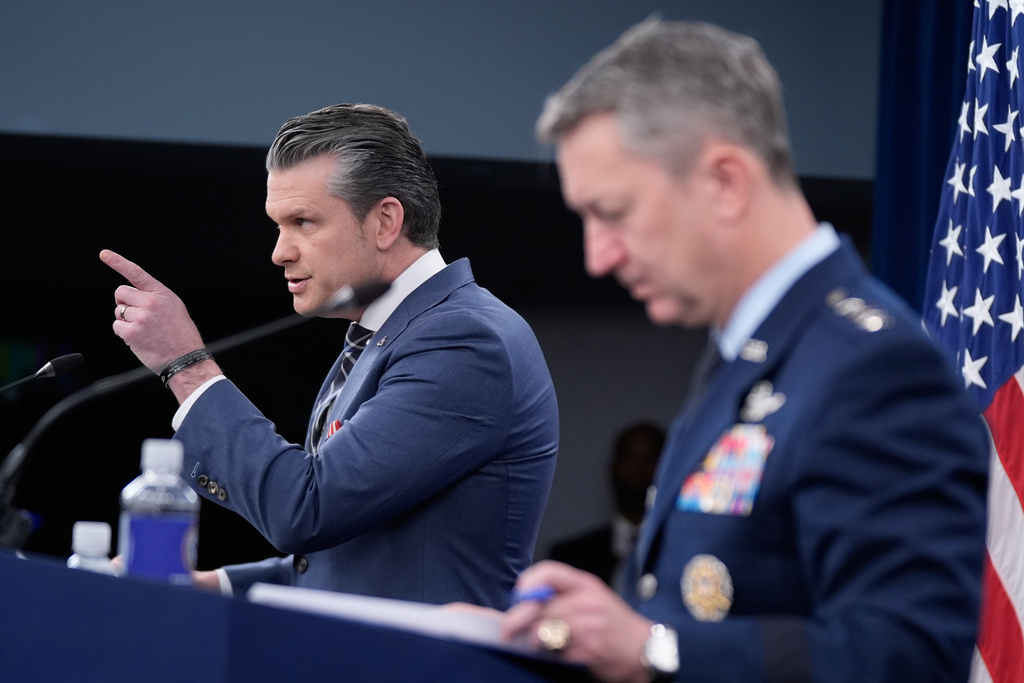
Pete Hegseth has a message for journalists covering his war with Iran: report the military victories, and if you ask questions about an endgame, you’re rooting for the United States to lose.
Hegseth’s Thursday morning Pentagon press conference was one of the more remarkable performances from a sitting Cabinet secretary in recent memory. He opened with Dover Air Force Base — flag-draped caskets, grieving families, tears and hugs — relaying what he said he heard from family after family: finish this. It was a genuinely moving invocation, and it also served a specific purpose. Gold Star families are the most powerful image in wartime politics, and Hegseth referenced them before turning, in the same breath, on the journalists in the room — accusing them of undermining the very war effort those families had just asked him to see through. The grief was real. What came next was deliberate.
Standing before a room full of reporters, Hegseth told them they were not his audience. His audience was “the good, decent, patriotic, hard-working, God-fearing American people.” The reporters in front of him were not beside the point — they were the problem. “A dishonest and anti-Trump press will stop at nothing,” he said, “to downplay progress, amplify every cost, and call into question every step. Sadly, TDS is in their DNA. They want President Trump to fail.”
This was the secretary of defense, at an official Pentagon briefing, diagnosing the assembled press corps with a political pathology while looking past them to address the public directly. Whatever else that is, it is not a communications strategy that is working. Because the more aggressively the administration makes that argument, the more it suggests the narrative is slipping beyond its control. When a strategy is clearly defined, the messaging takes care of itself. You don’t fight with chyrons. You point to outcomes. The fact that the focus keeps drifting back to presentation is the story.
Hegseth did offer something neither the White House nor the Pentagon has consistently provided: an actual list of objectives. Destroy Iran’s missiles, launchers, and defense industrial base. Destroy their Navy. Ensure Iran never gets a nuclear weapon. “Our objectives,” he said, “unchanged, on target and on plan.”
Those words matter — and so does what surrounded them. In the same briefing he described hunting targets across a vast country with buried facilities, methodically, ruthlessly, overwhelmingly, with the largest strike package yet arriving that same day. Over 7,000 targets struck, and the capabilities keep building.
So when do those objectives get declared achieved? Who decides? What does the morning after look like if the regime survives, if the missiles are degraded but not gone, if the nuclear program reconstitutes in facilities the strikes never reached? These are not gotcha questions. They are the ones Hegseth’s own briefing makes unavoidable — and the ones he preemptively dismissed as media fabrication.
The most revealing moment came unprompted. No question, no pushback — Hegseth volunteered it: “This is not those wars.” Iraq. Afghanistan. The forever wars Trump built his entire political identity opposing. He called Bush, Obama, and Biden foolish politicians who squandered American credibility, and asked for credit, in advance, for knowing better. Nineteen days into an escalating air campaign against a vast country with a surviving regime and buried facilities, the forever war question is not something the media invented. Hegseth raised it himself before anyone in that room asked, which tells you more about where his head is than anything else he said.
That anxiety runs straight through the rest of the administration’s posture this week. On Wednesday, White House press secretary Karoline Leavitt appeared on Fox News citing CENTCOM reports — more than 7,800 targets struck, more than 120 Iranian naval vessels sunk, a “known terrorist” killed — as proof that Operation Epic Fury has been “highly successful.” She then amplified a Wall Street Journal op-ed arguing that major outlets were producing “relentlessly negative” coverage, adding her own characterization: “the American left-wing media is sadly rooting for President Trump, and therefore the United States Military, to fail.”
The op-ed carried a byline worth noting. Mark Penn spent more than a decade as Bill Clinton’s chief pollster and strategist. His willingness to co-author a piece accusing the mainstream press of rooting for American military defeat gave the White House something it needed — a veneer of bipartisan credibility for an argument that is entirely partisan in its intent. What neither Penn nor Leavitt engaged with is the substance of the coverage they condemned.
The stories they cited — economic fallout, questions about strategy, uncertainty about what comes next — are not rooting for failure. They are describing a war whose objectives, until Hegseth’s briefing, had not been clearly stated in public. That is not bias. That is the job.
Fox News offered its own version of the same argument this week. Martha MacCallum ran clips of Symone Sanders, Whoopi Goldberg, and Joe Scarborough questioning the war’s planning and objectives, then turned to Brit Hume, who recast the critics as people calling the war a stalemate. None of them had. American military superiority over Iran is not what anyone is questioning. What is being questioned — across the partisan divide, including by people who voted for this president — is how this ends, and what happens if the regime is still standing when it does. Hume’s reframe is a telling one: when you can’t answer the actual question, you answer a different one.
American wars have a way of being narrated through metrics before anyone reckons with outcomes. Body counts in Vietnam. Kill ratios and territory held in Iraq. The official numbers kept improving in both wars, right up until the moment they stopped mattering. The administration is not the first to conflate military activity with strategic progress. It is doing so while attacking anyone who points out the difference.
If the war goes badly — more complicated, more costly, more prolonged than advertised — the explanation is already being constructed. The problem will not be the planning. It will be the coverage. That fallback is visible in everything Hegseth said Thursday, in everything Leavitt said Wednesday, in the Penn op-ed, the Hume segment, and every other piece of this week’s coordinated argument. The press is not just being criticized. It is being pre-blamed.
The military campaign appears to clearly be succeeding on its own terms. The terms themselves remain unsettled. Until that changes, the argument with the press will continue to stand in for the argument about the war itself.
This is an opinion piece. The views expressed in this article are those of just the author.
New: The Mediaite One-Sheet "Newsletter of Newsletters"
Your daily summary and analysis of what the many, many media newsletters are saying and reporting. Subscribe now!






Comments
↓ Scroll down for comments ↓