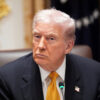
CNBC’s Trump Interview Followed by Scathing Tariff Takedown by Ex-Treasury Secretaries: ‘A Bad Tax’

Two former treasury secretaries skewered tariffs as a “a bad form of tax” in a brutal CNBC segment just moments after President Donald Trump’s live Squawk Box interview on Tuesday in which he insisted that his tariffs were bringing many countries to heel.
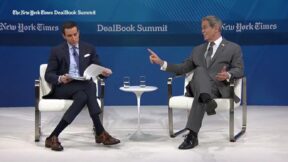
After a brief commercial break following Trump’s interview, coverage moved to Colorado where CNBC journalist Andrew Ross Sorkin interviewed Tim Geithner, who served as Treasury Secretary under the Obama administration, and Hank Paulson, who held the role under former President George W. Bush.
Sorkin challenged the pair, now co-chairs on the Aspen Economic Strategy Group Forum, on Trump’s “excitement” about his tariffs regime.
Paulson began: “The economy, Andrew, you’ve got to start by saying, our economy is amazingly resilient, amazingly resilient. It’s been the bright spot in the world since 2020. So just think about what we’ve been through: the financial crisis, multiyear pandemic, shifting economic policies, and yet, you know, if you go back to 2020, we’ve grown at three times the rate of the rest of the G7.”
He continued: “I start there then in terms of what’s going on with the economy, tariffs, etcetera, let me tell you, it’s going to take a while to determine that. It looks like things have slowed down a lot, okay? In terms of manufacturing jobs and in terms of job creation.”
He added: “But there’s so much going on, right? Look at everything that’s going on right now. It is amazing. And it’s going to take a while to work its way through the system. So we’ve got as you said, we’ve got tariffs, we’ve got tax cuts. We’ve got the impact of AI. That’s going to take a while for us to determine.”
“Where do you land on tariffs?” Sorkin pressed Geithner.
More blunt in his response, Geithner said: “I mean tariffs are a bad tax. They’re like a corrosive tax on American manufacturers. They’re aggressive in their impact there.”
He continued: “And we don’t know where they’re going to settle out yet. You still don’t have, you know, where China’s going to settle out where India is going to settle out. You don’t know what the relative changes are going to be. So you don’t know yet what the broad impact on supply chains is going to be. But it’s a shock.”
Geithner echoed Paulson’s affirmation of the resilient U.S. economy but warned: “It’ll be hard to figure out how hard to see the ultimate effect until we see where they settle out. But, you know, it’s like it’s like rust. It’s corrosive, hard to reverse.”
Sorkin cut in for more, asking how tariffs were “corrosive,” as Geithner described them.
Geithner replied: “Because they tax… they raise the costs of inputs to manufacturers. And they are a hit to real incomes of the average American. And you know, they have that basic effect you can’t escape.”
The “long term challenge” he added was assessing the impact of tariffs, noting that tariffs will bring in revenue but that future administrations could come to depend on that income.
“It’s going to be hard to get the political system to figure out a way to clean up and reform that legacy of tariffs, because they’re going to find the revenue so attractive,” he said.
Returning to Paulson, Sorkin pushed him on what the market thinks of tariffs. Paulson noted that a problem was that there was “no real permanence” to Trump’s regime and that a tariff could “change tomorrow.”
“I think the thing that I dislike the most is that they’re uneven, right?” he continued. “And so they’re uneven. They punish some, they benefit others. I’m talking about within the U.S. economy. And so they create distortions which have an adverse impact. It can have an adverse impact.”
Watch above via CNBC.