
REVIEW: Steve Martin’s Apple TV Documentary Is Everything a Devoted Fan Would Want — Yet So Much More

There is a moment in the second part of STEVE! [Martin], A Documentary in Two Pieces, in which the subject reveals deep concerns about participating in the documentary. He worries that the filmmakers might dig up something embarrassing from his past, like the fact that he purchased a condom when he was 18 years old.
Viewers learn about this concern via cartoons interspersed throughout the doc, which were created by Steve Martin in collaboration with well-regarded illustrator and collaborator Harry Bliss, accompanied by a fake headline: “BREAKING NEWS: Steve Martin ‘Sure Likes Condoms.”

It was all I could do to resist using that headline for this review.
It is just one of the dozens of beautifully self-aware, insightful, and funny moments provided by the two-part documentary series focused on and featuring Steve Martin, which debuted late last week on Apple TV.
When I learned that the relatively un-promoted documentary was soon to launch, I was concerned it wouldn’t come close to my impossibly high standards. You would be hard-pressed to find a fan as passionate about Steve Martin’s earliest work as the 12-year-old version of me. As I started to watch the documentary, I realized Martin shared my concerns about the quality of the experience and used those concerns to make it far more enjoyable and insightful for the viewer.
The documentary is split into two parts: “Then” and “Now.” The first episode tells the story of Martin growing up in a rather loveless childhood home, learning magic tricks at a young age, and entering an “avant-garde” realm of becoming a comedian who is “unaware” that he is really bad at stand-up. The footage of him bombing with his “way-ahead-of-his-time” act is hard to watch but made more palatable with the knowledge of how his career grows.
The story is familiar to anyone who has read his memoir, Born Standing Up, but the documentary features amazing archival footage and contemporaneous notes saved from a much younger and ambitious Martin, perhaps knowing that they would one day hold great value. And they do.
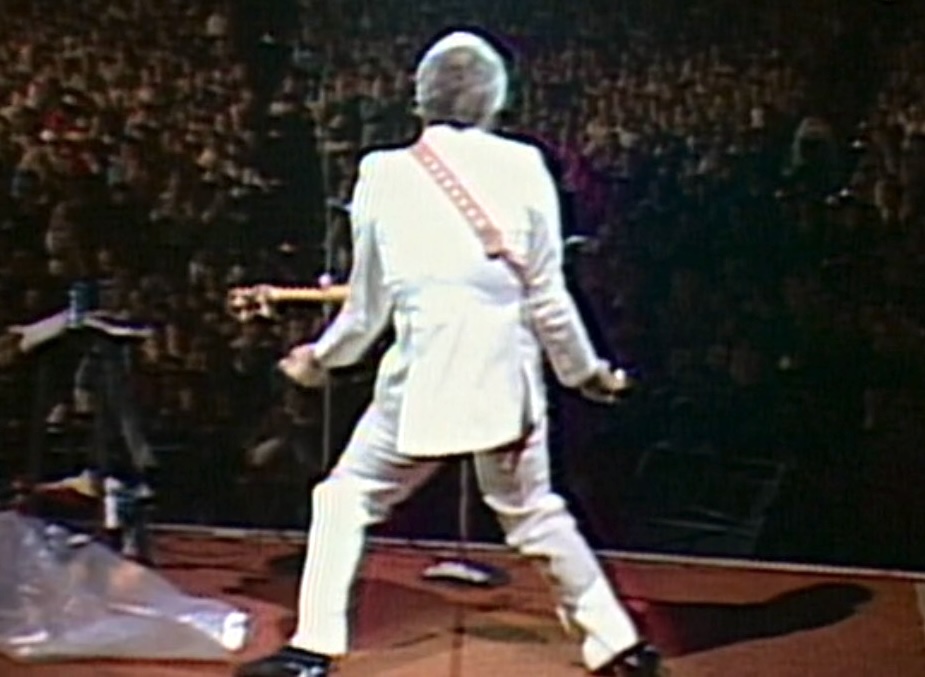
It is difficult to sum up just how influential Steve Martin was in popular culture in the late 1970s. This documentary shows his journey from a struggling performer craving attention to becoming arguably the most successful commercial stand-up comedian of all time, the first to sell a million records and fill arenas on national tours.
However, the film also accurately demonstrates how Steve Martin ushered in a new age of comedy. His act made fun of traditional stand-up, often playing the part of a dimwitted arrogant hack that everyone could laugh at — even Martin. He was a deconstructionist’s stand-up as if foretold by the late ’50s philosophers who understood the shifting and transient nature of meaning. All the ironically detached comedy we’ve consumed in the past two decades — silly and absurd comedy for smart people — started with him. (Shout out to Ernie Kovacs goes here.)
I was young, but I still remember the Vietnam War hangover of the early 1970s. It was a pretty dark time. People were unhappy—there was the Nixon resignation, gas rationing, and economic stagnation—and as a result, they were served post-angry political comedy by the brilliant George Carlin and Richard Pryor (who stood out from the traditional hackneyed bits from Bob Hope and his ilk that were still in the game).
I clearly remember my father bringing home his first record, Let’s Get Small, and laughing hysterically with my dad while we played the vinyl on repeat over and over again. I also recall bringing my friends over one by one to play the record and suddenly realizing I didn’t have much in common with each of them because they just didn’t get it. I suspect there were a lot of pre-teens and teens who had a similar experience.
Martin ushered in a new era of silliness, funny for fun’s sake. Laughs were not canned; they were genuine, and he — along with Saturday Night Live and, later, David Letterman — truly started a whole new thought movement, the DNA of which is apparent in Judd Apatow’s movies or great comedic actors like Paul Rudd, Jack Black, and Kristen Wiig, to name a few.
Johnny Carson was the kingmaker in comedy at the time, and the documentary contains a ton of incredible archival footage for people of a certain age to enjoy. There are excellent clips cobbled together from episodes of Cher, The Smothers Brothers, The Dating Game, and many other programs that put the viewer right back in the mid-70s.
But this is not just a wistful romp. Yes, it is a nostalgic look, but it comes with a much deeper story of Martin’s long-term struggles with anxiety and depression that started with growing up in a pretty isolated suburban home in Orange County. It’s not a sad retelling but, instead, a beautiful one that doesn’t hide the human condition we all struggle with. In fact, Martin and the filmmakers embrace it to the degree that the mission of finding happiness almost becomes a protagonist unto itself.
It is difficult to convey the wild influence Martin had on culture at the time and just how horribly unhappy he was, yet the filmmakers — and Martin, of course — do the impossible: they paint a complete picture that not only tells the story but resonates with how many of us feel when we look back at different times when we were less experienced or wise.
Special shout to director Morgan Neville, who perfectly captures the tone by using brilliant music beds from The Beach Boys at critical junctures. First is the classic Don’t Talk (Put Your Head on My Shoulders), which sums up the mixed-up emotional and LA-based, sun-drenched melancholy captured by Brian Wilson on Pet Sounds. Then, as a coup de grace for Martin’s bittersweet arrival as a commercial success — while still struggling with anxiety — is the spine-tingling use of Wilson’s later, lesser-known and haunting Surf’s Up.
There is a Portuguese term, “Saudade,” that sums up the wistful beauty or sad nostalgia often evoked in Bossa Nova music, many of which rely on major 7th chords. You hear it in Antônio Carlos Jobim and João Gilberto, but also in the American pop music of Burt Bacharach and Brian Wilson. Looking back at Steve Martin’s early struggles, his rise to cultural phenom, and ongoing struggles to find happiness is as close to a documentary version of Saudade as one can ever find, evidenced by how perfectly well the deep Beach Boys cuts fit with Martin’s complicated story. Steve Martin seems himself to be a major 7th chord.
The second part of the series—”Now”—deals with Martin’s growth as a human to the point when he’s a fully formed, down-to-earth, and happy husband and father. He still has the same quick wit but no longer seems to feel the need to either succeed or please anyone other than the ones he loves.
There is a very sweet moment in which an interview is interrupted by his daughter, whose identity is covered by filmmakers using a clever stick-like animation. Martin gives a fatherly hug and quite naturally says sweet things, and he then ends by asking his daughter, “And what is your name again?” Swoon.
We learn of Martin’s genius, not just in his later-day reinvention into a New Yorker contributor but also as a curator of fine art. The viewer sees interviews with (and commentary from Jerry Seinfeld, Frank Oz, Martin Short, and Martin Mull, to name a few, which are interspersed with the quiet desperation of Martin making poached eggs and joking about how boring it is.
The hyperrealistic conveyance of the struggles with being a human reminded me of another criminally underappreciated artist who launched a million impressionists, the father of realism himself, Gustave Courbet. But instead of The Stonebreakers, we’d have the Egg Poacher.
When asked why he is doing this (making the documentary), Martin answers, “I see it as an antidote to the sort of anodyne interviews, generic things I’ve talked about a million times,” which is an understatement. After watching it, one feels like he not only set out to reinvent the form but was remarkably successful in achieving that goal.
What Martin and Neville accomplish here is a true masterpiece: a reinvention of the hagiographic and self-serving documentary into something far greater. They produced a self-aware, at times self-mocking, and often funny celebration of one’s success not in show business but in becoming a whole person.
Watch above via Apple TV.
This is an opinion piece. The views expressed in this article are those of just the author.










Comments
↓ Scroll down for comments ↓