Three of the Most Important Points From This Excellent WebMD Interview with Dr. Anthony Fauci

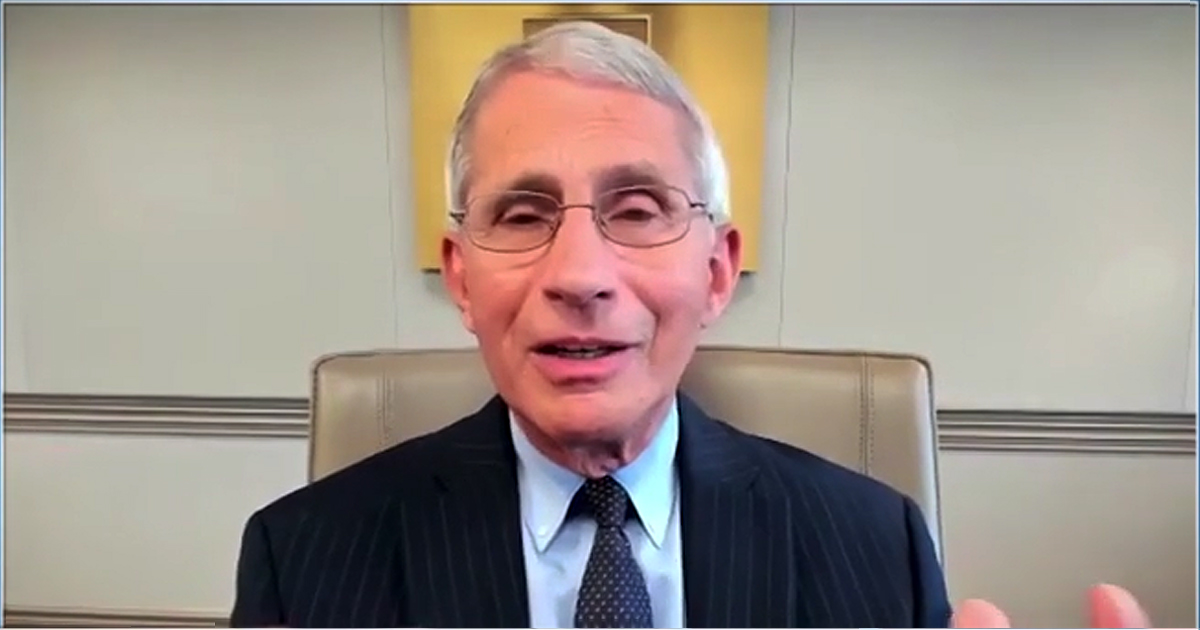
Face of the (smart) coronavirus response Dr. Anthony Fauci spoke with Dr. John Whyte, Chief Medical Officer at WebMD, on Saturday in what was really a terrific and informative interview that covered a lot of ground.
One of Fauci’s main points was to say that those who are careless or unconcerned about their own possibility of being infected can become part of the problem for people at risk. “By allowing yourself to getting infected, or not caring if you do get infected, you are propagating a pandemic,” he said. “Because it doesn’t end with you.”
It is worth your time to watch every one of the 19 minutes and 26 seconds of the WebMD interview, located at this link, but here are a few excerpts that really deserve emphasis.
Not being part of the solution means you’re actively being part of the problem:
JOHN WHYTE: So why aren’t the public health guidances working in some populations, particularly a younger population, which is attributing for some of that surge in cases? Is it– is it a failure of effective communication? What’s going wrong here?
ANTHONY FAUCI: No, I think they’re– I think it’s multifaceted. I don’t think you could put your finger on one thing. But the one thing that I think is important, and I’ve been analyzing this, really, for quite a while, is that, particularly with young people, and clearly young people are driving this new surge.
Because if you go back and look at the demography of the new infections, the age group is at least 15 years younger than what we were seeing a few months ago when things were surging in New York when they got hit very badly. So what happens is that younger individuals who generally, statistically, are not going to have symptoms to the frequency that elderly people do.
They’re not going to get very sick. They know that. So what I think is happening is that, understandably, innocently, but not correctly, the younger individuals are saying, well, if I get infected, so the chances of it is that I won’t even have any symptoms, so who cares? That’s a big mistake.
Because by allowing yourself to getting infected or not caring if you do get infected, you are propagating a pandemic. Because it doesn’t end with you. You get infected and have no symptoms. The chances are you’re going to infect someone else, who will then infect someone else.
And then someone who’s vulnerable to severe consequences will get infected. That could be somebody’s father, mother, or grandmother. It could be a sick child who’s an immunodeficient child. It could be a woman who’s on chemotherapy for breast cancer. Then all of a sudden, you’re not operating in a vacuum. You’re part of the problem as opposed to being part of the solution.
So somehow, we’ve got to keep getting that message across. And I don’t mean in the sense of blaming anybody. Because these are people that are doing this innocently and inadvertently.
The public’s faith in science, facts, professionals, and experts:
JOHN WHYTE: … Have the public lost their faith in science?
ANTHONY FAUCI: Well, I think we have to face the reality that we do have an anti science trend in this country that mixes with an anti authority trend. And scientists and regulators are often equated with authority. And there is that pushback, particularly on the part of young people, maybe for some good reasons, that they’ve been disappointed in authority and have been disappointed in government.
And they get disillusioned. And that kind of translates or measures into an anti science attitude, which is very unfortunate, particularly when you’re in the middle of a pandemic and you’re trying to deal with it. There isn’t anything worse that you have as someone who doesn’t care about the science, which is clearly trying to tell you to act in a certain way.
JOHN WHYTE: It seems as if almost everyone is their own expert. From the perspective of, you have your opinion as a– as a, you know, infectious disease expert. And someone else will say, well, that’s your opinion, Dr. Fauci. I have mine. Isn’t that part of the problem?
ANTHONY FAUCI: Yeah. I mean, people’s opinions are a fact of life. What gets, um, I think troublesome, is when people develop their own set of facts. Facts don’t change. So you can have a different opinion, but facts are consistent. That’s the problem.
We can turn it around if we actually do the things we ought to be doing:
JOHN WHYTE: And back to this infection rate in the community. The CDC director has talked about if we would all just wear a mask for three to four weeks, we could decrease incidents dramatically. What’s your thoughts about the need for a full lockdown for a couple of weeks to truly stop the spread of the virus?
ANTHONY FAUCI: We would like to avoid a full lockdown if we possibly can. What we feel we have to do is pull back a little. You know, in the guidelines that we put out some time ago, we said there’s a gateway, which means a preliminary look to keep the infections going down for 14 days. Then you go to phase I. And then if that works, you go to phase II, then to phase III.
What states and cities might have to do is to backtrack a bit and come back a little. That doesn’t mean you have to go all the way back to lockdown, but you need to pause and take a look at what’s going on and why it’s not working. And what you do, you may need to pull back a little on the phase you’re in and then say, OK, we have a problem.
Close the bars. Everybody wear a mask. Physical distancing. No crowds. Wash your hands. And I agree completely with Bob Redfield, the CDC director, when he says that– that if we do that, we can turn this around. We can turn it around.
Whyte asked all the most pressing questions, including on the topic of opening schools, which Dr. Fauci explained is a complicated question but definitely leaned toward the idea that it should be decided on a county-level based on that community’s needs.
Watch the whole thing from WebMD here. Seriously. Information is good. We need it. Direct and truthful from a source with some understanding of the topic, not from some politician or president playing games to tell certain people what they want to hear. So watch this, not that.
And when you go out, put a mask on like you’re a grown-up who can do grown-up things. Don’t be a tool.
New: The Mediaite One-Sheet "Newsletter of Newsletters"
Your daily summary and analysis of what the many, many media newsletters are saying and reporting. Subscribe now!









Comments
↓ Scroll down for comments ↓