The Biggest Health-Care Price Spike in Decades Is Imminent — And the Media Is Ignoring It


(Photo by: Emily Wabitsch/picture-alliance/dpa/AP Images)
A 60-year-old in Illinois making $65,000 a year will see their health insurance premium jump from $460 to $2,800 a month. Starting now.
A young worker earning $35,000 who paid $80 per month will now pay $300 per month. That’s groceries. That’s rent.
These examples, reported by the New York Times based on figures from KFF, aren’t because hospitals suddenly cost more. Not because insurers got greedier. It’s because Congress let enhanced Affordable Care Act subsidies expire—and millions of Americans are about to get the bill.
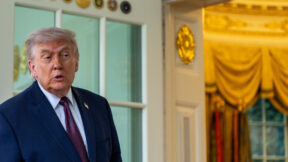
Health-care premiums are about to detonate — and we’re all staring at the wrong explosion. While Washington and the press corps are hypnotized by the 31-day government shutdown and President Donald Trump’s insistence that he has a “better, cheaper” health-care plan on an invisible clipboard, millions of Americans are about to learn what happens when political sabotage meets media inattention: they get a bill.
The sticker shock is already arriving. Without federal subsidies — killed off in the deadlock before the shutdown — premiums on the ACA exchanges are poised to jump an eye-popping 40 to 60 percent for many consumers. It’s not hypothetical. It’s math.
And yet somehow, this is not the dominant news story. It is barely a story on cable news at all. The lights are flickering on the country’s single largest consumer expense category (health care surpasses housing), and the media has essentially shrugged.
This isn’t just terrible coverage — it’s political malpractice.
The Republican strategy here is almost artful in its cynicism: First, kneecap the existing system by killing the subsidies that make it function; second, point at the inevitable chaos and scream, See? Broken! Third, argue that only repeal can save us. It’s like slashing someone’s tires and then handing them a brochure for a new car dealership.
Now, conservatives will argue that if the planned expiration of what were supposed to be short-term subsidies causes a crisis, maybe the system itself is the problem, which is an entirely reasonable point, undermined by the lack of any alternate play put forth going back to 2017 when Trump first came into office.
There is no great mystery about why this is happening. The ACA marketplaces were designed with subsidies as a core feature; without them, prices rise. That’s not a partisan judgment. It’s economics — ironically conceived in the free market conservative think tank the Heritage Foundation, and first implemented by Republican Governor Mitt Romney.
And yet, you’d be hard-pressed to find a sustained cable-news segment about the pending spike — certainly nothing commensurate with the magnitude of the crisis. We’ve had more coverage of Speaker Mike Johnson and Minority Leader Hakeem Jeffries hurling insults at one another during cable news hits in which no one seem to be directly asking about this imminent disaster.
The government shutdown consumes nearly all political media oxygen — even though that drama is, at heart, mostly procedural brinkmanship. The shutdown has functioned as both a distraction and a shield: a visible crisis that obscures a quieter, more consequential one. For Republicans, it’s a lucky sleight of hand: focus on the circus while the trapdoor falls open.
This should be the dominant story. Instead, the press corps is transfixed by shutdown choreography and the latest presidential theatrics. That attention gap is not an accident; it’s a condition that political actors exploit.
President Trump, for example, spent Thursday night on Truth Social accusing Democrats of wanting to “take Trillions of Dollars to be taken from our Healthcare System and given to others…who have come into our Country illegally, many from prisons and mental institutions.”
It’s a spectacularly false claim — enhanced subsidies were never meant for undocumented immigrants, and the cost to extend them is measured in tens of billions a year, not “trillions” — but the post performs a political work: it fills the narrative vacuum. When facts are absent from the loudest microphone, fiction rushes in like creditors.
Make no mistake: this is sabotage. Republicans didn’t have to repeal the ACA. They simply let its stabilizers expire. Remove the subsidies that keep premiums affordable, and the market reprices. Then, when people scream about higher bills, the saboteurs cite the damage as proof the system itself is irredeemable. It’s the oldest trick in the book — break it, then sell yourself as the only one with a new plan to fix it.
Democrats, for their part, have been maddeningly passive. Chuck Schumer and Hakeem Jeffries spent the month insisting government must reopen — true and necessary — but they failed to weaponize the narrative: Republicans killed the subsidies; those choices will cause your premium to spike. Instead we get process-speak and legislative choreography. Silence is not a strategy; it’s a surrender.
Democrats, astonishingly, have been just as ineffective. Instead of hammering home the basic message — Republicans broke it; now they’re blaming the fallout — they’ve allowed Trump to float fantasy claims that he alone can fix health care, a promise recycled from 2016 that still has no details backing it. One of the greatest propaganda gifts you can give a liar is silence. Democrats have complied.
Where is the press? Some outlets have done terrific reporting — The Hill and The New York Times have outlined the consequences with clarity. But overall, the story has been covered as a bureaucratic policy wrinkle rather than what it truly is: a deliberate political booby trap that will profoundly burden millions.
Newsrooms love novelty and conflict; health-care pricing is neither. It’s complicated, incremental, and actuarial. But that framing mistake — “dull policy story” instead of “weaponized sabotage blowing up household budgets across the country” — is precisely how political actors get away with it.
And here is the real danger: When those higher bills arrive in January, Republicans will be well positioned to blame the very law they just undermined. It’s a double manipulation: sabotage → spike → blame. If Democrats remain this inept and the media remains this inattentive, the strategy will work.
This is not a policy debate. It’s a political trap. And unless the press treats it like one, Americans won’t know who pushed them off the cliff — only that they’re falling.
This is an opinion piece. The views expressed in this article are those of just the author.
New: The Mediaite One-Sheet "Newsletter of Newsletters"
Your daily summary and analysis of what the many, many media newsletters are saying and reporting. Subscribe now!





Comments
↓ Scroll down for comments ↓