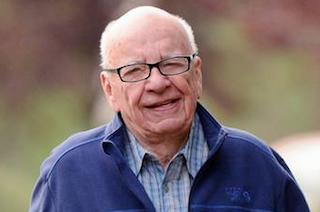
Rupert Murdoch Needs The NYT’s Help — So He Can Destroy The NYT!
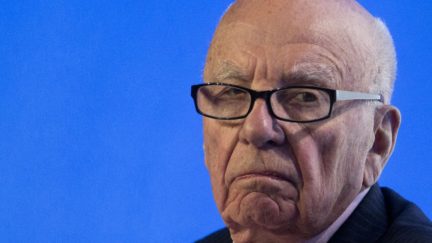
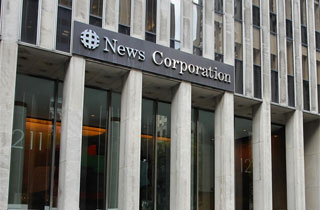
In case you haven't heard, Rupert Murdoch's News Corporation is in the process of creating a New York City edition of the Wall Street Journal, a project he planned to go "all in" on not a mere two months ago. Now, it looks like "all in" means "turn to your biggest competitors for help." (more...)
Newsweek Affirms Mediaite: Fox News’ Roger Ailes Runs The GOP
A recent Newsweek column makes a bold, if slightly counter-intuitive pronouncement that pairs media and politics: "Roger Ailes is the real head of the GOP" argues Howard Fineman in "Life of the Party." But it just sounds so familiar... Ah, yes! Mediaite has been making a similar case since September, when a column by Managing Editor Colby Hall called Ailes "The Most Powerful Political Figure In America," supported again last month when we named Ailes the #1 Media Innovator of 2009. Glad we can agree, Newsweek, but let's run down the evidence. (more...)
Why Is The Daily Beast Continuing The False “Roger Ailes Out At News Corp.” Storyline?
The New York Times lengthy, largely-positive Sunday profile of Fox News Chairman Roger Ailes has gotten a lot of attention from around the media (including here). But the one major element that was negative - a quote from Rupert Murdoch son-in-law Matthew Freud - has been the focal point of two Daily Beast columns in the past three days. There may be a reason. (more...)
Roger Ailes’ NYT Profile: “There Is Him And There Is Everybody Else”
Last month we named Roger Ailes as #1 on our Mediaite 50, ranking the top innovators and influencers in media And now it looks like the New York Times agrees. David Carr and Tim Arango give the Fox News Chairman the full Sunday profile treatment today, looking at all aspects of the man who has built the most successful news channel of the last decade. (more...)
Soundbite: ‘Murdoch Didn’t Ruin WSJ; He Just Made It Ordinary’
“Murdoch didn’t ruin The Wall Street Journal; he just rendered it into a much more ordinary paper.”
(more...)Financial Times Writes About MySpace – But Misses The Story
"...News Corp dragged its feet over implementing Ajax, a program that allows users to send a message, an e-mail or to post a comment on their friends’ pages without having to open a new browser window." - From the Financial Times' look at the decline of MySpace, emphasis added. Yeah, no it isn't. "Ajax" is a term referring to functionality that allows a scripting language (Javascript) to load content without refreshing a webpage. It's no more a program than HTML is a program. How do I know this? Because I develop web sites. But if I didn't, its Wikipedia page is a Google search away. Who cares?, one might ask. The story, after all, isn't about arcane web protocols - it's about MySpace's inglorious descent into irrelevance. It's about how the News Corp. acquisition of the site transformed from a triumph to a debacle. It's true. It is about that, and it's a very good read (as Mediaite's Joe Coscarelli notes in his review). But the story of MySpace's decline is inextricably linked to the story of its failure to adopt technological changes. The assessments in this story miss crucial steps in Facebook's rise to prominence that were the knives in MySpace's spine. It's as though someone wrote a post-mortem of the American automobile industry without describing Japanese cars. Two examples. Friends' Activity Much is made in the article of Facebook's ability to automatically send invites to the friends of new users. What isn't mentioned is the real change that set Facebook apart, early on: the friends' activity timeline. Now common on social sites, the news feed of new relationships and profile changes was roundly criticized by users at launch. Many considered it invasive, since they were used to the more passive structure of other sites. That feature was added in September of 2006. Here's a chart of subsequent growth. Many of us sign up for a lot of new, interesting websites - but which do we use over the long term? What Facebook realized was that the social component would keep users engaged, spurring growth as they encouraged those they knew to join the network. It's standard logic now, but in 2006, it was groundbreaking. Facebook Connect What's happened since, as Slate's Farhad Manjoo notes in a great piece about Facebook's growth, is that Facebook has become infrastructural. The scope of people's engagement with the site yields exponential benefit to participants old and new. What was missing was only the ability to carry that social infrastructure to other sites. In December 2008, Facebook launched Facebook Connect, essentially a set of tools that allow any website to let users log in with their Facebook identity. The benefits work two ways: sites are given an easy way to not only provide access to site functionality, but are given access to social media's Holy Grail: the Facebook user timeline. Sign into Digg using Facebook Connect, and any links you add to Digg are posted on your Facebook timeline. And Facebook, meanwhile, extends its brand - and its role as the backbone of online interaction. (A quick aside: it's that ability to become infrastructural in a unique way that has allowed Twitter to grow quickly - and why Facebook considers it most threatening. It's also why, in my estimation, Foursquare will never become a long-term blockbuster.) Both of these technologically innovative moves by Facebook were critical in taking MySpace out of the game, the latter being the death blow. (MySpace is even rumored to be adopting Facebook Connect next year.) Neither was mentioned in the Financial Times article because the reporter, Matthew Garrahan, didn't understand the technology. Garrahan got right, it seems, that Murdoch's misstep in announcing a billion dollars in ad revenue in 2008 crippled MySpace's ability to innovate - but MySpace, even early last year, was already doomed by Facebook's tools and its own size. Business reporters need to understand the web and how it works. Merely visiting or using a website doesn't tell you everything you need to know about how it is doing - any more than driving a Chevy Cavalier would be enough to report on expected revenues for its parent corporation. A reporter doesn't need to be able to write Javascript, but they need to understand what they don't know about technology. The Financial Times told a good story about advertising revenue and News Corp.'s decision-making process. The nut of the story, though, was about web technology. And that, they got wrong.
Murdoch’s Mistake?: Financial Times Chronicles The Fall Of MySpace
By 2005, it was time for Rupert Murdoch to "get serious" about the internet. Or so starts the engaging Financial Times profile of the wilting social network MySpace, which New Corporation acquired that summer. Kids, Murdoch noticed, were "watching less television and reading fewer newspapers,” and the most fertile ground was online. Well-intentioned, but then things crumbled. It's a story that has been told, but not this well. (more...)
News Corp. President Carey On White House vs. Fox News And More
video News Corp. COO and President Chase Carey was a guest this week on Fox Business Network, and host Neil Cavuto asked him about a wide range of issues. Serving as Rupert Murdoch's #2 means there's a lot to talk about - from White House vs. Fox News to Google. (more...)
Rupert Murdoch Wants All His Sites Removed From Google
There have been times the past twelve months or so when it's seemed as though Rupert Murdoch may be attempting to build some sort of way-back machine that would take both him and his media empire back to a safer time when the Internet could not interfere with his newspaper world dominance. The latest evidence is news that Rupe is going to take his newspapers off Google. Not a joke. (more...)
Overlooked: Two Key Players In Comcast’s NBC Bid Are Ex-NBC Execs
Yesterday, the news that former News Corp. heavyweight Peter Chernin had been advising Comcast in its bid for NBC Universal sent shockwaves throughout the media world. Before the speculation as to what this means gets out of hand, it's worth bringing up one key data point: both of Chernin's top deputies, Katherine Pope and Dylan Clark, are former NBC/Uni execs. (more...)
Star-Crossed Partners? Rupert Murdoch Flirts With Buying NBC
Somebody call Gossip Cop. As theories about the fate of NBC Universal rages on, one eyebrow-raising potential bidder has popped up in press accounts: Rupert Murdoch's News Corporation. Before you schoolgirlishly giggle and assemble a Shep Smith/Ann Curry/Greg Gutfeld/Mika Brzezinski news anchor dream team in your mind (or darkly fantasize, as HotAir's AllahPundit has, about Keith Olbermann having to report to Murdoch), it's worth asking: how likely is this? More importantly, what's in it for both parties to keep this speculation alive? (more...)
Rupert Murdoch Thinks The Internet Is One Big Porn Chat Room
Sometimes it's hard not to wonder if Rupert Murdoch didn't exist whether Vanity Fair's (and Newser's) Michael Wolff would have invented him, so much joy does Wolff seem to get from writing about him. (more...)
Incarceration Is The Sincerest Form Of Flattery, Or, Did News Corp. Call The NYPD On Fake Post?
"Did Rupert Murdoch call the fuzz on the Yes Men?" tweets David Carr, (in what could also be the opening line to an old Perry Mason episode). What Carr is referring to, of course, is Monday's fake New York Post prank, orchestrated by the group Yes Men, who published and handed out their (impressive) environmentally-themed version of the Post at multiple locations around the city. Or attempted to hand it out, anyway. (more...)
Godfather Rupert Murdoch Wants Everyone On Board His Paid Content Train
Ever since Rupert Murdoch announced that he was going to institute a pay-for-content policy on everything he publishes the media world has been much-a-chatter over whether Rupe publishes anything other than the Wall St. Journal that people would actually be willing to pay for. Solution? Make everyone get on board your paid content train...someone must have something that's worth shelling out for! (more...)
Is Bias Seeping Into the Post-Murdoch WSJ? UPDATE
As the debate over health care reform continues to dominate the news, there is the inevitable criticism of media bias on both sides of the debate. Aside from their editorial pages, the Wall Street Journal is well known for its unique focus on reporting facts, keeping its reputation as an unbiased source of news untarnished. But since its acquisition by Rupert Murdoch's News Corp. two years ago, has the WSJ succumbed to the alleged bias that has afflicted other News Corp. properties Fox News and the NY Post? (more...)
Rupert Murdoch Wants Everyone to Pay For What He Is Selling
Rupert Murdoch is not scared to take your money! While the New York Times willy-nillies around the paid content debate -- will they charge? how will they charge? maybe they'll only charge for parts -- Rupe, whose WSJ has been behind a paid firewall since the start, is going to charge for everything! This from the Financial Times (more...)
Forget The Truce: Fireworks Likely From Olbermann and O’Reilly
As we approach the moment of truth - whether Keith Olbermann and Bill O'Reilly will address the supposed truce between their respective parent companies during their 8pmET shows tonight (we'll live-tweet it), early indications point to some comment from each. Let's lay out what we may be in store for - and why it matters what the MSNBC host has to say so much more. (more...)
Truce Between Olbermann and O’Reilly: Nobody Wins, Especially the Viewers
In a sign of the cable news apocalypse, Fox News and MSNBC may no longer be at each others throats. A report by Brian Stelter in the New York Times, and another by Joe Flint in the Los Angeles Times, reveals a deal that began at the top of each organization, and has led both networks to tamper down the criticism. It sounds like a historic truce between two longtime enemies - and a truce that both organizations clearly did not want public. Now it opens the door to more questions than before. (more...)
© 2010 Mediaite, LLC | About Us | Advertise | Newsletter | Privacy | User Agreement | Disclaimer | Power Grid FAQ | Contact | Archives
| Dan Abrams, Founder
| Hosting by Datagram
|
RSS