After Taking a Deep Dive into the Jim Jordan/Ohio State Controversy, Here Are Some Conclusions

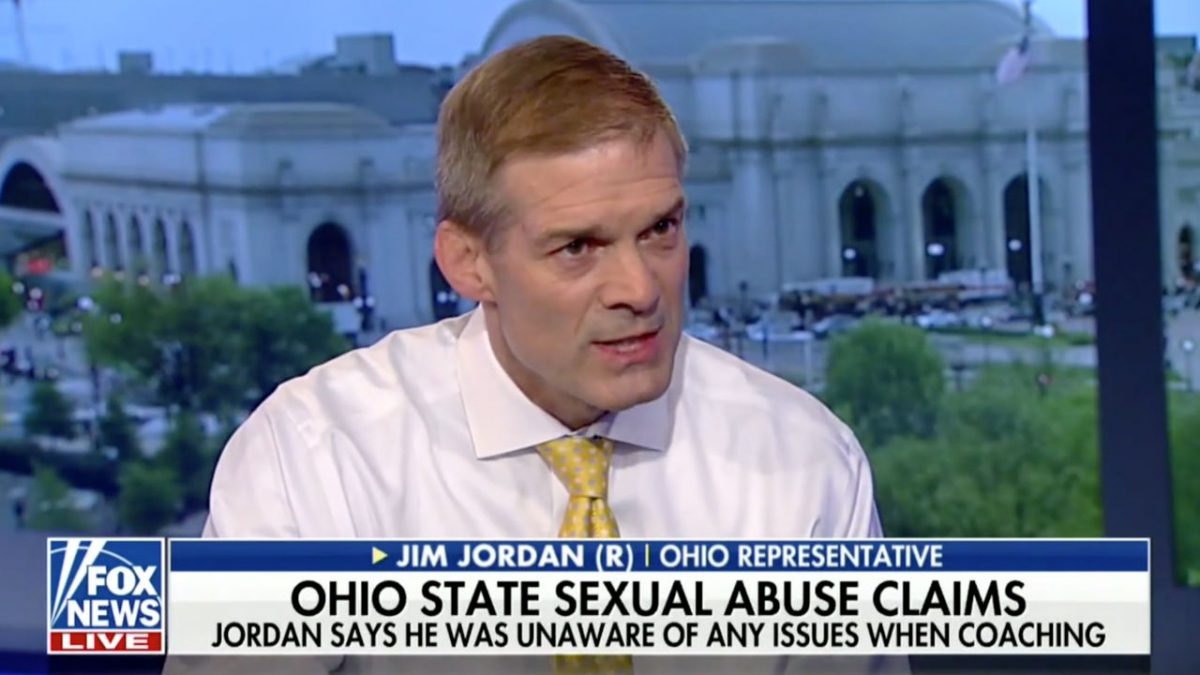
Since the beginning of July, when it exploded nationally that prominent Republican Congressman Jim Jordan was being accused of having enabled sexual abuse of wrestlers by a team doctor when Jordan was an assistant coach at Ohio State thirty years ago, I have been skeptical of the media’s preferred narrative. I have written twice about the factual problems with the case and the dangers of the media rushing to presume that one story seems a lot like previous ones, thus creating confirmation bias.
Since then, as I am all too prone to doing, I have spent an absurd amount of time trying to figure out what really did and did not happen in this strange story, which took another dramatic turn late last week. That’s when the most famous of Jordan’s “accusers,” former pro wrestler Mark Coleman, walked back much of his original story and distanced himself from the person who has most made Jordan’s alleged role national news, former Ohio State wrestler Mike DiSabato.
While I have spoken to a lot of people close to this situation, I have spent the most energy interacting with sports agent/lawyer Bret Adams, who helped facilitate Coleman’s reversal and got him to sign an important affidavit (to be revealed below), and to DiSabato. These two men truly seem to hate each other and are currently embroiled in multiple legal battles.
Based on my extensive communication with each of them, they also are incredibly unreliable narrators. This has made trying to find the real truth of this matter exceedingly difficult.
Adams, the lawyer, is a Trump-loathing Democrat and Ohio State alum who has come to Jordan’s defense because he strongly believes that the media has misrepresented this entire story.
Recently, Adams finally got Coleman, a friend of Jordan’s whose statements condemning the congressman were used as catnip to feed the media’s narrative, to sign an affidavit where he clearly recants his original comments critical of Jordan. He also repudiates the work of DiSabato in making Jordan the focus of a story which should have been solely on his alleged abuser, Dr. Richard Strauss, who, for the record, was never charged with any crime or even sued related to sexual abuse, and who has been dead now for thirteen years.
For some reason, Jim Jordan’s people didn’t want the actual affidavit released, so, to my knowledge, here it is exclusively.
However, after Coleman signed the statement but before it could be released (partly because Adams was trying to get Coleman to sign a second affidavit saying that DiSabato had paid him $2,000 for his original statement implicating Jordan, which, to my knowledge he has never officially confirmed), NBC suddenly came out with what seemed like a preemptive attack on anyone recanting their stories about Jordan. In it, DiSabato and NBC’s other source on the original Jordan story which they broke, Dunyasha Yetts (who was convicted of federal fraud charges for having stolen almost $2 million from his clients), make it sound like Jordan was pressuring wrestlers to recant their stories that the then assistant coach had to be at least generally aware of what Dr. Strauss may have been doing and enabled further alleged abuse by keeping quiet about the whole thing.
However, a closer look at the actual NBC report does not support such an implication. Rather, it was Ohio State’s head wresting coach at the time, Russ Hellickson, who was just letting those who had spoken out know that if they felt as if the media had misrepresented them, that they should feel free to set the record straight.
Since I already knew that Coleman’s “retraction” was coming, it was clear that, planned or not, the impact of Coleman’s new statement was going to be blunted by the NBC report. After all, in a classic case of confirmation bias, since the NBC report had already warned that wrestlers were being pressured to recant by a corrupt pro-Trump Republican congressman, any future revised statements would now only serve to confirm that narrative.
Consequently, I started to focus on whether Coleman really was paid by DiSabato because obviously that would be difficult, even for a news media invested in one side of this story, to ignore. Adams told me there was a “99%” chance he could get Coleman to do an interview with me and a “75%” likelihood that I could get him to admit to me that DiSabato had paid him to tell his story.
However, after the coverage of Coleman’s CNN interview didn’t go as planned (the Jordan people inexplicably nixed a plan to concurrently release a list of about 25 former Ohio State wrestlers on the record as supporting Jordan, a group which Adams told me Coleman had joined) it was quickly very obvious to me that Coleman, who apparently has been extremely fearful during this entire process, was never going to do an interview with me.
I then decided to contact DiSabato directly and simply ask him if he had paid Coleman for his original story. I would quickly learn that there is absolutely no such thing as “simple” when you are talking with him.
I proceeded to have about two hours of conversations with him this past Sunday, all of which the man who has been constantly quoted in numerous media outlets about this story unilaterally determined to be “off the record.” (I did not agree to those terms, but will nonetheless not quote any of DiSabato’s comments in this piece.) While telling me all sorts of things which I couldn’t make sense of and that appeared to be contradictory, he kept promising me that he would provide me a quote if I emailed his PR person so that his lawyer could review my questions first.
Word-for-word, just as he requested, I asked only these two, very straight-forward, questions:
1) Did Mark Coleman recently get paid around $2,000 from a party connected to Mike? If he did, why should this payment not be considered a quid pro quo in exchange for his original story to the media which he has now walked back?
2) Does Mike believe that the media narrative that Jim Jordan didn’t do enough about Dr. Strauss at the time and engaged in some sort of cover up for him to be inaccurate/unfair?
The second question was based on DiSabato indicating to me on multiple occasions that this was indeed his opinion of the media coverage, at least when the story first broke nationally.
After initially telling me that a few hours was not enough time to answer two yes/no questions, DiSabato’s PR person told me that if I waited until Monday morning I could get my answers. I was fine with that, but just after the “deadline” we agreed on had passed, I finally got an email from DiSabato’s lawyer saying that the quote would come only from him, not DiSabato, and he offered just a vague denial of the first inquiry, with no response at all to the second one (the PR person claimed this was because of lack of time, a claim which appeared to me to be utterly ludicrous). When I texted DiSabato expressing my disappointment in the response from his team, he told me that he would go on the record himself with regard to the second question, and then immediately proceeded to only send me a meme of Vladimir Putin laughing, which Ohio Governor John Kasich had just tweeted at Donald Trump.
Ironically, while I found DiSabato to be a bit strange and with numerous credibility problems (he praised Jordan’s character on Twitter last year, has sued Ohio State multiple times over losing his ability to sell their merchandize and is on video recently clearly joking about Dr. Strauss) I actually found him, in some ways to be rather compelling. If he had just directly answered those two questions without obfuscation, I probably would have had no problem believing him.
So after all of this, here are my own conclusions about this bizarre saga:
- Strauss clearly acted inappropriately and perhaps criminally, but not enough people at the time thought of his sometimes nebulous acts as “sexual abuse” for anyone to do something really significant about him.
- There is still no solid evidence that Jim Jordan was directly told of anything about Dr. Strauss which would have logically provoked an assistant coach in the early 1990s into strong action.
- I have no idea whether DiSabato actually paid Coleman for his original story, or if perhaps, like so much of this case, the truth lies somewhere in the middle.
- Going against the media’s narrative in cases like this is like trying to launch a small sailboat from a beach out into the open sea against a choppy high tide. It is very risky, nearly impossible to pull off, and probably not nearly worth all the extreme effort it requires.
John Ziegler hosts a weekly podcast focusing on news media issuesand is documentary filmmaker. You can follow him on Twitter at @ZigManFreud or email him at johnz@mediaite.com
This is an opinion piece. The views expressed in this article are those of just the author.
New: The Mediaite One-Sheet "Newsletter of Newsletters"
Your daily summary and analysis of what the many, many media newsletters are saying and reporting. Subscribe now!






Comments
↓ Scroll down for comments ↓