Furious Judge Throws Trump Prosecutor Out of Courtroom in Child Porn Hearing, Orders DOJ Officials to Testify About Alina Habba’s Role

Pool File via AP
An exasperated federal judge in New Jersey tossed a prosecutor out of his courtroom Monday after a contentious sentencing hearing in a child pornography case and ordered senior officials from the local U.S. Attorney’s Office to come testify about who was actually running their office.
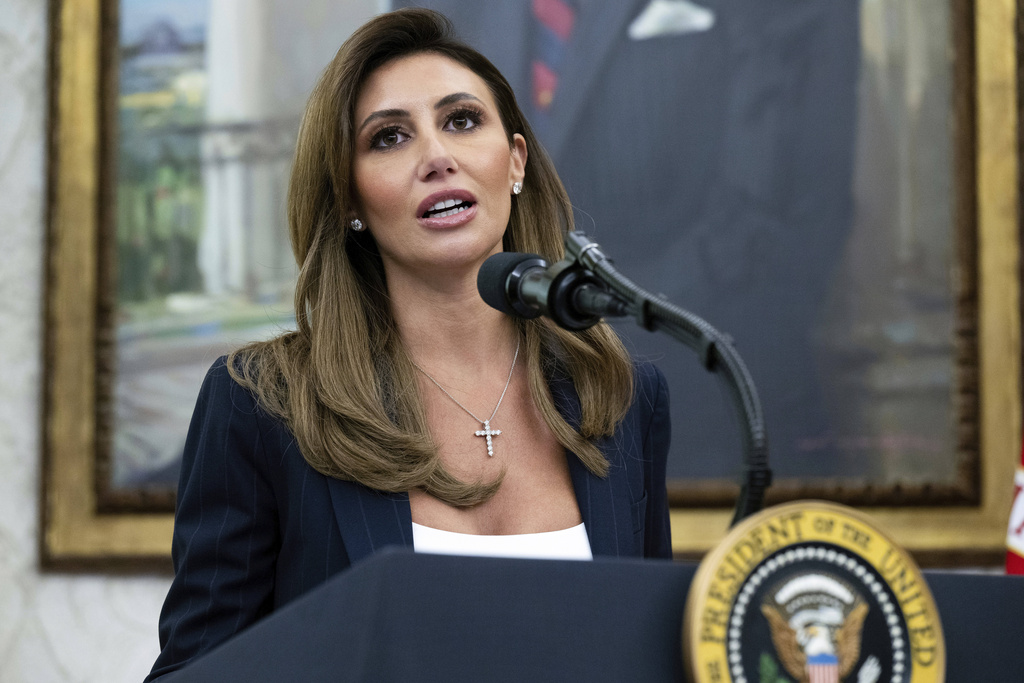
The kerfuffle traces back to President Donald Trump’s appointment of Alina Habba as acting U.S. Attorney for the District of New Jersey a year ago, after she had represented him and his super PAC for several years.
In August, Judge Matthew S. Brann, an Obama appointee with the U.S. District Court for the Middle District of Pennsylvania (specially presiding for the New Jersey court), ruled Habba was not “lawfully performing the functions and duties of the office of
the United States Attorney for the District of New Jersey” and therefore “[h]er actions since [her appointment] may be declared void…[a]nd because she is not currently qualified to exercise the functions and duties of the office in an acting capacity, she must be disqualified from participating in any ongoing cases.”
Brann’s ruling was upheld at the beginning of this month by a unanimous three-judge panel (two Bush appointees and one Biden appointee) on the Third Circuit Court of Appeals.
In December, Habba announced she had “decided to step down in my role as the U.S. Attorney for the District of New Jersey” as a result of the Third Circuit ruling “and to protect the stability and integrity of the office which I love,” adding that she would then serve as an adviser to Attorney General Pam Bondi.
During a sentencing hearing for a man who had pleaded guilty to possession of child sexual abuse materials, Judge Zahid N. Quraishi on the U.S. District Court for the District of New Jersey expressed skepticism that Habba had truly complied with the court’s order and fully stepped back from any role managing the U.S. Attorney’s Office.
The New York Times reported on how the hearing quickly devolved as the judge’s patience expired, calling it “the latest indication of growing tensions between the Justice Department and the federal judiciary.” The 26-page transcript of the hearing was posted online by the Times as well.
Normally, this sort of hearing would be highly predictable, with long-established sentencing guidelines for the prosecutors to use as parameters for their arguments to the judge. But the exodus of many experienced prosecutors, a spike in cases connected to the administration’s immigration crackdown, plus the added complication of several the president’s appointments being tossed out by courts has left Trump’s DOJ in disarray.
“The hearing did not go as prosecutors had planned,” reported the Times in quite the understatement, describing how the judge “grew frustrated with the office’s head of appeals, Mark Coyne, who had not formally disclosed that he would appear, and fiercely interrogated a more junior prosecutor about whether the former interim U.S. attorney, Alina Habba, still had some role in operating the office.”
“Judge Quraishi eventually threw Mr. Coyne out,” the Times report continued, and he then ordered Philip Lamparello, Jordan Fox, and Ari Fontecchio to appear next month to testify under oath about the leadership structure and operations of the New Jersey U.S. Attorney’s Office. Lamparello, Fox, and Fontecchio were appointed by Bondi as what was referred to internally as the “triumvirate” leadership team in the wake of Habba’s disqualification, a departure from the traditional singular person serving in that role. Last week, they too were disqualified from their roles by Brann, the same judge who disqualified Habba.
In his ruling, Brann warned that Trump’s repeated unlawful appointments of prosecutors could result in “scores of dangerous criminals” being able to get their cases dismissed or convictions overturned, a concern that a growing number of federal judges have voiced recently.
For Monday’s hearing, the line prosecutor on the case was Daniel Rosenblum, whom the Times described as a “relative newcomer” who was accompanied by Coyne, “a veteran of the office.”
Quaraishi determined that Coyne had not filed a notice of appearance in the case, and scolded the prosecutors, instructing them that Coyne could pass Rosenblum notes but could not formally participate in the hearing.
“I’m not going to hear from you, Mr. Coyne,” said the judge. “If you want to sit there for moral support or hand Mr. Rosenblum Post-its or whisper in his ear, I’ll let you do that as supervisor.”
The hearing went off the rails when the judge found out that Rosenblum was willing to let the defendant, Francisco Villafane, serve a sentence that was “significantly lower than the advisory guideline range” and had not reviewed all the evidence in the case of the “egregious child pornography” in his possession.
Quraishi blasted the proposed plea agreement as “deficient,” emphasizing over and over that the suggested sentence was “less than a third of the advisory range” despite the horrific severity of the child abuse shown in the images the defendant admitted to having:
THE COURT: How did the screw up happen? Was it your office, the U.S. Attorneys Office, the FBI, or both? How did you execute a plea agreement without knowing all the evidence on the device only later to find out, Oh, my God. There’s babies and prepubescent children and bestiality. It’s so egregious, Judge, but we didn’t address any of that. Who screwed it up? Your office, the FBI, or both?
MR. ROSENBLUM: It is probably a combination of errors.
THE COURT: Right.
As Quraishi interrogated Rosenblum about his office’s operations and whether Habba still was exerting any sort of control, Coyne interjected to say she was not, drawing a swift rebuke from the judge, ultimately resulting in Coyne being ordered to leave the courtroom:
THE COURT: Sit down, Mr. Coyne. If you speak again, I’m going to have you removed. I already told you not to speak.
MR. COYNE: Your Honor —
THE COURT: You didn’t file a notice of appearance. You don’t get to blindside the Court and do whatever it is you guys want to do. So if you continue to speak, you can leave.
MR. COYNE: Your Honor —
THE COURT: Sit down.
MR. COYNE: — if —
THE COURT: Sit down.
MR. COYNE: If a notice of appeal —
THE COURT: Sit down.
MR. COYNE: — is entered —
THE COURT: I’m directing the court security officers to remove Mr. Coyne. Mr. Coyne, I told you not to address this Court. You didn’t file a notice of appearance. You don’t get to blindside this Court. I’m going to ask you to leave. I’m going to ask you to leave. Kindly, I’m going to ask you to leave, or I’ll have you removed.
MR. COYNE: I will.
THE COURT: All right. Thank you for your time.
After further questioning, Quraishi found Rosenblum’s answers unsatisfactory and said he wanted the triumvirate to testify next week so he could “figure out who is currently operating this office before I proceed with today’s sentencing hearing.”
“You have lost the confidence and the trust of this court,” the judge admonished Rosenblum. “You have lost the confidence and the trust of the New Jersey legal community, and you are losing the trust and confidence of the public.”
According to the DOJ’s original complaint against Villafane, the defendant engaged in “an online sexual relationship” with a thirteen-year-old girl, exchanging over 7,000 messages with her, instructing her to send him pornographic photos and videos of herself.
“I’m willing to spend life in prison to be with you,” Villafane texted the victim in October 2023.
New: The Mediaite One-Sheet "Newsletter of Newsletters"
Your daily summary and analysis of what the many, many media newsletters are saying and reporting. Subscribe now!






Comments
↓ Scroll down for comments ↓