Second Amendment Advocates Cheer Supreme Court Ruling Striking Down Law Barring Marijuana Users from Having Guns

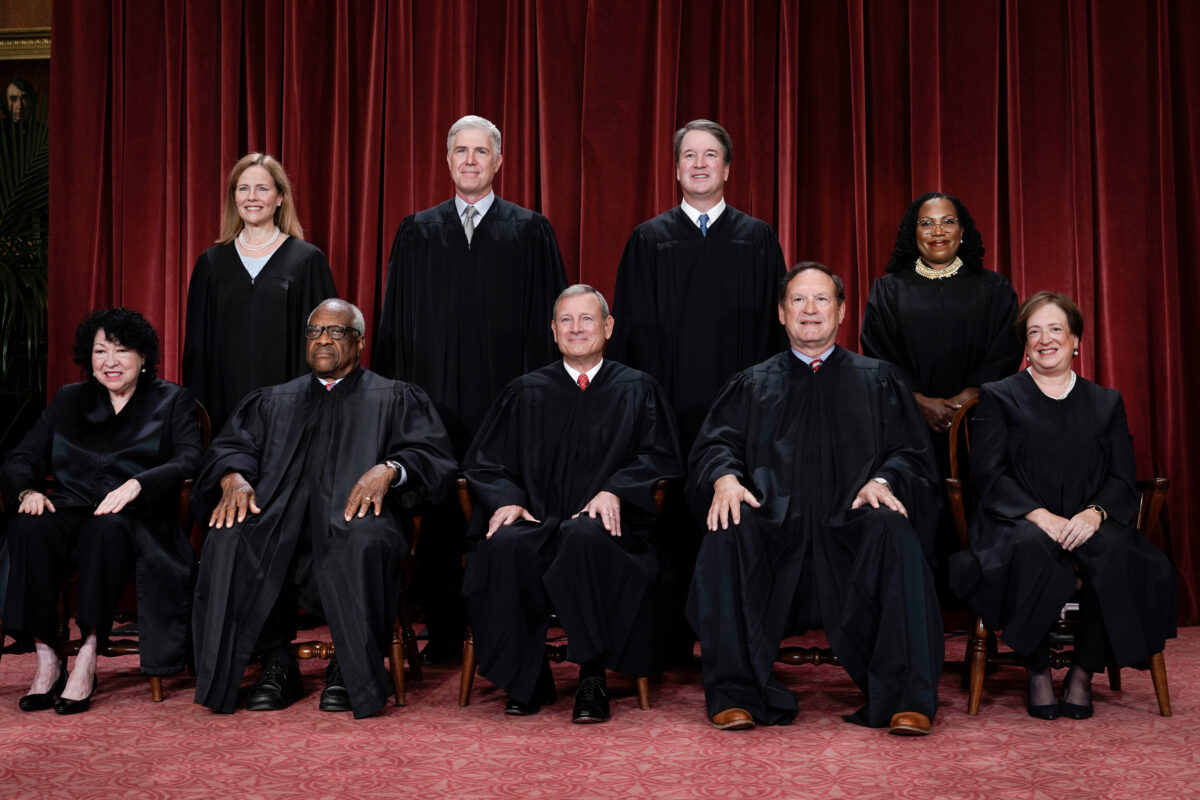
AP Photo/J. Scott Applewhite, File
The Supreme Court issued an opinion Thursday finding that a federal law barring anyone who is “an unlawful user of or addicted to any controlled substance” from having a gun was “inconsistent” with the Second Amendment, at least as far as it was enforced against the plaintiff in the case.
The court’s ruling in United States v. Hemani, written by Justice Neil Gorsuch, was unanimous on the core points and four separate concurring opinions debating the scope of the constitutional rights in this situation.
The case arose from the arrest of Ali Danial Hemani, a dual citizen of the U.S. and Pakistan who was born in Texas and lived in the Dallas area with his parents. In 2022, the FBI searched his family home based on suspicion of terrorist activities. The opinion described Hemani as being “cooperative” during the search process, voluntarily surrendering a gun he had in the house, showing agents where he had some marijuana, and admitting that he “used marijuana about every other day.”
The records show that the FBI found 60 grams of marijuana, 4.7 grams of cocaine, and a Glock 19 9mm pistol during their search.
No charges were brought against Hemani or any of his relatives on the terrorism charges.
However, over six months later, based on Hemani’s admission he used marijuana, he was arrested and prosecuted for a violation of 18 U. S. C. §922(g)(3) for knowingly buying, owning, or possessing a gun while being an “unlawful user of” or “addicted to” a “controlled substance.” This is a felony offense and carries a sentence of up to 15 years in prison.
That federal statute found itself in news stories a few years ago when Hunter Biden was prosecuted for violating it, initially saying he intended to challenge the constitutionality of the law before pleading guilty and then getting a pardon from his father, President Joe Biden.
Hemani filed a motion to dismiss the indictment on Second Amendment grounds, the district court agreed with his argument and granted the motion, the government appealed to the Fifth Circuit, the appellate court again ruled in Hemani’s favor, and then the government petitioned the Supreme Court to review the case.
“The government’s prosecution of Mr. Hemani under §922(g)(3)’s unlawful user provision is inconsistent with the Second Amendment,” wrote Gorsuch.
To explain his decision, Gorsuch cited a 2022 case, New York State Rifle and Pistol Association v. Bruen, that held that courts should look back at early American history to interpret laws restricting gun rights, and only uphold such laws where there was historical precedent for that. Such traditions did not need to be an exact match, Gorsuch added, the government defending the regulation just needs to show that “the challenged regulation is consistent with the principles that underpin our regulatory tradition.”
In this case, the feds had pointed to early American laws that targeted “habitual drunkards” by jailing them, committing them to asylums, ordering them to post bonds to ensure good behavior, etc. but Gorsuch found this to be insufficiently similar, as the government was arguing it did not need to show that a drug user was “regularly incapacitated.” The government’s interpretation of the law would let it prosecute “and a college student who routinely uses a friend’s Adderall to cram for exams” or “a husband who regularly takes his wife’s prescription Ambien to sleep,” an example brought up by Justice Amy Coney Barrett during oral arguments.
The habitual drunkard laws also “usually provided some form of process,” wrote Gorsuch, like a trial or bond hearing “before an individual lost any of his liberties, even temporarily.” In contrast, 18 U. S. C. §922(g)(3) purported to “automatically divest[] an individual of his constitutional right to bear arms the moment he becomes an unlawful user and until he ends his drug use.”
Those habitual drunkard laws were also justified by claiming a purpose of protecting the public from “unusually dangerous” people who presented concerns they would “misuse” firearms and commit “violent crimes,” wrote Gorsuch, but here, “[i]t doesn’t matter what controlled substance an individual uses, in what amounts he does so, or whether his drug use has ever made him a danger to himself or others. It doesn’t even matter why he keeps a gun or how safely he does so. And for violating this automatic ban, the government insists, an individual like Mr. Hemani may be sent to prison for up to 15 years and disarmed for life.”
The court’s ruling was “a narrow one,” Gorsuch emphasized, and did not mean that someone who unlawfully uses marijuana or other drugs could be a danger to himself or others, but it was too far to allow the federal government “to conclude that anyone who regularly uses marijuana is categorically violent and dangerous without any further showing” — especially in light of recent reforms that downgraded marijuana on the federal list of controlled substances and acknowledging that it has a “currently accepted medical use.”
The ruling also did not block the government from banning people who had been convicted of felonies from possessing guns or say it could never prosecute drug addicts for gun possession, he added, including situations where the government had proof that someone’s drug use “renders him a danger to himself or others.”
SCOTUSBlog reporter Amy Howe aptly summed up the concurring opinions:
Although all of the justices agreed that Hemani’s conviction was improper, several justices wrote separate opinions. Justice Clarence Thomas filed a concurring opinion in which he argued that the law under which Hemani had been convicted violates the Constitution, because Congress does not have the power “to regulate the possession of firearms solely on the ground that they crossed state lines at some point in the past.”
Justice Ketanji Brown Jackson also wrote a concurring opinion, joined by Justice Sonia Sotomayor, in which she contended that the framework established by the Supreme Court in Bruen “is unworkable” and “vulnerable to inconsistent and arbitrary application, as judges draw different conclusions from the same historical evidence.”
Justice Samuel Alito, in an opinion joined by Justice Elena Kagan, agreed with the result that the majority reached, if not its reasoning. In his view, the federal government had “failed to show that a marijuana user like” Hemani “is incapacitated in a way analogous to the habitual drunkards that the Government’s analogues regulated.”
“The Supreme Court made the right call,” the NRA, which filed an amicus brief in the case, triumphantly wrote in a social media post lauding the court’s decision. The organization’s executive director called the opinion “a major victory for the Second Amendment and peaceable gun owners across America,” adding that “no one should be deprived of their God-given right to keep and bear arms for engaging in nonviolent conduct, and there is no historical justification for doing so.”
The Second Amendment Foundation (SAF), which was among numerous other gun rights organizations that filed amicus briefs, provided a statement to Mediaite saying that the ruling had “secured a victory for Second Amendment advocates and firearms owners nationwide.”
“The Court’s decision today affirms what SAF has argued for some time – there is no historical tradition of permanently disarming law-abiding citizens who use marijuana,” said SAF Executive Director Adam Kraut. “Founding-era laws addressed the dangers of intoxication through temporary restrictions, but not the complete ban on firearms possession for the remainder of the person’s life. We’re thrilled the Supreme Court agrees with us and struck down Mr. Hemani’s unconstitutional conviction.”
“The Court rightly held today that the proper understanding of the Second Amendment only provides for disarming those who are actually dangerous,” said SAF founder and Executive Vice President Alan M. Gottlieb. “Simply being an unlawful user of any drug fails to meet that standard, and today the court concluded that marijuana use, absent any other evidence, was insufficient to show Mr. Hemani was dangerous such that his rights could be constitutionally extinguished.”
The SAF also posted multiple tweets with an in-depth analysis of the opinion — some tongue-in-cheek, like one that quoted a section listing the Founding Fathers’ extraordinary alcohol consumption habits, some more serious and citing arguments made in their amicus brief or putting the ruling in context of other ongoing gun rights court battles.
Rob Romano with the Firearms Policy Coalition highlighted a statement from the ACLU, which had represented Hemani. The decision “makes it clear that the government cannot make it a crime for people to own a gun – which the Supreme Court has held is a fundamental constitutional right – simply because they use marijuana,” the statement said.
The law “let the government arbitrarily discriminate against marijuana users and deprive them of their rights,” the ACLU added, but now, “[t]he court has sent a strong message that the government cannot criminalize the conduct of large numbers of people by making categorical and unfounded assumptions about whether they are dangerous.”
“The High Court Says Yes to Buds and Bullets,” wrote Stephen Gutowski, founder and reporter at The Reload.
—
New: The Mediaite One-Sheet "Newsletter of Newsletters"
Your daily summary and analysis of what the many, many media newsletters are saying and reporting. Subscribe now!








Comments
↓ Scroll down for comments ↓