Trump Calls to Get Rid of Debt Ceiling Entirely, Backing Proposal from Democrats That Sparked GOP Revolt

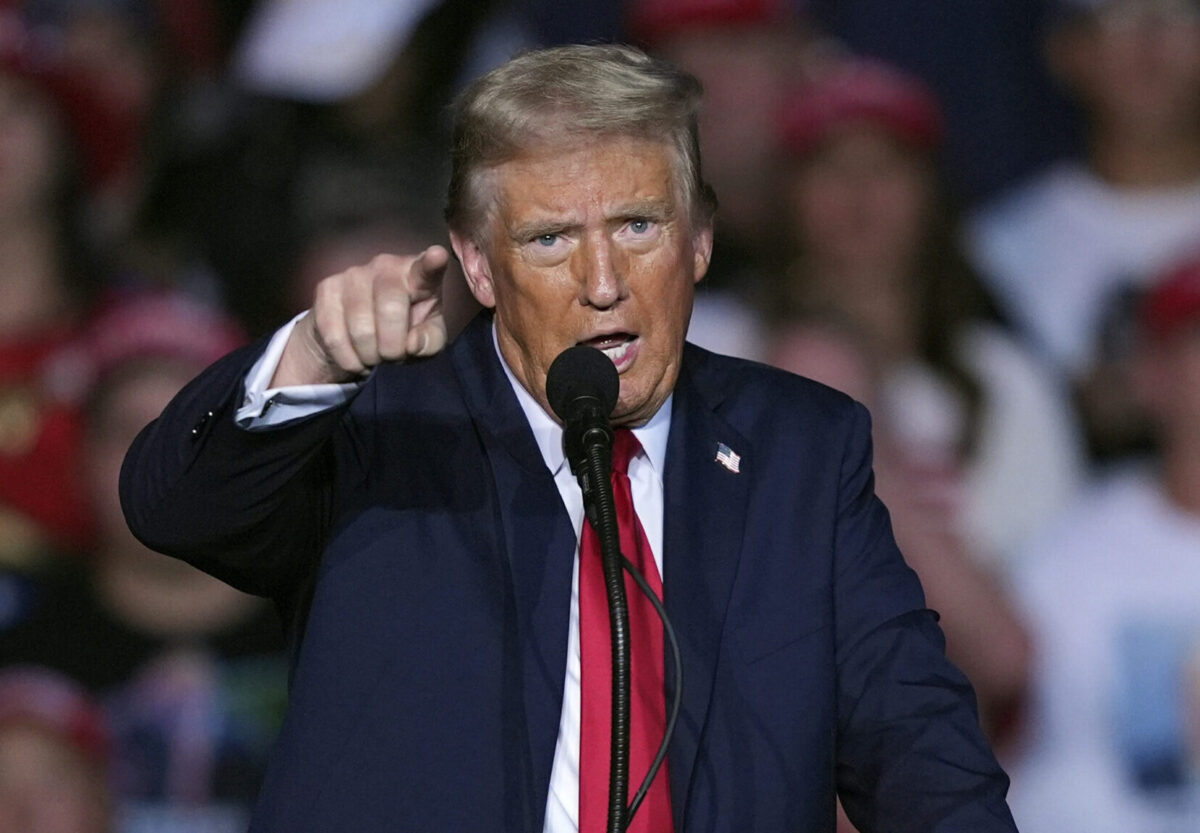
Republican presidential nominee former President Donald Trump speaks during a campaign rally at Lee’s Family Forum, Thursday, Oct. 31, 2024, in Henderson, Nev. (AP Photo/Evan Vucci)
President-elect Donald Trump called for abolishing the federal debt ceiling altogether on Thursday—offering to “lead the charge” on an idea championed in the past by some Democrats but fiercely opposed by the GOP.
Trump made the comments to NBC News journalist Garrett Hake in a phone interview, who tweeted how the president-elect “doesn’t just lift the debt ceiling—he’s keen to get rid of it.”
The Republican leader was quoted as having said: “The Democrats have said they want to get rid of it. If they want to get rid of it, I would lead the charge.”
Trump, Haake added, “sees it as a fake thing. No real value re: debt control.”
The statement comes as Washington teeters on the edge of another shutdown showdown. Just days before a government funding deadline, House Speaker Mike Johnson’s attempt to pass a sprawling bipartisan stopgap measure was derailed.
The pushback deepened when Trump and Vice President-elect JD Vance issued a statement insisting Republicans tie their spending strategy directly to raising the borrowing cap—an approach historically shunned by conservatives and which neither party had even considered.
“Republicans want to support our farmers, pay for disaster relief, and set our country up for success in 2025. The only way to do that is with a temporary funding bill WITHOUT DEMOCRAT GIVEAWAYS combined with an increase in the debt ceiling,” they said. “Anything else is a betrayal of our country.”
Trump and Vance also took a swipe at future negotiations: “If Democrats won’t cooperate on the debt ceiling now, what makes anyone think they would do it in June during our administration? Let’s have this debate now.”
Now, clearly ready to go all the way from his demand of increasing the debt ceiling to eliminating it, Trump is citing previous Democratic efforts to scrap the borrowing limit.
For the GOP, a party that has traditionally wielded the borrowing limit as a fiscal weapon, Trump’s stance has the potential to upend years of political orthodoxy for Republicans and complicate end-of-year spending negotiations. The idea alone sparked a GOP revolt in May 2023 when Democrats introduced a renewed push for the measure. Led by then-House Speaker Kevin McCarthy (R-CA), Republicans dug in ultimately ensuring that the debt ceiling remained in place as part of a last-minute deal.
Even among Democrats support for eliminating the borrowing cap has tended to cluster among progressive lawmakers and some moderate members who have grown frustrated with repeated high-stakes showdowns. Failed legislative attempts have been made by Senators Brian Schatz (D-HI) and Chris Van Hollen (D-MD) aimed at permanently defanging the ceiling as a political flashpoint.
While calls to abolish the debt ceiling have come largely from Democrats, the push has not been unanimous within the party.
Other influential Democrats have been more cautious. President Joe Biden himself has previously said removing the cap would be “irresponsible,” and some party moderates have been wary of appearing fiscally unrestrained.
The difference this time is that a Republican powerbroker—the party’s de facto leader—is making the call, exploiting an inner-party faultline for Democrats in a bid to leverage out the kind of spending bill he wants even to the fury of conservatives.
New: The Mediaite One-Sheet "Newsletter of Newsletters"
Your daily summary and analysis of what the many, many media newsletters are saying and reporting. Subscribe now!







Comments
↓ Scroll down for comments ↓