Credit Where It’s Due: Trump’s Weight-Loss Subsidy Is a Public-Health Game Changer

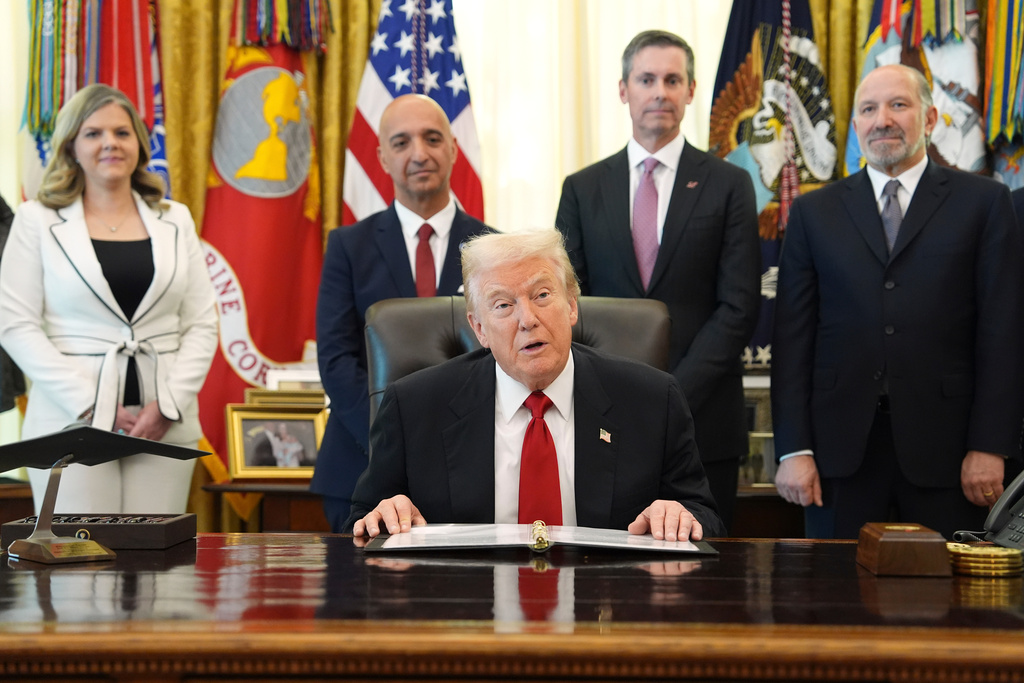
(AP Photo/Evan Vucci)
The federal government just did something extraordinary: It finally acknowledged that obesity is not a moral failure, but a chronic disease shaped by powerful corporate-run systems designed to profit from our hunger. That truth has been whispered in doctors’ offices and muttered at kitchen tables for decades, but this week, it got something much closer to an official stamp.
On Thursday, President Donald Trump announced that two blockbuster weight-loss drugs — Wegovy and Zepbound (which are also available for Diabetes treatment under the brand names Ozempic and Mounjaro, respectively) — would become dramatically more affordable thanks to new federal subsidies. An executive for Eli Lily fainted minutes later, and cable news did what cable news does and had a field day with Trump’s bizarre reaction captured by a pool photographer.
It tells you something about the moment we’re in that a policy affecting millions of bodies was instantly eclipsed by a single body collapsing. That’s cable news. That’s also us.
But if you look up from the clip, what happened just before the commotion could become one of the most consequential public-health decisions of the century.
Americans carry a heavy burden — literally. Roughly 42% of U.S. adults now live with obesity, nearly double the rate from 30 years ago. That shift costs us an estimated $170 billion a year in medical spending, and the bill is climbing. These drugs, which can cut body weight by 15–20%, are not cosmetic; they’re the rare intervention that could meaningfully change life expectancy at a massive scale. Imagine a country with fewer amputations, fewer heart attacks, fewer CPAP machines humming through the night. Even a 10% reduction in obesity prevalence would save tens of billions and give millions more people back their knees, their breath, their literal second chance.
I know because I lived it.
Over the past year or so, I’ve lost more than 70 pounds on Zepbound. No, I didn’t get my shapely form back from fasting or running; I got my life back from a prescription that enabled an intentional healthier lifestyle and diet. The side effects — nausea, GI rebellion — were annoying but not debilitating. The relief of simply fitting inside my own body again is hard to convey without slipping into testimony.
But here’s what matters: I wasn’t weak. I was sick. My relationship with food had been engineered into addiction. And the drug helped me escape by allowing me to finally cut food noise and have what I’d long thought was impossible — a healthy relationship with food consumption.
We like to believe obesity is a crisis of willpower, and there is some merit to that for sure. But the food industry knows better. Consider the humble Dorito: a chip reverse-engineered to disappear from your mouth at the precise rate that prevents “sensory boredom,” ensuring you keep reaching back into the bag. Portion sizes ballooned over decades — the original Big Gulp was 16 ounces; today its siblings top 50. This was not an accident. It was design. We outsourced our appetites to an industrial complex that became very good at making us eat more than we intended.
Now, for the first time, we have pharmaceutical tools that can counterbalance that machinery, which brings us back to Trump.
There is a particular irony here: a president who long marketed himself as a paragon of personal discipline (no alcohol, no drugs, DC-to-Bedminster on four hours of sleep) is now endorsing a policy predicated on the idea that discipline alone isn’t enough. He’s validating what public-health experts have said for years — obesity is not a moral failure; it’s a biological and environmental condition. That contradiction isn’t just striking; it’s disorienting.
So why do it?
Partly because it’s good policy — the sort of federal support and intervention that would be praised on left-leaning outlets if Joe Biden announced this. And cynics might accurately see it as a great political play: tens of millions of Americans want these drugs; most can’t afford them. Any president who finds a way to put them within reach becomes an overnight hero. And Trump has always understood the power of a deal like this — clean, transactional, instantly understood.
A subtler calculation may be at play: subsidizing drugs is easier than confronting the food industry that helped break our metabolism in the first place. Changing supply chains and subsidies is trench warfare; covering prescriptions is a sprint. Still, the outcome could be transformative. If costs drop and access rises, the ripple effects will reach hospitals, schools, and workplaces in ways we can barely model.
I’ve criticized Trump for his authoritarian tendencies, his instinct to dismantle norms like they’re drywall. I don’t retract any of that. But reality is annoyingly complicated. Here is a president who may have just done more for American health than any of his immediate predecessors.
And that’s where the story gets messiest. My own renewed life now intersects with a policy championed by Trump and executed by an administration that includes a health secretary, Robert Kennedy Jr., who thinks better eating can replace vaccines. The MAHA politics are inconsistent at best and often incoherent. But this policy is clear. The benefits are real.
Credit where due — but not without ambivalence. This is what progress looks like in 2025: a healthier nation pulled forward by a drug, backed by a president you may distrust, and paid for because we finally admitted willpower was never going to save us.
No bow. No moral. Just relief — and the hope that the ground keeps shifting beneath us in the right direction.
This is an opinion piece. The views expressed in this article are those of just the author.
New: The Mediaite One-Sheet "Newsletter of Newsletters"
Your daily summary and analysis of what the many, many media newsletters are saying and reporting. Subscribe now!







Comments
↓ Scroll down for comments ↓