Poll Showing Florida Democrats Winning Isn’t a Crystal Ball, It’s a Map

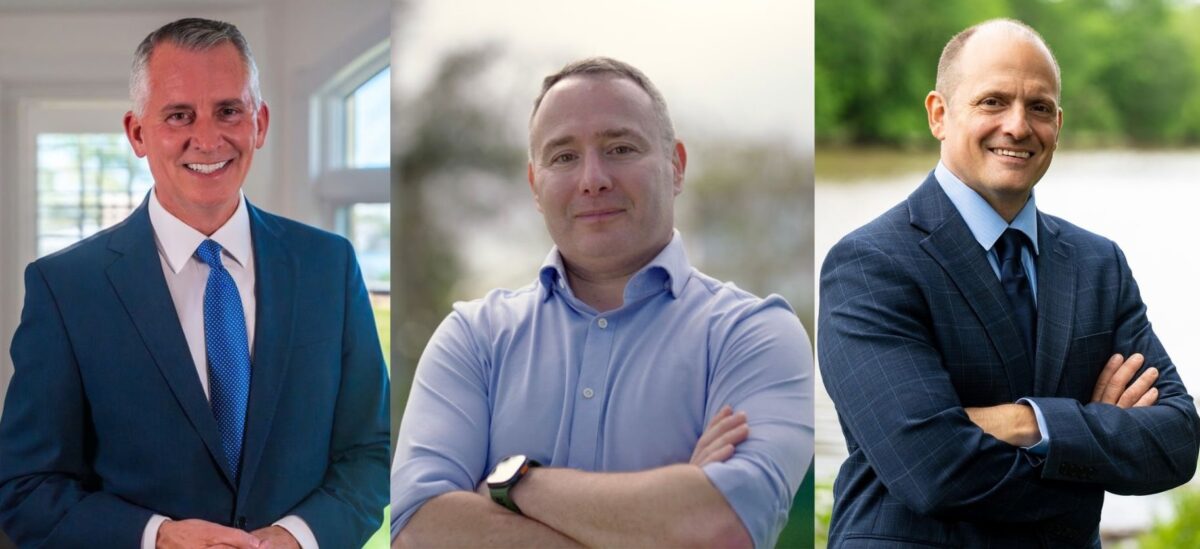
Photo credits L to R: David Jolly Campaign, Alex Vindman Campaign, José Javier Rodríguez Campaign.
A new poll with some very optimistic numbers for Florida Democrats isn’t necessarily a crystal ball for how Election Day will play out this November, but it does provide a strategy blueprint for how the candidates can find a path to victory.
Republicans have had near-total majority control of the Sunshine State since the 1990s. Rare exceptions include former Sen. Bill Nelson (D-FL), who lost his seat to Sen. Rick Scott (R-FL) in 2018, and Nikki Fried, the current chair of the Florida Democratic Party who was elected Agriculture Commissioner in 2018 and served one term before an unsuccessful gubernatorial campaign in 2022.
President Donald Trump won Florida and increased his margin of victory each time he ran: 49.02% to 47.82% (1.2 points) against Hillary Clinton in 2016, 51.22% to 47.86% (3.36 points) against Joe Biden in 2020, and 56.09% to 42.99% (13.1 points) against Kamala Harris in 2024.
This year, Florida Gov. Ron DeSantis (R) is term-limited, and it’s an open seat. Sen. Ashley Moody (R-FL) is running for re-election, and Attorney General James Uthmeier, who was appointed to the position by DeSantis after the governor appointed Moody to fill the Senate seat after Trump appointed Marco Rubio as Secretary of State, is also running for re-election.
In the GOP primary for governor, Rep. Byron Donalds (R-FL) scored the Trump endorsement and has consistently polled well above the rest of the field, with Lt. Gov. Jay Collins, former Speaker of the Florida House Paul Renner, and James Fishback all struggling at least 25 points behind Donalds over the past few months.
On the Democratic side, David Jolly, who previously represented a Pinellas County congressional district as a Republican before switching parties in 2018, is the frontrunner over Orange County Mayor Jerry Demings, although by a narrower margin. Senate candidates include Lt. Col. (ret.) Alex Vindman, who testified against Trump during his first impeachment, and State Rep. Angie Nixon. For attorney general, former state legislator and assistant secretary of labor for the Biden administration José Javier Rodriguez is all but certain to be the primary winner; one other candidate has raised only $6,600 (mostly from a $5,000 personal loan from the candidate) compared to Rodriguez raising over half a million dollars as of the end of March.
A new poll by Change Research showing optimistic numbers for Jolly, Vindman, and Rodriguez over the Republican competition got buzz on social media Monday, and the head-to-head numbers don’t tell the whole story, but they do highlight critical weaknesses for the GOP and possible pathways to victory for the Democrats.
The poll, which was commissioned by Freedom Project USA, surveyed 2,070 registered voters in Florida from May 13 to 16 via the online platform SurveyMonkey. Of this sample, 1,583 identified as likely to vote in the November 2026 election. The margin of error is 2.3%.
Change Research’s methodology memo says that the respondents were recruited through “targeted advertisements on Facebook and Instagram, as well as across the web via Facebook’s ad platform” and “text messages sent, via the Switchboard platform, to cell phone numbers listed on the voter file for individuals who qualified for the survey’s sample universe, based on their voter file data.” The memo added that “[p]ost-stratification was performed on age, gender, race/ethnicity, education, 2024 presidential vote, and region,” with the “weighting parameters…based on the demographic composition of registered voters in Florida, based on voter file data” from the Florida Secretary of State.
When respondents were asked how they were registered to vote, 34% said Democrat, 46% said Republican, 19% said Independent, and 2% said some other party.
Steve Schale, a veteran Democratic consultant who was Barack Obama’s 2008 campaign manager in Florida, told Mediaite in a phone interview Monday that Change Research was a “legitimate Democratic pollster” with a respectable track record.
“I have confidence in their work,” he said. “I’ve used them.”
Still, Schale acknowledged, political polling in modern times was complicated, and online surveys “can skew” to include respondents who are “more informed, more politically active, more likely to be college educated.”
Change Research’s polling emphasized the ongoing trends showing Donalds and Jolly the likely winners of their primaries.
Among Republicans, 48% chose Donalds, 9% Fishback, 8% Collins, 3% Renner, and 28% undecided. Trump’s endorsement is the nuclear bomb in this primary, much like it was for DeSantis in 2018, with 73% of likely GOP primary voters saying it was persuasive in their vote.
Jolly leads Demings 42% to 27% in the initial questioning, the pollster reported, and then “[a]fter brief bios are read, Jolly’s expands to a 32-point lead (56% to 24%) over Demings.”
For November, Jolly leads Donalds in the governor’s race 46% to 42% among likely voters. Key to this small lead, the pollster pointed out, were Jolly’s appeal to independents, whom he was winning “by 18 points (46% to 28%) with apparent room to grow,” and Hispanics, with Donalds falling short of Trump’s performance with Hispanic voters overall by 10 points. Only 30% of Puerto Ricans and 50% of Cuban-American voters said they would vote for Donalds over Jolly.
The poll asked a series of questions about the candidates’ records and then asked again whether the voters preferred Jolly or Donalds. This caused a small shift, with Jolly then beating Donalds 48% to 41%.
In the Senate race, Vindman was ahead of Moody 47% to 45%, and Rodriguez was ahead of Uthmeier 45% to 41% for the attorney general race (both with likely voters).
Vindman’s campaign sent Mediaite a press release touting the Change Research poll as “underscoring growing momentum” behind his campaign, pointing out another recent independent poll taken March 27 to April 3 that showed the race within the margin of error.
The Jolly campaign also sent out a press release citing the four-point lead he had in the poll as “the most recent example of Jolly’s upward momentum,” with the numbers being “driven by [the] affordability crisis and Democratic enthusiasm.”
Mediaite asked Schale for his reaction to the Change Research poll and he said he agreed with those who evaluated the Florida statewide races as still uphill for Democrats but not impossible.
“I heard Ryan Tyson say recently, it’s not probable but it’s possible for Democrats to win Florida,” said Schale, referring to the polling expert and political consultant who has advised DeSantis, Rubio, Trump’s Florida campaign, and several pro-Trump PACs.
“I’m very much a realist” on this election, said Schale, and he noted he had “seen plenty of polls that had the races flipped” with the Republicans in the lead, but there were a number of reasons to say November “feels a lot more like 2020 than 2024” and is going to be “a lot more competitive.”
Other recent national polls have showed a growing trend of negative approval ratings for Trump and Republicans on several major issues, including a reversal of the gains the GOP made with Hispanics in 2024.
The Change Research survey followed these trends, with Trump getting an overall 44% favorable rating and 52% unfavorable. With the critically-important independents, the president was drifting-down-to-the-ocean-floor depths of underwater, 28% favorable to 63% unfavorable.
Voters were unhappy with both the direction of the country (69% not satisfied) and their state (55% not satisfied), and again those numbers were worse among independents (79% not satisfied with direction of the U.S., 64% not satisfied with direction of Florida). A key part of that was the cost of living, with strong majorities expressing stress about paying for gasoline (81%), food and groceries (80%), health care (73%), homeowners’ insurance (73%), and utility costs (73%).
When asked what should be the top goal of the Florida government, the top answer was lowering the cost of living (57% for total sample, 61% for independents), second was cleaning up political corruption (50% for all, 54% for independents), and then eliminating or lowering property taxes (41% for all, 38% for independents).
There’s a warning sign in those figures for the GOP majorities in Tallahassee, as 95% of Florida voters blame higher costs on “political corruption and unchecked money in politics” and 79% say “most of the bills and executive orders in Tallahassee are influenced by who is giving whom the most campaign money.”
Even with the Democrats polling ahead, Schale still was cautious, noting that it was one thing to get from the low-40s to the mid-40s but “the road from 46% to 50% is a different conversation,” and he still viewed November as “uphill for Democrats.”
However, just the shift in Hispanic voter sentiment alone could be enough to put races at play, Schale said, explaining that if Hispanic voters had voted in 2024 the way they had in 2016, Trump would have still won Florida but by only two points, not thirteen.
Republicans will point out their strong advantage in voter registration, Schale added, and “skeptical is a totally fair place to be” but still, “I think there’s an argument for leaning in pretty hard” for Florida Democrats in November.
There were “good reasons” to invest in Florida now, argued Schale, in the short term because of the negative approval numbers for Trump and the GOP and the higher Democratic enthusiasm — as shown by the growing list of Democratic wins in special elections during Trump’s second term — and for the “longer term opportunities.”
The redistricting passed in a special session last month meant that the congressional map was “all new, we’ve never run these races,” Schale explained, and to be competitive, Democrats had to target a broader map in states like Florida and North Carolina, especially since Florida was going to add even more congressional seats in 2032 after the next U.S. Census.
“We gotta win back Miami-Dade” to have a chance, said Schale. “If we don’t engage with those voters, that’s our fault,” he added, seeing good possibilities because Hispanic voters were “open to Democrats winning them back” after souring on the economy and Trump’s immigration policies, and the promising polling among independents too.
The Change Research poll tested the effectiveness of some potential attack points for the campaigns (asking if certain things in the candidates’ records caused the voters to have “very serious doubts,” “serious doubts,” “minor doubts, “or “no real doubts” about voting for them), revealing deeper vulnerabilities for Donalds than for Jolly.
For example, only 19% of Democrats said they had serious doubts about voting for Jolly when asked about his past votes as a Republican congressman a decade ago. Only 12% of Democrats and 30% of independents had serious doubts about Jolly’s views on guns (a supporter of gun ownership but is for universal background checks, licensing for gun owners”), and 9% of Democrats and 35% of independents had serious doubts about Jolly’s position on immigration (“illegal immigrants strengthen our communities and state and want a path to legal status for people who might be here illegally but play by the rules.”)
In contrast, questions about Donalds showed both strong majorities of independents and a much higher percentage of voters in his own party voicing “serious concerns”:
52% of Republican voters and 79% of NPA’s have serious doubts about voting for Donalds when they learn about his volume of stock trades and Donalds failure to report $1.6 million is stock trades while in Congress.
42% of Republican voters and 68% of NPA’s have serious doubts about voting for Donalds when they learn about Donalds arrest records and selling drugs as an adult.
39% of Republican voters and 74% of NPA’s have serious doubts about voting for Donalds when they learn Donalds is against releasing the Epstein files.
71% of NPA’s and even 25% of Republicans have serious doubts about voting for Donalds for his support of Trump’s war in Iran. 63% of NPA voters have very serious doubts about voting for Donalds when learning Donalds gave Trump an “A” rating on the economy.
–
This is an opinion piece. The views expressed in this article are those of just the author.
New: The Mediaite One-Sheet "Newsletter of Newsletters"
Your daily summary and analysis of what the many, many media newsletters are saying and reporting. Subscribe now!




Comments
↓ Scroll down for comments ↓