
The Appeal of Elon Musk’s ‘Go F*ck Yourself’ Rant

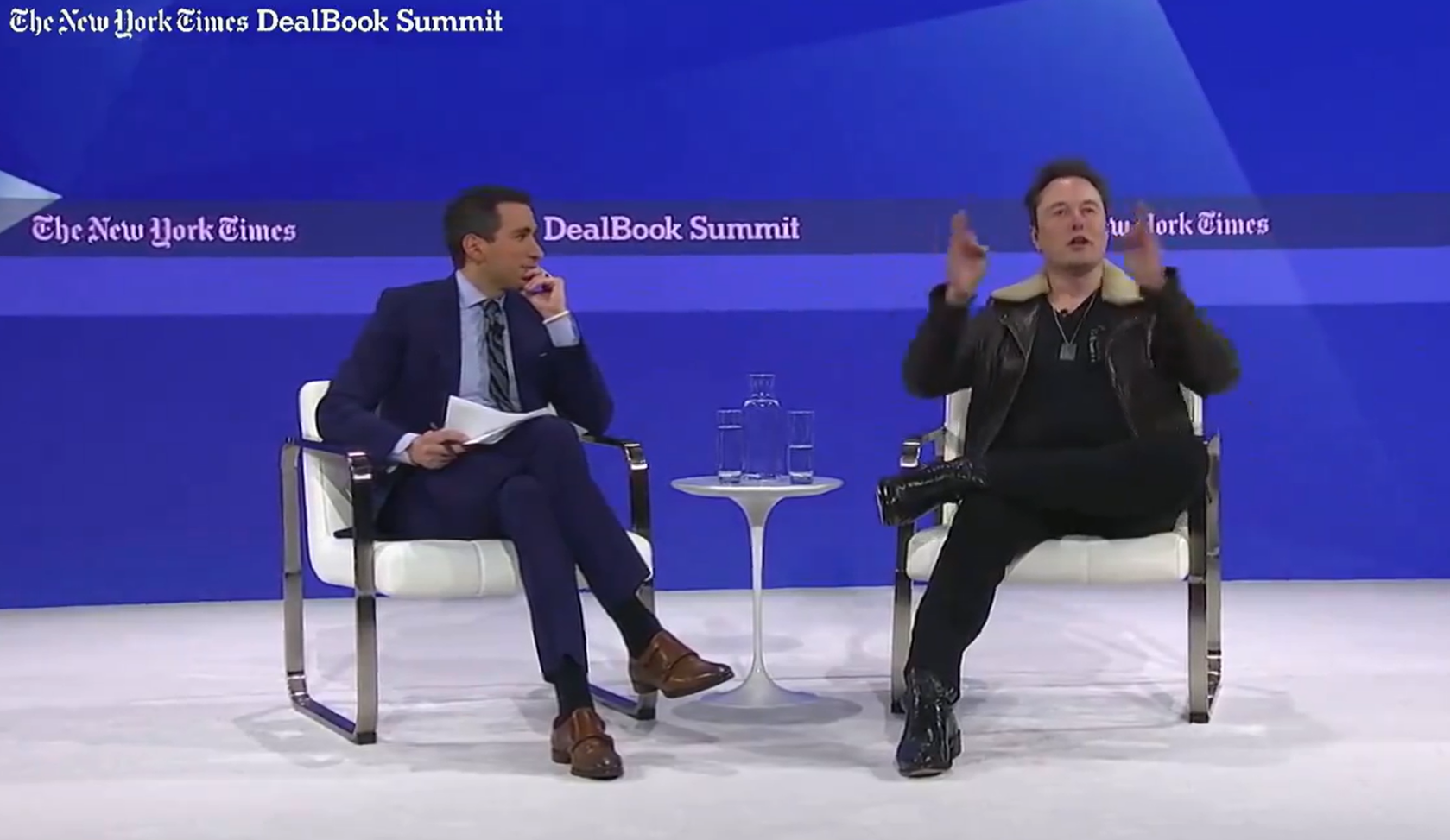
Elon Musk’s outburst at the New York Times’ DealBook summit drew a wide variety of hysterical reactions on Wednesday evening.
Some clutched their pearls while others marveled at Musk’s lack of practical sensibility. Why would — and how could — he provoke the drivers of X’s revenue at such a time as this?
With advertisers increasingly willing to bend to pressure campaigns meant to get them to withhold their dollars from X, common sense would counsel Musk to do all he can to reassure and mollify them.
Instead, Musk chose violence.
“If someone’s going to try and blackmail me with advertising? Blackmail me with money? Go fuck yourself. Go. Fuck. Yourself. Is that clear?” asked the defiant billionaire from the stage.
Much — much too much, in this author’s estimation — has been made of Musk as a kind of conservative savior. At the head of X, Musk has been far too erratic to fulfill the promise of his initial takeover. And despite his occasional endorsement of conservative policy or a far-right conspiracy theory, Musk has an inconsistent worldview that is oftentimes antithetical to that of a majority of conservatives; take his praise for and placation of the Chinese Communist Party as an example.
But there is some appeal in Musk’s willingness to hold up a middle finger to the horde of critics who giddily report on his every failing or ill-advised utterance.
Musk is a powerful public figure whose decisions and words carry weight, and he gives the media plenty of material to work with. Still, it’s obvious that the oversaturated coverage of Musk is attributable not just to the worthiness of each of the individual acts and remarks he’s responsible for, but to the press’s palpable, all-consuming contempt for him.
Eager to provide more evidence for this axiomatic truth, CNN’s Oliver Darcy commented on Wednesday evening’s events by evenhandedly declaring that “Musk killed Twitter long ago. It no longer exists. What currently sits in its place, X, is a deformed, warped version of the social media company that so much of the public turned to for information.”
“Like a zombie, X occupies the same body of Twitter, but its soul has long departed,” he continued.
To the average American or even user of the platform, this reflects a strange, un-relatable fantasy more than real life. And yet it is still broadly emblematic of so many journalists’ view of Musk and his role in their own lives.
There are plenty of reasonable criticisms to make of Musk and the ubiquitous company he owns. In some ways — perhaps most notably by renaming it X — he has made that company worse.
But to pretend to that Twitter was a fountain of truth and model for discourse in its pre-Musk era and assert that it is now unrecognizable from that ideal comes across as detached from reality. The bird app has always been a hive of disinformation and invectives. Any increase in either over the past year has hardly been discernible, like an extra million dollars tacked onto a a billionaire’s net worth.
The truth is that Darcy and most of the media subject their audiences to such overwrought pronouncements mostly because Musk has run afoul of some of their most treasured orthodoxies about Covid, gender ideology, and the extent to which objectionable political speech should be regulated by private actors.
Musk provides cover for the media by dabbling in ridiculous conspiracy theories and lashing out in the way that he did on Wednesday.
But whatever his manifold and manifest faults, the root of the disdain for Musk is his willingness to just say no to the kind of people who attend the New York Times DealBook summit. The media would not suddenly change their tune on Musk if X were to find financial success or even if he were to mature in his own online habits.
It would take a wholesale ideological mea culpa, a heartfelt apology for ever associating with members of the right to earn back the approval of the press.
So there is something appealing — if not admirable — about his decision to pursue this alternate, uncompliant course.
This is an opinion piece. The views expressed in this article are those of just the author.
New: The Mediaite One-Sheet "Newsletter of Newsletters"
Your daily summary and analysis of what the many, many media newsletters are saying and reporting. Subscribe now!








Comments
↓ Scroll down for comments ↓