Why Experts Predict a Shift Toward Tokenized Assets by 2027


The idea of tokenizing assets has been around for a while, but 2027 is shaping up to be the year when it moves from theory into mainstream trading. Experts point to rising institutional involvement, clearer regulations, and fast-improving tech as reasons why tokenized markets are set to explode.
For traders, this means a new layer of opportunity. Instead of only dealing with stocks, ETFs, or crypto, you’ll start seeing real-world assets like real estate, bonds, and money market funds traded on blockchain rails. The shift won’t happen overnight, but by 2027, tokenization could be a normal part of how portfolios are built and managed.
Market Predictions: Tokenized Asset Growth Forecasts for 2027
EY’s survey shows that big investors plan to allocate between 7 and 9 % of their portfolios to tokenized assets by 2027. As interest grows, more investors are asking how to tokenize an asset, from real estate and bonds to money market funds, because understanding the process is quickly becoming as important as choosing the right allocation.
BCG projects tokenized assets could hit $17 trillion in value by 2030, while McKinsey takes a more cautious view at $2 trillion. That spread shows just how much uncertainty is still in play. For traders, it highlights the need to stay flexible, markets may overshoot or underdeliver, and positioning ahead of the curve will matter more than ever.
As of 2025, tokenized assets sit at around $50 billion in market size. That might look small compared to forecasts, but it’s the foundation for exponential growth. In just a few years, we’ve already seen treasury tokens, tokenized funds, and early real estate deals gain traction. If that momentum compounds, the jump from billions to trillions isn’t unrealistic, it’s the same trajectory crypto itself took in its early years.
High-Yield Asset Classes Leading Tokenization by 2027
Not all assets are being tokenized equally. By 2027, we’re seeing a strong shift in how these are packaged, traded, and opened up to more investors through tokenization.
For traders, this means two things:
1. You get access to asset classes that used to be limited to institutions.
2. You can now trade or allocate into these assets with more flexibility and lower minimums.
Here are the four key areas leading the way:
● Private Credit and Alternatives: Around 86% of institutions plan to include private credit in tokenized portfolios. Tokenization lowers entry barriers with fractional ownership and shorter lockups, making high-yield debt more accessible to traders.
● Real Estate: Analysts call this a $10 trillion unlock. Tokenized real estate breaks properties into digital shares, creating liquidity in a historically illiquid market and offering secondary trading options.
● Money Market Funds: Tokenized MMFs have already passed $1 billion TVL. Products from Franklin Templeton and others settle instantly and are gaining traction as a low-risk capital park between trades.
● Corporate Bonds and Treasuries: Tokenized fixed income is expanding, with US and EU pilots issuing digital treasuries. Faster settlement, transparency, and smaller ticket sizes are opening bond markets to more investors.
Trading and Investment Strategies for Tokenized Assets
Tokenized assets are still new, but traders are already building strategies around them. The main focus is on allocation models, platform selection, and risk management. Institutions are setting the tone, and individual traders can take cues from how capital is flowing.
Different strategies depend on risk appetite. Conservative investors use tokenization to diversify without taking on major exposure, while more aggressive traders are leaning in to capture early yield. Here’s a quick breakdown:
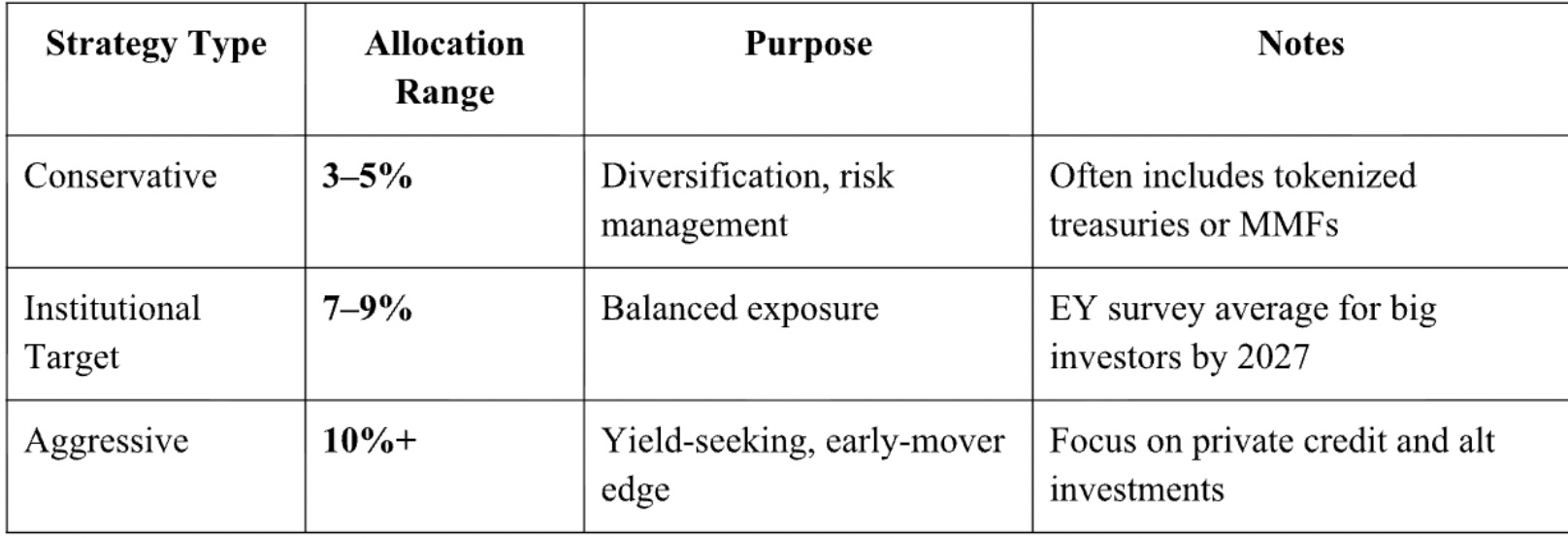
Where you trade matters. Not all tokenized asset platforms offer the same experience. Key things to check:
● Custody & Security: Is the platform insured or regulated? How are assets stored?
● Liquidity & Access: Are there active secondary markets? What’s the bid-ask spread?
● Interoperability: Can assets be moved between wallets or used in DeFi apps?
Look for platforms with multi-chain support, institutional-grade custody, and on-chain auditability.
Technology Infrastructure: What’s Changing by 2027

The rails behind tokenized assets are quickly improving. What used to be a clunky, high-fee environment is now moving toward faster, cheaper, and more flexible systems. By 2027, these upgrades will make a real difference in how traders interact with tokenized markets.
One of the biggest changes is the rise of Layer 2 solutions. These are built on top of existing blockchains like Ethereum to reduce transaction fees and speed up trades. Instead of paying $20 to move a token, Layer 2 systems can bring that down to just a few cents — or even less. That makes active trading and portfolio rebalancing much more realistic.
We’re also seeing big improvements in cross-chain interoperability. Before, if your token lived on one blockchain, you were stuck there. Now, with new bridging protocols, you can move assets between networks without having to cash out or start over. This creates more flexibility for traders and lets liquidity flow where it’s needed.
Another key upgrade is smart contract automation. More platforms are embedding logic directly into tokenized assets. This means things like automatic yield distribution, fee payouts, and even portfolio rebalancing can happen on-chain — no manual input needed. That saves time and reduces execution errors.
Here’s what to keep in mind as a trader:
● Layer 2 scaling = lower gas fees and faster transaction times.
● Bridging protocols = flexibility across networks without needing to off-ramp.
● Smart contracts = automation of tasks like yield claims and asset swaps.
Trading Risks and Market Inefficiencies to Monitor

Tokenized assets are still in the build-out phase, which means timing your entry matters. Traders who understand when to step in can capture growth while avoiding unnecessary risks. The path to 2027 will likely unfold in stages, each with its own opportunities.
From now through 2026, we’re in what many call the infrastructure build-out phase. Platforms are being tested, regulations are being finalized, and institutions are lining up capital. For traders, this stage is about positioning early. Watching pilot projects, treasury token launches, and real estate platforms can reveal which markets will scale first.
By 2027, the shift will be clearer. Liquidity will deepen, institutional flows will grow, and tokenized products will start appearing in mainstream portfolios. Entering too late could mean missing early-mover advantages, but entering too early in thin markets could trap capital. Balance is key.
Here are three timing strategies to consider:
● 2025–2026 (Build-Out Opportunities): Focus on infrastructure plays and pilot programs. Traders who track early adoption can capture growth before markets mature.
● Early-Mover Advantages: Tokenized private credit, real estate, and treasury tokens may offer outsized returns as liquidity builds. Fractional access means smaller positions can still deliver strong exposure.
● Exit Strategy Planning (Post-2027): Like any market, tokenization will eventually normalize. Having an exit plan — whether rotating into more liquid products or locking in early gains — helps manage risk.
Conclusion: Positioning for the Tokenized Asset Shift
By 2027, tokenized assets are expected to move from niche experiments into mainstream portfolios, creating both opportunities and risks for traders. Market forecasts point to trillions in value, with institutions already planning allocations and regulators providing clearer frameworks.
The strongest growth will likely come from high-yield areas like private credit, real estate, and tokenized money market funds, supported by infrastructure upgrades that make trading faster, cheaper, and more transparent.
Members of the editorial and news staff of Mediaite were not involved in the creation of this content.
New: The Mediaite One-Sheet "Newsletter of Newsletters"
Your daily summary and analysis of what the many, many media newsletters are saying and reporting. Subscribe now!








Comments
↓ Scroll down for comments ↓