
Google Working On New Version of Google Glass, New VR Devices, and High-Tech Temporary Tattoos

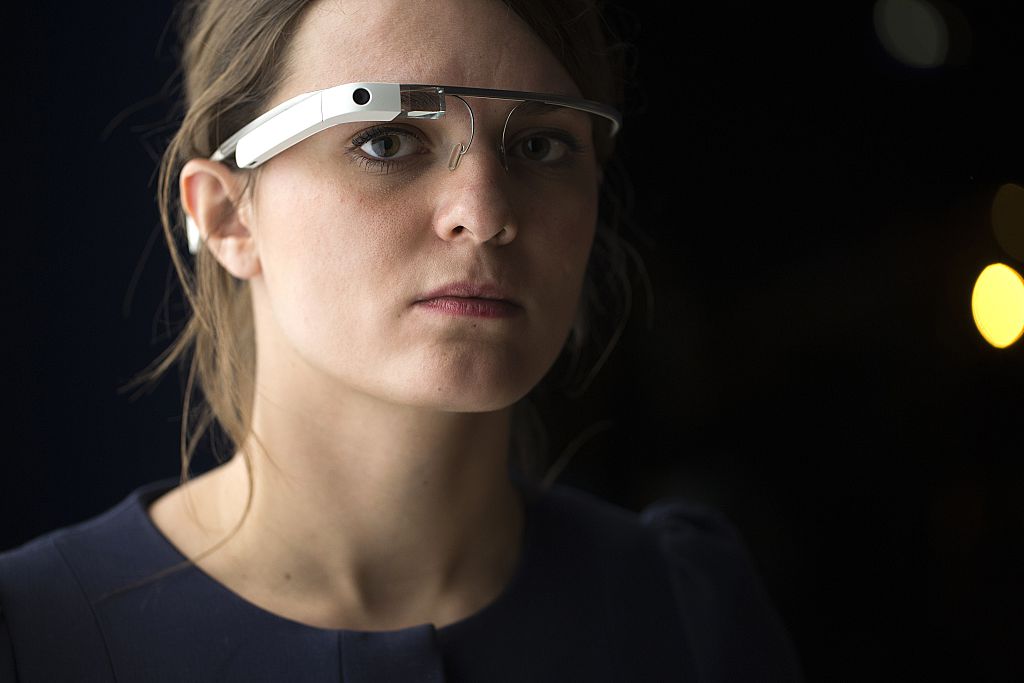
Photo credit: JOEL SAGET/AFP via Getty Images, from the November 6, 2014 exhibit by Niki de Saint Phalle at the Grand Palais in Paris.
As we’re all stuck at home during this pandemic, technology that allows us new ways to amuse ourselves and communicate with each other has become more important than ever, and Google has been working on several new ideas that may impact our lives very soon.
Tech website CNET has the detailed feature story, describing several projects in the works at Google. Some of the projects are being developed internally at Google, as part of their Interaction Lab, a division of Google Research.
Alex Olwal, who currently heads the Interaction Lab, described its goal as expanding Google’s “capabilities for rapid hardware prototyping of wearable concepts and interface technology,” including wearable tech like smartwatches and eyewear like Google Glass, which launched in 2013, only to be discontinued amid concerns that it could violate privacy laws.
Other projects, like virtual reality devices and wearable smart temporary tattoos, are being developed in collaboration with computer scientists, engineers, and researchers from universities across the globe, supported with funding from the Google Faculty Research Awards.
These efforts, notes CNET, have implications beyond device sales and Google’s ability to compete with products like the Apple Watch or various video game platforms:
It isn’t just about selling hardware. Getting sensor packed-devices onto consumers could mean a treasure trove of data beyond what people produce on their phones or at their desks. It’s an especially valuable haul for Google, which makes more than $160 billion a year, mostly through targeted ads that are informed by the personal data of people who use its services. The gadgets also create inroads to lucrative new businesses for tech giants, like health and fitness, though lawmakers and regulators have privacy concerns about Silicon Valley’s ever-expanding scope.
Google’s status as the modern world’s default search engine and its ubiquity as an email, calendar, contacts, messaging, mapping, and website platform — not to mention other Google subsidiaries like YouTube — means that the company has an unprecedented level of access to all of our personal data. The tech giant’s recent acquisition of Fitbit further raised concerns about opening the door to access the health data of millions of people.
Still, time has shown that many people are willing to sacrifice some level of personal privacy in exchange for convenience. Letting Google Maps save your home and work locations, and learn your common routes — and those of the other drivers in your town — helps it offer you better navigational advice.
Here are some of the new projects Google has been developing to entertain you while they learn all sorts of interesting details about you:
1D Eyewear are spectacles are described as “an understated pair of shades that pairs with an Android device and projects holographic icons and colored lights over a wearer’s eyes,” and attempt to improve upon Google Glass’ failures, notably the chunky design, as well as offering holographic images that assist with navigation and notifications.
Grabity, one of several devices meant to improve the “reality” of virtual reality, is “a wearable haptic device designed to simulate kinesthetic pad opposition grip forces and weight for grasping virtual objects in VR.”
The device, developed in collaboration with researchers at Stanford University, the alma mater of Google co-founders Larry Page and Sergey Brin, slips over the thumb and forefinger like you are holding onto a soda can and employs several small motors that recreate the vibrations, resistance, weight, and inertia of picking up an object and moving it around.
SkinMarks uses temporary tattoos made with conductive ink to turn your skin into an interactive touchpad to control other devices. The tattoos would trigger sensors on the device as you made gestures like tapping or swiping, or bending or squeezing your finger.
The benefits to using a tattoo in this way include taking advantage of our more precise fine motor skills as more natural-feeling way to interact with technology, and in a way that allows you to do so without looking.
Other Google projects described by CNET include smart fabrics with interactive sensors woven into the material and hybrid watches that combine analog watch hands with digital smartwatch tech.
“Oh, Grandmother,” Little Red Riding Hood famously remarked to the Wolf, “what big ears you have.” And what big eyes too!
“All the better to see and hear you with, my dear,” came the Wolf’s reply.
Soon, no one will have bigger eyes and ears than Google.
“And oh, Grandmother, what big teeth you have!”
New: The Mediaite One-Sheet "Newsletter of Newsletters"
Your daily summary and analysis of what the many, many media newsletters are saying and reporting. Subscribe now!











Comments
↓ Scroll down for comments ↓