
Freed Jan. 6 Ringleaders Convicted of Seditious Conspiracy Vow ‘Retribution’ Against Prosecutors, Court

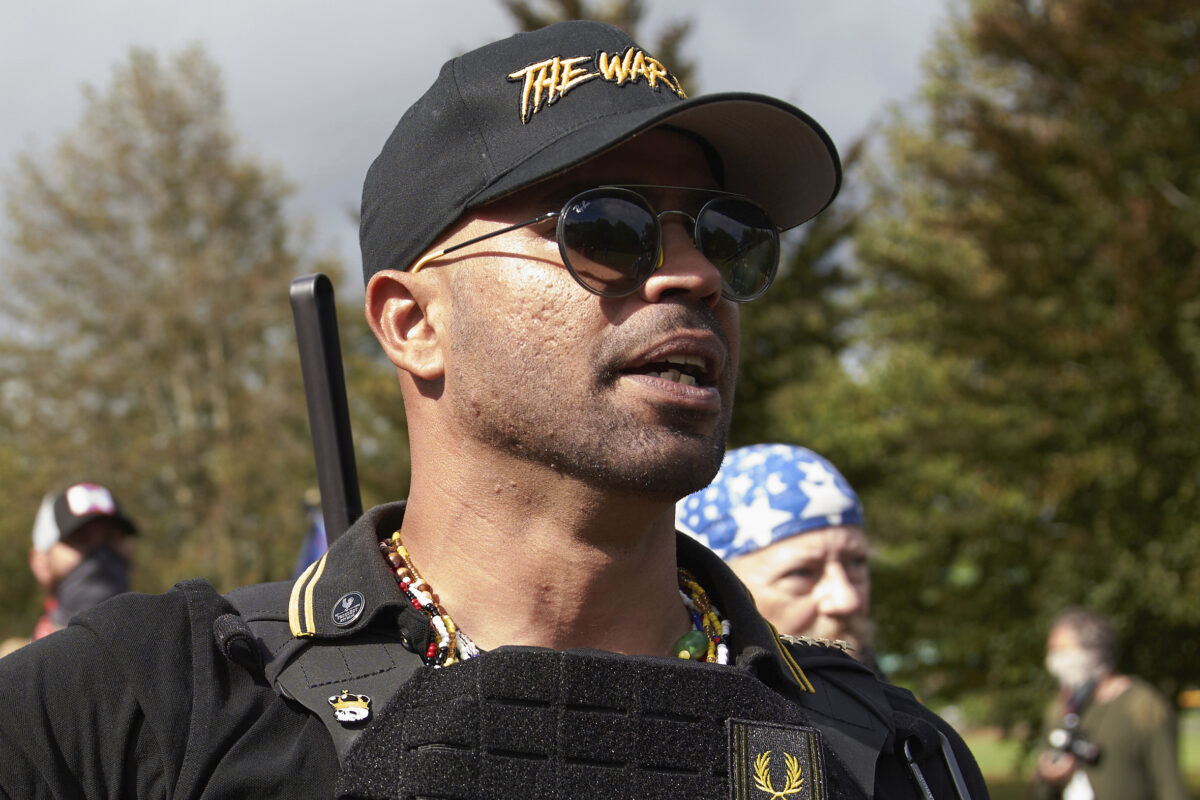
AP Photo/Allison Dinner
Proud Boys leader Enrique Tarrio and Oath Keepers founder Stewart Rhodes, newly freed from prison after President Donald Trump commuted their sentences for seditious conspiracy connected to the Jan. 6, 2021 attack on the U.S. Capitol, vowed “retribution” against those who put them behind bars.
Within hours of his inauguration, Trump signed off on orders to pardon approximately 1,500 people, commute the sentences of fourteen more, and direct the Department of Justice to dismiss with prejudice (meaning the cases cannot legally be re-filed) any remaining indictments. The 47th president’s broad grant of freedom applied to nearly all the Capitol rioters, even those charged with or convicted of violently assaulting police officers and the ringleaders of the attack like Tarrio and Rhodes, who walked free early from their 22- and 18-year sentences, respectively.
The broad scope of the pardons and commutations took even congressional Republicans by surprise, and several explicitly criticized it, including former Senate GOP leader Sen. Mitch McConnell (R-KY) and Sen. Thom Tillis (R-NC), as did a national police union that had endorsed Trump.
The sudden release of hundreds of rioters who had been charged or convicted of felonies for violently assaulting law enforcement officers has raised concerns about potential future acts of violence. At least one freed rioter has already been re-arrested, a Florida man indicted for assaulting police officers and setting off an explosive device during the riot, but that was for a previous federal gun crime.
The rhetoric from Tarrio and Rhodes since their release seems likely to intensify worries about new criminal activity. Their post-commutation commentary “was couched in a tone of cautious belligerence,” wrote The New York Times’s Alan Feuer, but they still “asserted unrepentantly that they wanted Mr. Trump to seek revenge on their behalf for being prosecuted.”
“Success,” Tarrio said on conspiracy theorist Alex Jones’s Infowars podcast, “is going to be retribution.” The far-right leader called into the show just a few hours after he was set free from a federal prison in Louisiana, expressing devout loyalty and gratitude to Trump “for helping us through these difficult times and releasing me.”
“Twenty-two years — this is not a short sentence,” said Tarrio. “That’s the rest of my life. So Trump literally gave me my life back.”
Tarrio then spoke about “seeking vengeance” against those who put him and his allies behind bars. From the Times report:
Mr. Tarrio then began a sustained attack on the criminal trial in Federal District Court in Washington where he and three of his lieutenants were found guilty of sedition — a crime that requires prosecutors to prove that defendants used violent force against the government.
…The Proud Boys played a central role on Jan. 6 both in confronting the police at the Capitol and in encouraging other rioters to breach police lines. While Mr. Tarrio was not in Washington that day, prosecutors say he helped prepare his compatriots for street fights and remained in touch with them while the mob — with the Proud Boys in the lead — overran the Capitol.
In his first hours of freedom, he was also focused on seeking vengeance against those who investigated and prosecuted the events of Jan. 6. “Now it’s our turn,” Mr. Tarrio declared.
“The people who did this, they need to feel the heat,” he said. “They need to be put behind bars and they need to be prosecuted.”
The Proud Boys leader made similar remarks when he landed at Miami International Airport on Wednesday. Local reporters with the Miami Herald described Tarrio as wearing a “Make America Great Again” hat, but in the black-and-yellow colors favored by the Proud Boys, and a t-shirt that portrayed Trump’s mugshot from his own arrest, but with both middle fingers extended (as shown in the Herald’s photographs at this link). From the Herald’s report:
He also said he hopes the Trump administration investigates former top Justice Department officials, including ex-U.S. Attorney General Merrick Garland, whose office oversaw the Jan. 6 probes. “If they committed any crimes, they should be prosecuted,” he said. “The same exact system that we went through, put them through.”
Rhodes also made comments after his release showing his lack of contrition and desire for payback when he showed up Tuesday afternoon outside a local Washington, D.C. jail that has held multiple Jan. 6 defendants.
When asked if he had any regrets, Rhodes said he had none “because we did the right thing.” He spoke about how he hoped Kash Patel would be confirmed as FBI director and then “get in there and clean house,” and made baseless accusations that the prosecutors in his case broke the law.
“What has to happen first,” said Rhodes, “is that the prosecutors who suborned perjury — that’s a crime — need to be prosecuted for their crimes.”
He was noncommittal about his future involvement with the Oath Keepers, commenting that he “might just decide to hang up my spurs.” Tarrio, on the other hand, expressed his intent to resume leadership of his organization, telling reporters on Trump’s inauguration day that he had “a suggestion for the mainstream media,” that “they should stop calling me the ex-Proud Boys leader.”
Both far-right groups were “devastated” by the Jan. 6 prosecutions, according to the Times, with “dozens of their members” — including senior leadership like Tarrio and Rhodes — being convicted and given lengthy sentences, “often with the help of turncoats and informants from within the organizations.” Many of the January 6 defendants had family members, former friends, or colleagues turn them in or submit incriminatory evidence against them.
It all adds up to a large number of people, with past convictions for violent crimes (many with criminal histories predating January 6), recently freed and with motivations to seek revenge. Trump’s pardons and commutations, as broad as they were, offer the rioters no protection here for any past unrelated crimes they committed where the statute of limitations has not yet passed, or for any subsequent crimes they might commit.
If Tarrio, Rhodes, or any other released rioter decides to seek vengeance on their own against the prosecutors, court officials, politicians, or anyone who provided evidence against them, they could very well find themselves back behind bars. Most of those charges one would expect to see for revenge efforts would fall under state criminal codes (assault, stalking, harassment, and so on), and would therefore be beyond the power of the president to pardon. Blue state governors would be highly unlikely to grant mercy to a former January 6 defendant, and even the most MAGA of red state governors may find it politically unpalatable to pardon someone for a domestic violence incident or other violent crime.
New: The Mediaite One-Sheet "Newsletter of Newsletters"
Your daily summary and analysis of what the many, many media newsletters are saying and reporting. Subscribe now!








Comments
↓ Scroll down for comments ↓