How Bernie’s Campaign Is Making Sure College Students Vote For The Revolution Before Partying On Spring Break

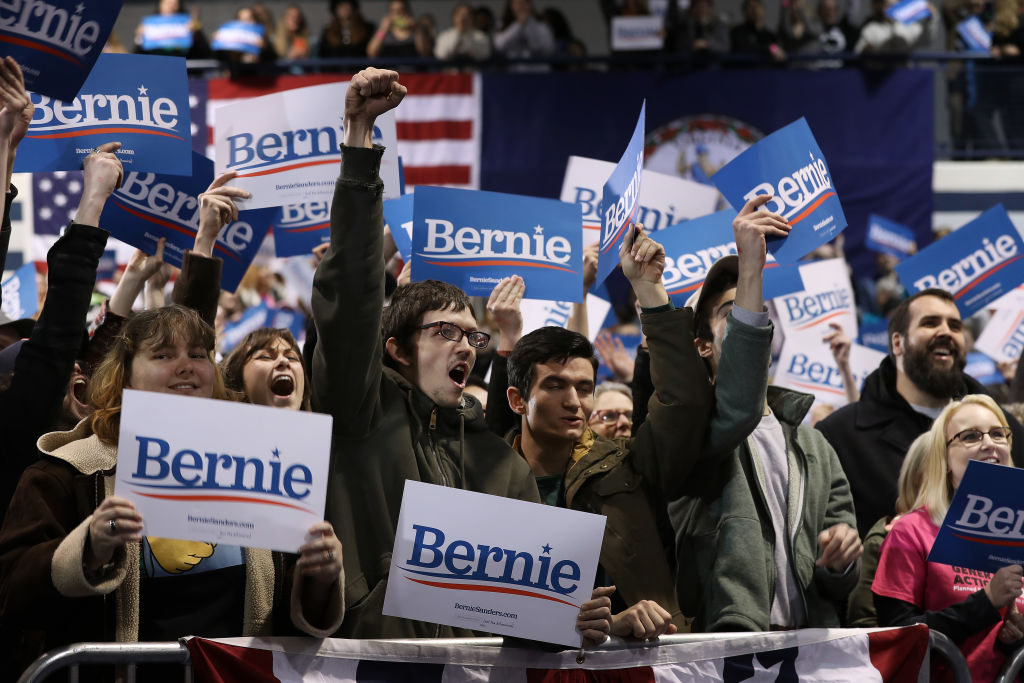
Chip Somodevilla/Getty Images
Fresh off a disappointing Super Tuesday, the Bernie Sanders campaign is turning its focus to new contests in critical March 10 and March 17 states, like Michigan, Florida, Arizona, Ohio, and Illinois.
But there’s just one problem: Thousands of young voters — who feel the Bern the strongest — could be partying in Cancun instead of breathing new life into his political revolution on primary day.
On Super Tuesday, which saw the rise of former Vice President Joe Biden, and the morphing of the Democratic primary into basically a two-person race, 58% of voters ages 18-to-29 voted for Sanders, while just 17% chose Biden, according to exit polls. And the Sanders campaign knows it can ill-afford to leave votes on the table from its most passionate constituency, especially since Super Tuesday exit polls also showed turnout from young people was not at the levels he hoped for, compared to older voters, in states like Texas.
“In 2016, we were building the airplane at the same time we were flying it,” Sanders senior advisor Chuck Rocha told Mediaite. “We were focused on the early states, but this time we preplanned for it.”
Rocha said the campaign is doing college webinars so students can develop, or “make a plan,” to early or absentee vote, before they get to the business of ordering a rum punch in South Beach.
“If you want to know which candidate is the Spring Break candidate, there is no doubt it’s Tio Bernie,” Rocha, the architect of the campaign’s Latino outreach strategy, said.
While some colleges like the University of Miami in Florida told Mediaite their students will be back in time for the state’s March 17 primary, others fall right during the early voting period or on primary day. Even if a university’s Spring Break is before the primary, student volunteers and organizers are working to make sure their classmates are educated on their ability to send mail ballots before heading out and not having to scramble the day of.
Starting off spring break storng, I’m attending Bernie Sanders for Michigan’s event, “Rally in Grand Rapids with Bernie Sanders” – sign up now to join me! https://t.co/1OFizqjCjg
— Nick West (@nw3st) March 4, 2020
Marisol Garcia, 18, a freshman at Arizona State University, said she is part of the Students For Bernie club on the Tempe, Arizona, campus she attends, which has about 30 students and received training from Sanders campaign staff to organize students on ASU campuses.
On Super Tuesday, while others were glued to cable news, ASU students were at a Bernie kickoff rally, where she planned to share a message that students should canvas and vote with the ballot they received a week ago, before they leave the state for Spring Break from March 9 to March 15.
Garcia said the energy for Sanders on campus is strong, with other groups like the Young Democrats pushing get out the vote efforts, and Bernie literature everywhere on campus. In a warning for Biden, who appeared ascendant Tuesday night, she said young people are “really worried” about his candidacy.
“I don’t speak for everyone, but I think Bernie Sanders is the only person who can beat Donald Trump at this point in the game,” she said before the Super Tuesday results rolled in. “I’m not excited about Joe Biden. If Democrats want young people to be enthusiastic about voting, he’s not the candidate.”
Florida A&M University, also known as FAMU, is a historically black college where Spring Break overlaps with the March 17 primary in the state. There, Dream Defenders, a group that was started after the murder of Trayvon Martin and advocates to reform the criminal justice system, is working to educate students on deadlines and when and how to vote.
While the school’s Spring Break is from March 13 to March 20, early voting has begun and the group’s political action committee, which endorsed Sanders, doesn’t think Daytona Beach trips will hurt the Democratic socialist firebrand.
“It’s not a huge disaster, because an on-campus voting location opens this Saturday, so we feel very confident about getting the majority of students on campus to vote before they leave for Spring Break,” Andrew Smith, the group’s electoral manager, said.
Smith said the student voter education includes information on day of voting, teaching them the need to register to vote as a Democrat, and “teaching people about Bernie’s policies and why they’re important and transformative for young people.”
Dream Defenders’ endorsement of Sanders was a “deeply democratic process,” Smith continued, which was supported by 90% of their more than 1000 members. “That speaks to the deep level of trust this presidential candidate has from young black and brown people in our country, because he put in the work to build trust with often overlooked communities,” he said.
Sanders has garnered higher levels of support during the primary from Latino voters than other candidates, including 36% to Biden’s 25% across Super Tuesday states. But Biden ran up the score with black voters, garnering 58% of black support, while 17% voted for Sanders.
Brian Gaines, a political science professor at the University of Illinois, which will have its students on Spring Break during the March 17 primary day, said the Sanders campaign is “unusually well-organized and so wherever there are early voting possibilities, they’re priming people with, ‘Don’t forget, if you’re not going to be here, you can vote early.'”
Other candidates don’t have the grassroots support Sanders has, Gaines said, so to the extent students “already bought a ticket to Mexico,” Sanders is likely relying on them more than others.
“Our people’s wheelhouse is knowing a good party,” Rocha, with the campaign, said. “And finding where the political excitement is.”
New: The Mediaite One-Sheet "Newsletter of Newsletters"
Your daily summary and analysis of what the many, many media newsletters are saying and reporting. Subscribe now!








Comments
↓ Scroll down for comments ↓