Washington Post Slapped With Massive Class Action Lawsuit for Alleged Price Gouging of Its Most Loyal Subscribers via ‘Surveillance Pricing’

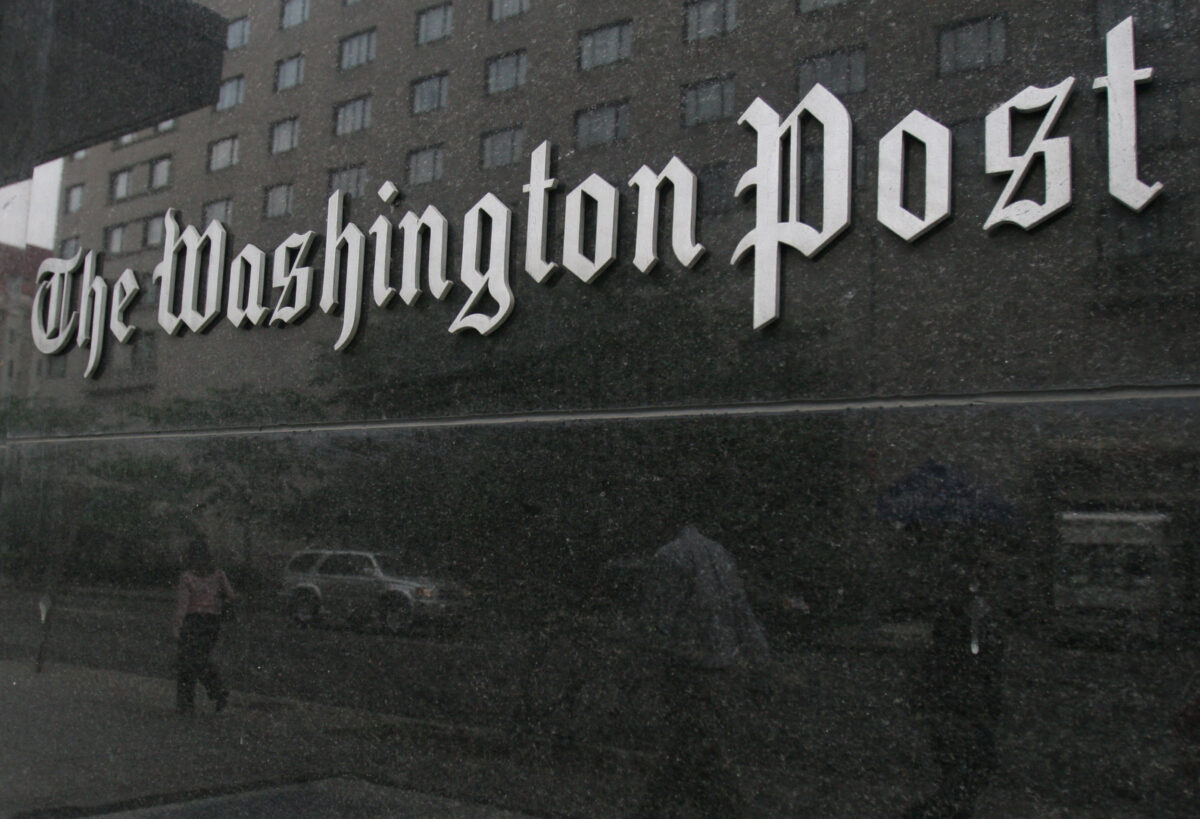
AP Photo/Lauren Victoria Burke
A class action lawsuit was filed against The Washington Post Thursday, alleging its digital systems collected private data through secret surveillance in order to price gouge its most loyal longterm subscribers — and potentially threatening to cost the paper “millions, if not billions, in damages,” according to one of the attorneys representing the plaintiffs.
The Post has lost hundreds of thousands of subscribers amid major layoffs and other changes at the paper; the 43-page complaint claims the paper deployed deceptive technological means to wring extra money from the ones who stayed.
The complaint, filed in the Superior Court of the District of Columbia, detailed how the Post had invested substantial resources in its website and other digital assets after Bezos took over in 2013, enjoying “predictable revenue, powered by consistent readership numbers and increased site traffic.”
Subscribers expected their personal data would be used for “mutually beneficial purposes,” the complaint continued, like showing “relevant advertisements,” but the Post soon allegedly began engaging in surveillance without the knowledge or consent of the subscribers.
The plaintiffs are represented by The Clarkson Firm, a national public interest law firm with nine offices across the country, including D.C., New York City, Chicago, San Francisco, and Miami.
In a statement provided to Mediaite, the attorneys denounced the Post for “deceiving and exploiting the paper’s digital subscribers,” accusing the storied paper of having “gone from an iconic institution of journalism to just another profit-obsessed technology company remade in the image of its tech bro billionaire owner and his move-fast-and-break-things mindset of value extraction.”
Mediaite also spoke to Tim Giordano, a partner at the firm, over the phone Thursday morning about the case.
According to the complaint, since the mid-2010s, the Post has “covertly harvested [subscribers’] personal data through their phones, computers, or tablets, collecting, aggregating, and analyzing deeply personal information that it would later weaponize to determine how much more money it could extract from each Subscriber to maximize its profits” through “personalized algorithm pricing,” or “surveillance pricing.”
“The more loyal a reader became,” the more information the Post was able to collect about them, the complaint continued, detailing how the system “gathered and built Subscribers’ profiles” including “demographic and professional data drawn from user profiles” and “detailed records of content interaction” with Post content, including “ordinary habits” like “reading the morning headlines, checking an election update, [or] following a favorite columnist.”
“Rather than rewarding loyalty, The Post’s system converted Subscribers engagement into leverage against them,” the complaint stated. “Longtime Subscribers would end up paying more than new customers simply because the company knew more about them.”
According to the complaint, the Post was forced to reveal it was engaging in surveillance pricing because of a disclosure law New York passed in 2025. Before this, “not a single subscriber was aware of their surveilled pricing or secret harvesting of their data,” the complaint added.
The legally-required disclosures last year outraged subscribers after they compared wildly differing prices being offered, the complaint noted. The “full impact” of the Post’s surveillance pricing “is not yet publicly known,” according to the complaint. But the attorneys argue the Post has collected “a vast trove of data – gathered over the years illegally and without knowledge or consent from the Subscribers – and it can and does use that personalized behavioral data to make individualized decisions on pricing and access” to its content.
The complaint goes on to note that an updated privacy policy suggests the Post may be compiling even more “comprehensive” profiles of its subscribers by accessing cookies and other online browsing information — including on Bezos’ online shopping platform Amazon.
The representative plaintiff, Chelsea Blink, is a resident of Washington, D.C. — described by the complaint as “one of millions” of subscribers who were harmed by the Post’s “covert data-harvesting practices” because she “was not warned and did not reasonably expect” that her data would be used against her. She personally has subscribed to the Post since 2016 and is a “daily” reader. The complaint said that Blink works for a member of Congress; when asked to identify which member or their party affiliation Giordano declined to comment.
According to Giordano, when the New York law forced the Post to disclose how it had been collecting data, “there was some pretty widespread outrage,” including numerous social media and Reddit posts, and Blink was “one of many consumers who reached out to us.” The firm has done a lot of work on tech issues, and AI especially, and has a lot of people who follow their work.
“We are hearing from people each week and as the case moves forward we may add new plaintiffs,” said Giordano, adding that they expected to hear from “many more” now that the complaint had been officially filed.
The proposed class is defined as “All current and former Subscribers who purchased a subscription to The Post at any point during the applicable statute of limitations and who maintained an active subscription at any point when The Post was gathering data for its surveillance pricing model.”
The complaint further alleged that no version of the Post’s privacy policy adequately disclosed how much data was being harvested, from what sources, how long it had been collected, and how it was being used to determine pricing.
“While many consumers may understand that free services, such as social networking and search sites, may gather information from users to pay for the service, a reasonable consumer would not suspect that a paid news site, like The Post, would gather this information from its Subscribers in order to increase subscription prices for certain Subscribers,” the complaint stated.
There are two causes of action listed: a lengthy section alleging multiple violations of D.C.’s Consumer Protection Procedure Act (the “CPPA”), plus one count of unjust enrichment.
The complaint seeks to have the case certified as a class action, Blink appointed as representative of the class, to issue an injunction prohibiting the Post from engaging in this data harvesting and surveillance pricing in the future, and to award each plaintiff the statutory damages under the CPPA (“[t]reble damages, or $1,500 per violation, whichever is greater”), punitive damages, and an award of “reasonable attorneys’ fees and costs, including expert witness fees and other litigation expenses.”
Getting a class action certified is no guarantee, and neither is being able to prove causation and damages, but because of the timeframe involved, the massive number of reportedly affected Post subscribers, and the statutory damages under the CPPA, if this lawsuit is successful, the lawyers believe it potentially threatens to cost the Post billions of dollars in damages.
The Post does not publicly disclose subscription data, but NPR and other media outlets have reported it has had about 2.5 million digital subscribers for the past four years. The plaintiffs’ lawyers are likely to argue that each subscription renewal counts as a separate “violation” under the CPPA.
Based on social media posts and other reporting, not all of those digital subscribers were hit with increased prices. (Some may have been offered a cheaper price to lure them in, stayed about the same, increased roughly along with inflation, etc.)
Giordano confirmed an analysis (which he believed used conservative estimates) that assumed that 10 percent of subscribers were charged more by the surveillance pricing and all renewed annually. Under that calculation, the past four years of subscribers could potentially incur damages of $1.5 billion (10% of 2.5 million subscribers, multiplied by 4 years, each due $1,500 statutory damages).
The lawyers view the possible damages with an even broader lens, as the plaintiff class can arguably extend back further (especially in cases like this where the alleged consumer fraud was hidden until last year) and many of them may have renewed their Post subscriptions more frequently than annually. Add in the CPPA’s provisions for awards of punitive damages and attorneys’ fees (all but certain to be millions of dollars to manage such a large class of plaintiffs, on the rare event this goes to trial), and Giordano believes that $1.5 billion conservative estimate from the preceding paragraph could be left in the dust.
Giordano emphasized that the legal team was taking the position that “every subscriber nationwide was affected” during the roughly ten-year period this undisclosed data harvesting was happening. While it was “too premature to get into the weeds on the statute of limitations, there was absolutely no disclosure until earlier this year,” he added, and what was given was inadequate and “lacked any meaningful opt-out for consumers.”
Mediaite asked Giordano for clarification on how a “violation” was counted under CPPA, and he noted that every state has “pretty similar” statutes like this, and said his firm was very familiar with how these laws operated. Again, it was “too premature” to get specific, but these laws do allow violations to be stacked, he explained, which is a matter that would be clarified during discovery.
“We feel pretty good about our prospects to deliver for consumers in a case like this,” said Giordano, predicting the case could generate “millions, if not billions, in damages, given that the scheme operated nationwide.”
“The Post’s deeply invasive practice of consumer surveillance is squeezing consumers for all they’ve got through a campaign of deception, rigging the cost of services against the very people keeping these companies in business,” said Ryan Clarkson, founder and managing partner of the firm in a statement provided to Mediaite. “Consumers did not agree to be surveilled. They did not knowingly sign up to be charged a different amount from their neighbor to read the same newspaper. Discriminatory pricing systems have no place in a fair market, and they need to be dismantled.”
“Surveillance pricing has been widely condemned as unfair and deceptive,” added Kristen Simplicio, a partner and one of the lead attorneys on the litigation. “The Post’s exploitation of its subscribers shows just how far companies will go to pad their bottom line. Action must be taken. Consumers cannot be left behind to bear the worst of these practices while corporations profit.”
Giordano told Mediaite the attorneys view this litigation as having a broader impact as AI takes an increasingly influential role in our media and economy.
“While we all hope AI will benefit society more than harm,” said Giordano, “it’s not surprising The Washington Post would deploy AI to improve their bottom line even if it betrays consumer trust. I think we’d all hope for more from one of the country’s most storied news institutions, but this really the new reality in the new economy and the AI arms race to consolidate wealth and privilege.”
Giordano mentioned reports about companies like Amazon and grocery stores using AI to increase profits, and how so far this was mostly operating inside a “complete black box” that consumers could not decipher or understand. Litigation like this “opens the black box,” he said, and may be the best defense to protect consumers against “predatory pricing models” in the emerging AI economy.
Multiple studies had shown that AI models are prejudiced, Giordano added, “explicitly or implicitly,” and he predicted companies deploying such tactics to adjust prices may face “even bigger problems under anti-discrimination laws.”
“It’s a new era,” he said, and unfortunately the “promise of AI” was not living up to positive projections, but instead “now we are seeing all sorts of harms from AI…all we’re seeing is harms and harms to everyday people” as our personal data is “weaponized against consumers,” and “that’s not something we can let proliferate.”
The litigation comes after several years of turmoil at the nearly 150-year-old newspaper as staffers have bristled at efforts by Post owner Jeff Bezos and publisher and CEO Will Lewis to adopt a more right-leaning, MAGA-friendly tone, spurring resignations and sharp public rebukes from several of the Post’s top journalists. In January, sweeping layoffs obliterated the sports department, eliminated long-running overseas bureaus, and sent dozens of seasoned reporters out the doors.
Former Post executive editor Marty Baron reacted furiously to the layoffs, releasing a statement calling it “among the darkest days in the history of one of the world’s greatest news organizations” and accusing Bezos’ “ill-conceived decisions” of making the paper’s challenges “infinitely worse” and driving off readers by “betraying the values he was supposed to uphold.”
Mediaite reached out to The Washington Post for comment and will update this article if we receive a response.
Chelsea Blink v. The Washington Post by sarahrumpf
(Plaintiff’s address is redacted in the above document for privacy reasons.)
—
New: The Mediaite One-Sheet "Newsletter of Newsletters"
Your daily summary and analysis of what the many, many media newsletters are saying and reporting. Subscribe now!









Comments
↓ Scroll down for comments ↓