ONE SHEET: Fox Cracking on Iran? NPR’s Empty Court Win and Golf Media’s Tiger Problem

The Big Picture
The newsletter class spent Tuesday watching cracks form in the pro-war media consensus on Iran — Fox News hosts included. Meanwhile, a federal judge blocked Trump’s executive order defunding NPR and PBS, handing public broadcasting a symbolic win even as Congress has already done the damage. On the personnel front, Politico ended a long, embarrassing editor search by promoting from within, and Bari Weiss is quietly preparing to blow up 60 Minutes the moment the season ends. Golf media is also having a reckoning it would rather not have, with the Masters nine days away and Tiger Woods in a Florida courthouse.
Today’s sources: Status | Awful Announcing | CNN Reliable Sources | Politico Playbook | To the Contrary | The Ankler | Breaker | Axios | Page Six Hollywood | Newsbusters | Poynter | CJR
Top Story
FOX NEWS ON IRAN: BREAKING WITH TRUMP OR NEWSLETTER WISHCASTING?
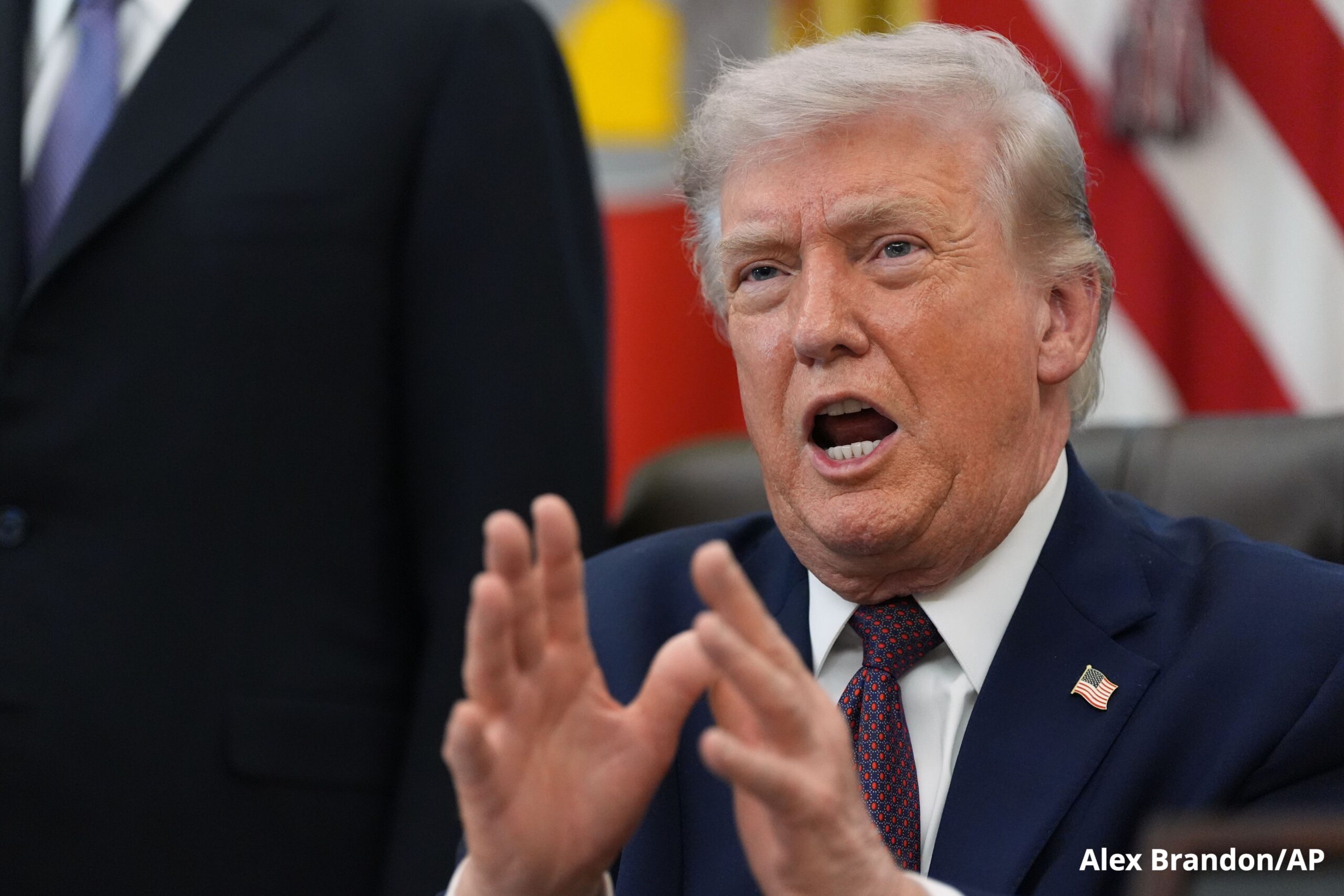
For a month, the Iran war had a reliable media architecture: Fox News and the broader MAGA media ecosystem as enthusiastic boosters, the center-left press as skeptics, and the newsletter class dutifully cataloguing the gap. The U.S. and Israel launched a joint assault on Iran in late February; gas prices have since topped $4 a gallon, Marines may be headed to Kharg Island, and the Strait of Hormuz remains effectively blocked. Through all of it, Fox’s primetime lineup held the line. That architecture is starting to shift — or at least, two data points suggest it might be. And the newsletters noticed, eagerly.
The most striking data point came from Fox’s own primetime lineup. Laura Ingraham, typically one of Trump’s most dependable defenders, opened her Monday show with a pointed question about whether the president had fully grasped the risks of the conflict. “Was the president fully briefed about the risks of all of this from the beginning?” she asked. “And was he then able to take it all in and understand the complexity of this?” Status’s Oliver Darcy flagged the moment as a notable departure from the Murdoch network’s earlier boosterism — and Megyn Kelly, on her SiriusXM show Tuesday, confirmed she’d noticed too, pointing out that the administration’s messaging had been “so erratic that even Fox News — the biggest cheerleader of this war by far — is starting to ask some questions.”
The fractures aren’t limited to primetime. Politico Playbook‘s Jack Blanchard and Dasha Burns reported that Tucker Carlson — a longtime war skeptic — took his anti-war message to the Metropolitan Club on Friday, delivering a closed-door address to roughly 200 Washington elites: lobbyists, ambassadors, business leaders, the kind of people who shape the capital’s consensus. Carlson said little publicly, but an attendee told Playbook his message was straightforward: the war is not in America’s best interest.
Reliable Sources‘ Brian Stelter approached the story from two angles. The first: Iran’s ongoing internet blackout — now the longest in the country’s history — is a structural problem for journalism. With 99.9% of Iranians cut off from the outside world, the information vacuum makes it nearly impossible to assess the war’s actual toll. The Pentagon’s own press operation hasn’t helped: Tuesday’s briefing with Defense Secretary Pete Hegseth was the first in nearly two weeks. The second angle was sharper: Reliable Sources editor Andrew Kirell observed that MAGA media commentators “almost never give Trump any agency” on Iran. Kelly said Benjamin Netanyahu and Mark Levin “talked him into” the war. Joe Rogan said someone “tricked” Trump into striking Iran. Ingraham questioned whether Trump was able to absorb the complexity of the conflict at all. The throughline: Trump’s most loyal media defenders have found a way to express doubt about the war while keeping the president himself blameless for it.
To the Contrary‘s Charlie Sykes added the sharpest military critique, featuring a conversation with retired Lt. Gen. Mark Hertling, who raised an uncomfortable question about the proposed seizure of Kharg Island: what exactly is the objective? Hertling warned that if Iran faces an existential threat to its territory, Marines on that island would be “sitting ducks.”
Newsbusters, meanwhile, offered a different read — flagging what it described as CNN’s attempt to use Hegseth’s invocation of Christian language during the conflict as a political attack, with religion commentator Father Edward Beck calling the Defense Secretary “unqualified.”
What the newsletter class is collectively assembling, piece by piece, is a picture of a war whose media consensus is fracturing at the edges — not from the center-left, where skepticism was always expected, but from within the coalition that sold it.
TAKEAWAY: When Fox’s primetime hosts start asking whether the president was “fully briefed,” the pro-war media architecture isn’t just cracking — it’s doing the opposition’s work for them. The newsletter class noticed. The question now is whether the White House does too.
Three Takes
NPR AND PBS WIN IN COURT … BUT THEY’VE ALREADY LOST THE FUNDING
A federal judge on Tuesday permanently blocked Trump’s executive order directing all federal agencies to cut off funding to NPR and PBS, ruling it “unlawful and unenforceable” on First Amendment grounds. The ruling was a significant legal win for public broadcasting — though with Congress having already voted to eliminate federal funding and the Corporation for Public Broadcasting forced to shut down, the practical stakes are murkier.
Status (Oliver Darcy): Led with the ruling as a genuine First Amendment victory, noting that, as Status reported, Judge Randolph Moss wrote it was “difficult to conceive of clearer evidence” of viewpoint-based retaliation. Noted that prominent media lawyer Ted Boutrous called it “a significant victory for the First Amendment and for freedom of the press” — then immediately contextualized the limits: with Congress having already defunded public broadcasting, Tuesday’s win may be largely symbolic. The Trump White House called the ruling “ridiculous” and the work of “an activist judge.”
Poynter (Tom Jones): Covered the ruling with the most media-specific lens of the three — noting that while the judge found Trump’s order unlawfully targeted NPR and PBS for their coverage, the practical impact is murky. Jones cited NYT reporter Benjamin Mullin‘s reporting that Congress had already clawed back roughly $500 million in annual funding for the Corporation for Public Broadcasting, which has since shut down. The ruling could, however, remove a future hurdle if Congress ever moves to restore funding. Jones also included NPR president and CEO Katherine Maher‘s full statement, which framed the ruling as “a decisive affirmation of the rights of a free and independent press.”
Newsbusters (Jorge Bonilla): Did not lead with the ruling itself but focused on what it described as the media’s selective coverage of Supreme Court proceedings running concurrently — arguing that network newscasts were ignoring rulings and arguments that cut against the left’s preferred narratives, including the birthright citizenship arguments and the Colorado conversion therapy decision. The public broadcasting ruling, in Newsbusters’ framing, was the story the “Elitist Media” was happy to cover; the others were the ones being buried.
TAKEAWAY: Three newsletters, three different definitions of what the story actually is — a First Amendment win, a partial and complicated reversal, or evidence of selective media priorities. All three are technically correct. That’s what makes the ruling a genuinely interesting media story rather than a clean victory lap for anyone.
📰 Top Reads 📰
Status | Oliver Darcy
STATUS REPORTS WEISS EYEING ‘60 MINUTES‘ OVERHAUL — BUT READ THE SOURCING: Status reports that CBS News chief Bari Weiss considered making changes to 60 Minutes mid-season before ultimately not doing so — with veteran network leadership, per Darcy’s anonymous sources, pushing back. Come summer, Weiss is expected to reshape the program more substantially. It’s worth noting the framing here: Darcy, who has consistently covered Weiss in the most unflattering light available, renders what could reasonably be described as a normal editorial process — leader floats idea, gets input, proceeds deliberately — as evidence of impulsiveness checked by wiser hands. Correspondent Sharyn Alfonsi, whose contract expires this season, is unlikely to be renewed. Anderson Cooper has already exited; Norah O’Donnell is set for an expanded role. Status notes that programs Weiss has already touched have posted historic ratings lows. QUOTE (60 Minutes staffer): “No one knows what to expect.” … QUICK TAKE: Weiss was hired to think outside the box — not every idea that gets tested against institutional reality is a failure. Whether her 60 Minutes overhaul succeeds or stumbles, Status’s framing deserves at least as much scrutiny as Weiss’s decisions do.
Awful Announcing | Drew Lerner / Sam Bozoian
GOLF MEDIA HAD FOUR CHANCES. IT WHIFFED AGAIN: Tiger Woods was arrested Friday on DUI charges in Jupiter Island, Florida — his fourth serious driving incident in 17 years. Awful Announcing’s detailed autopsy of the weekend’s coverage found a sport-wide failure of nerve: Barstool’s “Riggs” publicly boasted about spiking coverage to “protect Tiger Woods until we f*cking die,” Dan Rapaport posted an emotional tribute that conspicuously omitted any mention of the danger Woods posed to others, and at a CBS Sports press call Monday morning, no reporter asked about the arrest for 54 minutes — until Awful Announcing raised the question. CBS Sports president David Berson ultimately punted, saying it would be “inappropriate to comment” before Woods’ camp issued a statement. QUOTE (Berson): “It’s not fair to anyone for us to speak about it or speculate.” … QUICK TAKE: When the outlet asking the question at a CBS press call is Awful Announcing, golf journalism has a structural problem that one DUI arrest didn’t create.
Breaker | Lachlan Cartwright
BEHIND POLITICO’S FAILED SEARCH — AND WHERE THE POACHING GOES NEXT: Politico announced Jonathan Greenberger as its new global editor-in-chief on Monday — the story the newsletter class already had. What Breaker adds is the inside account: after a lengthy pursuit of marquee external candidates including NYT columnist Bret Stephens, AP’s Julie Pace, The Economist‘s James Bennet, and the FT‘s James Fontanella-Khan, co-founder John Harris — remaining as chairman — played a significant role in chasing off the competition, leaving Axel Springer with little choice but to promote from within. More fresh: Breaker reports that NOTUS, the re-startup run by Politico co-founder Robert Allbritton, has now set its sights on NYT staff after raiding the Washington Post and Politico, with editors pitching that NYT reporters get lost in a maze of bylines. QUOTE (Greenberger): “We’re not going to say, ‘Oh, we aspire to someday compete with so and so.'” … QUICK TAKE: The Greenberger hire is a known quantity dressed up as a decision — the real story is Harris running out the clock on every external candidate, and Allbritton now hunting the Times.
Axios | Sara Fischer
FOX BETS ON THE ULTRA-WEALTHY WHILE RIVALS CHASE STREAMS: Red Seat Ventures, the talent company Fox Corp. acquired in 2025, is building a premium membership program for ultra-wealthy individuals centered on live event access — think World Cup suites and NASCAR hospitality — according to CEO Chris Balfe, who confirmed the plans to Axios. Fischer frames it as Fox Corp.’s broader strategic discipline: while competitors have burned cash chasing on-demand streaming, Fox has leaned into live programming and events, and its stock has soared 48.9% over the past five years compared to steep declines at Disney, WBD, and Comcast. Tubi has now posted profits for two consecutive quarters and is earning over $1.1 billion in annual revenue. QUOTE (Balfe): “Live events are getting more premium and more special.” … QUICK TAKE: Balfe deserves credit — building a white-glove live experience business inside a news company is genuinely novel, and Fox’s stock performance suggests Wall Street agrees. The tension worth watching: a network whose entire brand is built on speaking for the regular guy is now selling $50,000 event packages to family offices. At some point those two identities have to reckon with each other.
Status | Oliver Darcy | Axios | Sara Fischer
OPENAI CLOSES $122B ROUND AS SORA QUIETLY DIES: OpenAI announced Tuesday it closed a record $122 billion funding round valuing the company at $852 billion, co-led by SoftBank alongside a16z, D.E. Shaw, MGX, and TPG. The company also alluded to the discontinuation of Sora — without naming it — saying it is focused on building “a unified AI superapp” because “users do not want disconnected tools.” Axios reported separately that Sora had been losing millions and was planning an enterprise version for Disney employees before OpenAI pulled the plug. QUOTE (OpenAI statement): “Users do not want disconnected tools.” … QUICK TAKE: Sora’s shutdown may be the first time a major AI company looked at what it had built, saw where it was heading, and decided to stop rather than defend it. That’s not nothing — most AI products get abandoned only after the PR disaster, not before. Whether that’s discipline or just good timing is a question the $852 billion valuation makes it easy not to ask.
Status | Oliver Darcy | Poynter | Tom Jones
AFP PHOTO FLAP: WHITE HOUSE PRESSURE, A PULLED IMAGE, AND A DISPUTED EXPLANATION: The White House complained to AFP about an unflattering photo of press secretary Karoline Leavitt holding her son near a turkey, and the image was quietly removed from the wire — then automatically scrubbed from the Getty Images library. Status first reported the pressure campaign and framed it as a straightforward capitulation. But Poynter’s Tom Jones followed up with AFP’s own on-record response: director of brand and communications Grégoire Lemarchand told Darcy the photo was pulled for editorial reasons — poor angle, superior images already available — and that while the White House complaints were received, there was “no formal request to remove it, nor was there any external pressure involved.” Two versions of the same story, and AFP’s denial doesn’t fully close it. QUOTE (Lemarchand): “We want to be clear that there was no formal request to remove it, nor was there any external pressure involved.” … QUICK TAKE: AFP’s explanation is plausible and may even be true — but a wire service that pulls a photo after White House complaints, then says the complaints had nothing to do with it, is asking for a level of benefit of the doubt that the current media environment doesn’t easily extend.
CJR | Susie Banikarim
INSIDE IRAN WITH A GOVERNMENT MINDER: THE IMPOSSIBLE MATH OF WAR REPORTING: CJR’s Susie Banikarim interviewed Sebastian Walker, the documentary filmmaker behind Frontline’s Strike on Iran: The Nuclear Question, on what it actually means to report from inside Iran under wartime restrictions. Walker was candid: every Western journalist in the country works with a government-affiliated translator at all times, can only go where authorities permit, and operates under monitoring so intense that ordinary Iranians won’t speak honestly on camera. A State Department official called CNN’s recent Iran visit “straight up pro-Iran regime propaganda.” Walker’s response: the value of going is getting a direct, in-person conversation with Iranian leadership — something that can’t be replicated remotely. He and his team were among the last journalists to interview Ali Larijani before his death. QUOTE (Walker): “It’s not a completely authentic reporting experience if you’re not allowed to go to certain places and see certain things.” … QUICK TAKE: The choice isn’t between authentic war reporting and compromised war reporting from Iran — it’s between compromised reporting and no reporting at all, and the newsletter class covering the information vacuum should probably say that more plainly.
Axios | Sara Fischer
VIDEO SPENDING HAS PLATEAUED — AND THE MATH DOESN’T FIX ITSELF: New data from MoffettNathanson shows consumer spending on video has flatlined since the pandemic, stuck around $140-145 billion annually despite the streaming boom. The culprit: a fragmented, expensive landscape and a shift toward out-of-home experiences. Ad-supported services are mostly cannibalizing linear TV rather than growing the overall pie. Senior analyst Robert Fishman told clients that re-bundling — the logical fix — remains unlikely as long as each streamer believes it can do better alone. Netflix last week raised its ad-free plan to $20 a month while holding its ad tier steady, a move that pushes consumers toward cheaper options without growing total spend. QUOTE (Fishman): “As long as each streaming service believes it can achieve better standalone profitability than it could through bundling, the prospect of a re-bundling remains elusive.” … QUICK TAKE: The streaming era was supposed to give consumers more choice and less waste. What it delivered was a $145 billion market going nowhere, with each player too scared of their own unit economics to cooperate. The cable bundle was ugly. Its replacement is just uglier and more expensive.
🎬 SHOWBIZ 🎬
The Ankler | Natalie Jarvey
CHERNIN GROUP BETS ON COMMUNITY OVER CELEBRITY IN CREATOR ECONOMY: The Chernin Group has quietly assembled one of the more interesting portfolios in media — co-leading Substack’s $100 million Series C, putting $40 million into Ashley Flowers‘ Audiochuck, backing romantasy publisher Entangled, and becoming the first outside investor in U.K. podcasting powerhouse Goalhanger. Partners Greg Bettinelli and Maureen Sullivan told Like & Subscribe that their unifying thesis is community over celebrity: the next generation of media companies will be built by creators who can turn audiences into durable, multi-revenue businesses. The firm also acknowledged that Food52 — in which TCG held a majority stake — declared bankruptcy last year and sold for $10.3 million against $25 million in debt. Sullivan said she’s “not deterred.” QUOTE (Sullivan): “We’re always hunting for unique companies that have managed to build a community.” … QUICK TAKE: Peter Chernin has one of the better track records in media investment, and also a history of backing things that didn’t pan out — Food52 being the most recent. The community-over-celebrity thesis is compelling and probably right. The jury is still out on whether it translates into durable businesses at scale, or just a more interesting set of bankruptcy filings.
The Ankler | Sean McNulty
SONY SETS EPSTEIN LIMITED SERIES WITH LAURA DERN: Sony TV has set an untitled limited series based on Miami Herald reporter Julie K. Brown‘s book Perversion of Justice: The Jeffrey Epstein Story, with Laura Dern starring as Brown. The project comes from Adam McKay‘s Hyperobject production company; Sharon Hoffman is writing and co-showrunning with Eileen Myers. The Ankler noted the series is now looking for a buyer — and pointedly suggested FX as a likely home. QUOTE (McNulty): “Now we see which studio without a deal currently before the U.S. government for approval steps up to buy.” … QUICK TAKE: The Epstein story broke the most powerful man in finance and exposed an entire ecosystem of enablers. The limited series version will be judged by whether it names names or lets the scenery do the work. McKay and Dern suggest ambition. The buyer will determine the ceiling.
The Ankler | Sean McNulty
NETFLIX EYES EXPANDED NFL DEAL — FOUR GAMES, NEW TERRITORY: Netflix is exploring an expansion of its NFL package from two to four games, according to the WSJ, with the new Thanksgiving Eve Wednesday game and an international slot as the targets. The current Christmas Day deal is in its final year. McNulty noted the international game would likely be the opening-week Thursday game from Australia — which would air as a crack-of-dawn broadcast on the East Coast. QUOTE (McNulty): “Netflix and NFL could be furthering their relationship before larger re-negotiations begin for the main U.S. NFL packages.” … QUICK TAKE: Smart business for Netflix. Smart business for the NFL. A disaster in slow motion for the fan who remembers when you could watch a game without a spreadsheet tracking which platform has which package. Every new streaming deal makes the set-top box era look more like a golden age.
👀 What Got Missed? 👀
The newsletter class spent Tuesday treating Laura Ingraham and Megyn Kelly’s Iran skepticism as evidence that Fox News is cracking. Maybe. But for every primetime host asking whether Trump was “fully briefed,” there were a dozen Fox voices spending the same news cycle amplifying White House talking points about the war’s progress, Iran’s weakness, and the necessity of the mission. The chattering class has a habit of cherry-picking Fox dissent as a signal of broader movement while treating the network’s overwhelming pro-administration baseline as ambient noise. Two data points aren’t a crack. They might just be two data points. The question the newsletter class didn’t ask: what would Fox actually look like if it weren’t cracking?
🏆 Newsletter of the Day 🏆
Awful Announcing | Drew Lerner / Sam Bozoian — Not every newsletter in the One Sheet’s universe covers sports media, and fewer still do it with the rigor Awful Announcing brought to the Tiger Woods story this week. While the golf press circled the wagons and CBS Sports ran out the clock on its own press call, Awful Announcing was the outlet that actually asked the question — and then wrote the autopsy. The piece didn’t just catalogue what Barstool and Dan Rapaport got wrong; it diagnosed the structural condition that made those failures predictable. With the Masters nine days away and CBS holding the biggest platform in golf, that diagnosis matters.
The Bottom Line
Iran’s internet blackout was supposed to be Iran’s problem. What it’s become is everyone’s. When reliable information from the ground is this scarce, the fog of war gets foggier — and in that fog, every actor digs deeper into their prior. The Trump administration has less incentive to brief a press corps it can’t be contradicted by. Legacy media, unable to report, fills the vacuum with framing. Newsletters fill it with meta-commentary. And readers end up with extremely confident narratives about a war that almost nobody can actually see. The information vacuum didn’t create the distrust between the White House and the press. But it has done something arguably worse: made that distrust self-reinforcing, and made the narratives on all sides harder to dislodge even when the facts eventually arrive.
Get full access to premium content with a Mediaite+ subscription.




Comments
↓ Scroll down for comments ↓