State of the Unions: Men, Women, and Everyone Else

 In 2005, California Governor Arnold Schwarzenegger launched a broad, unprecedented attack on union members. He proposed a series of ballot initiatives that would strip teacher job security, upend their pay structures, eliminate the use of union dues for political campaigns, and gut pensions that went to public safety officers killed in the line of duty.
And the labor movement rose up and beat him silly.
That fight in 2005 was led by the state’s teachers and nurses. They hounded Arnold wherever he went – protested outside fundraisers, at speaking gigs. I remember standing with thousands of men and women outside San Jose’s Fairmont Hotel waiting for Arnold to show up; a diverse crowd from a broad array of occupations and income levels.
Eventually, Californians rejected every one of Schwarzenegger’s proposals. The pension initiative never even made it to the ballot.
Why is this story relevant today? Because NYT contributor Natasha Vargas-Cooper has decided that the reason people care about Wisconsin is because of the manly firefighters.
Or… something. To be frank, I’m not clear on the point of the piece in today’s Times. There’s an undertone of disempowered service sector women being carried across the finish line by muscle-choked studs wearing suspenders. That female union members, who live shadowy existences, are being protected by society’s protectors, in the name of solidarity.
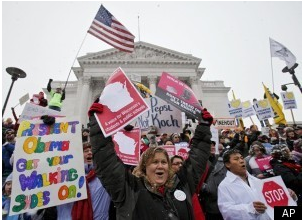 But that’s not the situation on the ground in Madison. The impacted unions in Wisconsin aren’t predominantly service sector – it’s government workers and teachers. While the latter may be predominantly (or stereotypically female), the former aren’t.
And to portray teachers as needing rescue ignores decades of history. Teachers, alongside police and firefighters, get enormous good will from the public. Deservedly. They’re politically strong because no one wants to be seen as opposing the guys who save lives and the women who teach our kids. Until, that is, the right learned that teachers’ unions were an obstacle to privatizing education (read: charter schools) and began a campaign that has (only slightly) diminished that status.
What people think when they think of unions are burly, manly people like steelworkers or Teamsters. What the labor movement would like them to think is of cops and firefighters, nurses and teachers – the unions most popular with the public. The union members that every kid wants to be when they’re young.
What the labor movement actually is, of course, is increasingly female, increasingly of color, and increasingly in the service and public sectors, by percentage. In this regard, Vargas-Cooper is right: that it is imperative that these members have strong representation and the ability to have a voice on the job and in public.
Where she’s wrong is that they need to rely on studs in uniform. It’s a disservice to the strong women of the labor movement – the nurses and teachers who trounced Arnie six years ago, those who stormed the Wisconsin Capitol before any police or firefighters there actually got engaged in the fight.
It’s a disservice to the solidarity of the labor movement itself.
Philip Bump does communications work in Washington, DC. For five years, he worked with the Labor movement in the Silicon Valley. He’s also the founder of TerribleMovieNight.com. Find him on Mediaite here and on Twitter here.
Image: AP via Huffington Post.
This is an opinion piece. The views expressed in this article are those of just the author.
New: The Mediaite One-Sheet "Newsletter of Newsletters"
Your daily summary and analysis of what the many, many media newsletters are saying and reporting. Subscribe now!







Comments
↓ Scroll down for comments ↓