
Former Supreme Court Justice Sandra Day O’Connor Has Died

Sandra Day O’Connor, the first woman to serve on the Supreme Court of the United States, died at the age of 93 from complications related to Alzheimer’s disease, it was reported on Friday.
O’Connor was appointed by former President Ronald Reagan in 1981 and served as an associate justice until she retired in 2006.
Born in Texas in 1930, O’Connor pursued a career in law despite a strong bias against women at the time. Her legal work led her to the Arizona Senate, where she was first appointed to a vacated seat and then elected. She was reelected twice and became the first female majority leader in the country. Her career went from legislative to judiciary in 1975 when she was elected to the Superior Court in Arizona’s Maricopa County. After serving on the Arizona Supreme Court of Appeals, she was nominated to the Supreme Court by Reagan, fulfilling his promise to put a woman on the bench.
As a Supreme Court Justice, O’Connor was considered a moderate conservative, often serving as a swing vote on divisive issues, so much so that the court was sometimes referred to as the “O’Connor Court” despite her status as an associate justice. Among her notable votes on the court were upholding abortion rights in Planned Parenthood v. Casey in 1992, affirmative action in 2003, and the election-deciding Bush v. Gore in 2000.
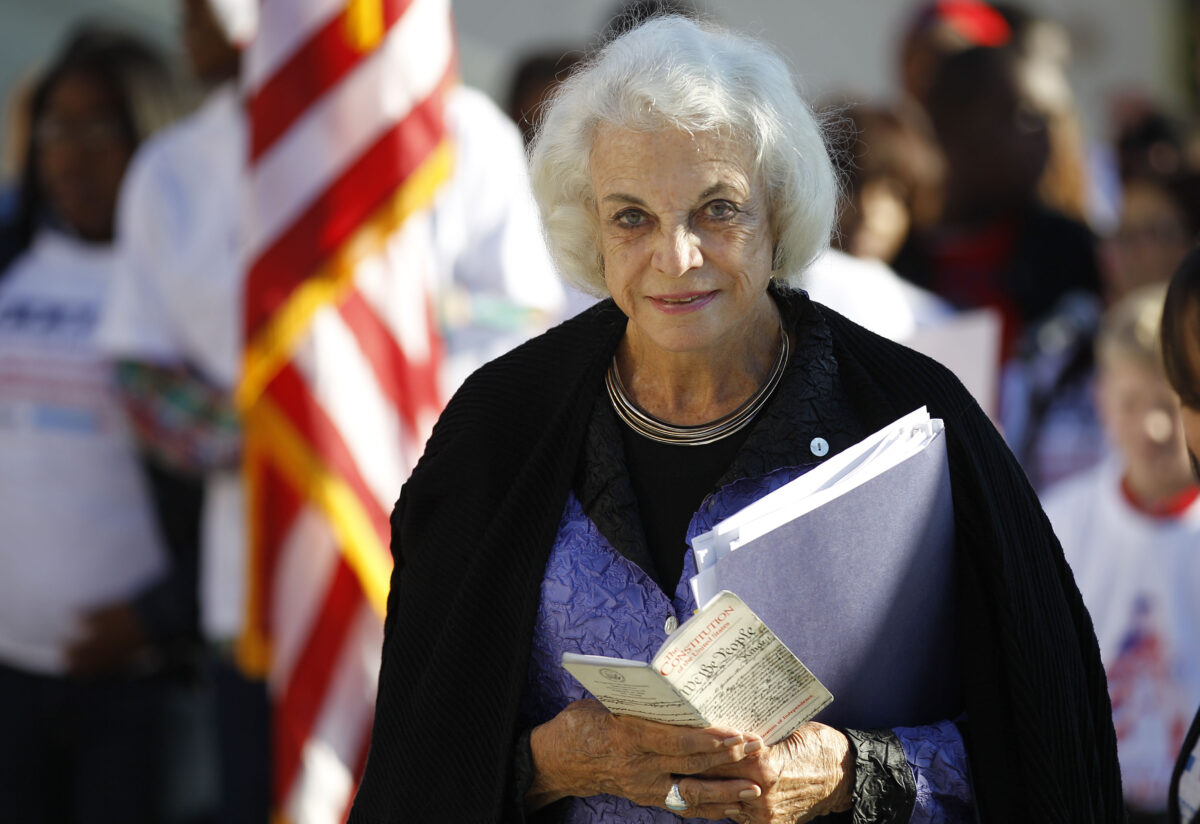
AP Photo/Matt Rourke
O’Connor left the Supreme Court in 2006 citing her husband John O’Connor’s declining health due to Alzheimer’s disease. He died in 2009, and Justice O’Connor became an advocate for the disease. In 2018, O’Connor announced that she was diagnosed with dementia, “probably Alzheimer’s,” and said in a letter at the time:
While the final chapter of my life with dementia may be trying, nothing has diminished my gratitude and deep appreciation for the countless blessings of my life. …
It is time for new leaders to make civic learning and civic engagement a reality for all. I hope that I have inspired young people about civic engagement and helped pave the pathway for women who may have faced obstacles pursuing their careers.
This story is developing and has been updated.
New: The Mediaite One-Sheet "Newsletter of Newsletters"
Your daily summary and analysis of what the many, many media newsletters are saying and reporting. Subscribe now!








Comments
↓ Scroll down for comments ↓