Conservative Media’s Love Affair with DeSantis: What It Means for the GOP Primary and His Showdown with Trump

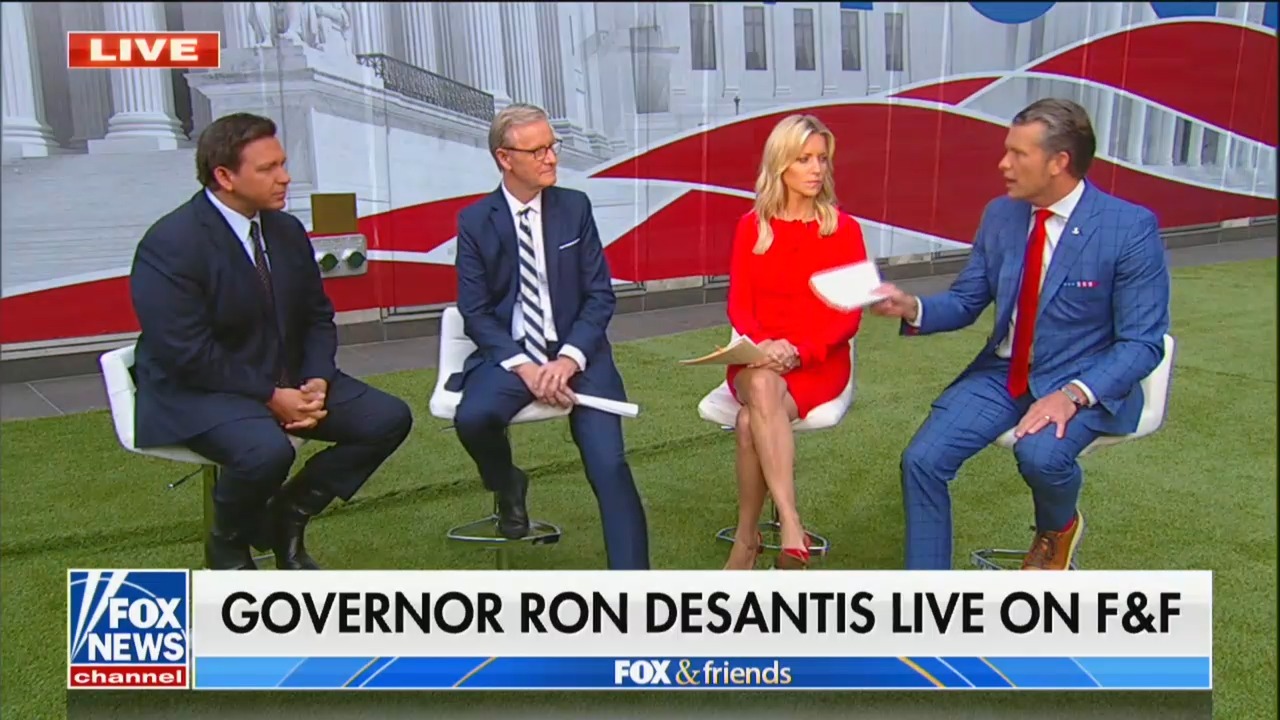
There’s no denying that Florida Governor Ron DeSantis benefits from a disproportionate amount of — and disproportionately positive — coverage from conservative media.
That’s not an accusation. Descriptively, it’s simply true that DeSantis’s exalted status among the conservative commentariat has helped turn him into a top contender for the Republican nomination for president in 2024.
To what can that status be attributed, and how sticky will it prove?
Prior to the pandemic, DeSantis had already positioned himself well in Florida, earning bipartisan acclaim. One poll conducted in December 2019 indicated that 68% of Florida voters — and even over 60% of minority voters in the state — approved of his job performance. But it was DeSantis’s response to Covid-19 turned him into a national figure and a conservative folk hero.
While much of the country stayed locked down for months and failed to resume in-person school for years, DeSantis required the Sunshine State’s schools to reopen in fall 2020 and kept the state’s beaches open. He vigorously protested the restrictions favored by public health officials even as former president Donald Trump, DeSantis’s chief competition for the 2024 nomination, continued to tout Dr. Anthony Fauci as the face of his administration’s pandemic policy.
It also turned him into a partisan figure. Much of the press spent the plague years launching ceaseless broadsides on him even as it swooned over New York’s Andrew Cuomo. The Washington Post, CNN, and MSNBC all threw their weight behind Rebekah Jones’s conspiracy theories. 60 Minutes ran a feature story painting DeSantis’s distribution of vaccine doses to Florida’s most popular grocery store as corrupt. “DeathSantis” trended on Twitter on a monthly basis.
Conservatives rallied around him, simultaneously outraged and delighted by the unfair and ubiquitous attacks on him. “You did a great job, you saved a lot of lives, and there’s a lot to learn from your success,” Fox News host Sean Hannity told DeSantis during a friendly interview in April 2020. “Where Does Ron DeSantis Go to Get His Apology?” asked National Review’s Rich Lowry a month later.
They’ve stayed in his corner, too. “The Future Is Florida,” proclaimed a February 2021 Washington Examiner cover story depicting a sunglasses-clad DeSantis in a beach chair. The Wall Street Journal published a retrospective editorial in April 2022 arguing that the country had much to learn from his pandemic-era. He’s also become a go-to guest on Fox, where if he’s not in make-up, he’s probably a topic of discussion.
DeSantis took a lonely stand on a generation-defining issue and made all of the right enemies in the process. That was his first step in consolidating the conservative ecosphere around him.
He parlayed that success into a broader reputation as a leader on other issues. Promotion of progressive dogma in schools and workplaces, and the ongoing crisis at the southern border were priorities. These fights bolstered his status in the more pugnacious corners of the right; a small army of influencers became an extension of his communications team online.
But even more importantly, they turned him from a national figure into a genuine threat to Trump’s hold on the GOP ahead of 2024.
Herein lies the other major source of DeSantis’s both deep and wide base of support inside of the conservative movement. For the first time since 2016, Republicans have a figure capable of supplanting Trump at the head of the party.
The story isn’t overly complicated, much less conspiratorial as some left-of-center journalists have suggested. Conservative media’s affinity for DeSantis is the logical endpoint of well-earned respect meeting opportunity.
What DeSantis should do with the broad coalition behind him is a much more interesting question. As he prepares for the official launch of his campaign, he has lurched, if not rightward, then into the anti-establishment lane. Asked to expand upon his view of the ongoing war in Ukraine last week, DeSantis called it a “territorial dispute” and tweaked “DC foreign policy interventionists.”
His comments were met with expressions of frustration from conservatives who had previously been effusive in their praise for him. “He wanted to go after people like us,” declared an indignant John Podhoretz on the neoconservative Commentary Magazine podcast.
“The DeSantis people — and I don’t know whether this is DeSantis himself or the DeSantis people — want to include in their indictment, following in Trump’s footsteps, a bunch of Republicans,” continued Podhoretz, who went on to characterize the comments as “politically stupid” because the governor “is the fusionist, consensus candidate for 2024.”
“DeSantis is trying to play in the ‘I’m going to destroy the Republican, Washington establishment and eat their lunch, just like you like with Trump,'” he said. “And that’s not the logic that will make him secure victory in the Republican primaries.”
“John, you’re absolutely right. That’s the logic that we see in DeSantis’s candidacy,” replied Matt Continetti, the founding editor of the Washington Free Beacon. “It’s becoming increasingly clear to me over the past few months that’s not the logic that Ron DeSantis sees in his candidacy… he seems to think that his path to the nomination goes through the online right.”
Others who have lavished praise on him in the past, including the aforementioned Journal‘s editorial board, National Review‘s Noah Rothman, and Fox’s Mark Levin, who called DeSantis’s remarks “very disappointing.”
Could it be that DeSantis’s attempt to outflank Trump on issues of importance to conservative influencers could undermine his support in more traditional conservative media? And if it does, would that imperil his presidential bid?
The first instinct of many observers would be to say no to the first question and chortle at the second. Most who seek an end to the Trump era will, after all, vote for any alternative, and the press’s hostility did little to impede Trump’s triumph in the 2016 primary.
But unlike Trump’s base of support, DeSantis’s standing with the electorate was built upon conservative media’s promotion of his stellar record in office. And while it’s hard to imagine conditions under which the likes of the Journal or National Review would turn against DeSantis completely, it’s entirely conceivable that in trying to lure some proportion of Trump’s largely immovable base into his own column, he could alienate the very institutions who helped him build his brand and lose a larger proportion of the rest of the party to other candidates in the process.
Trump’s victory in 2016 persuaded many that the positioning of the mainstream conservative press was no longer relevant to Republican politics. But that’s folly, not only because some slice of the electorate takes cues from it, but much more significantly, because it reflects a portion of the larger party. DeSantis’s base of support in the media is a reflection of his base of support in the electorate. Of course DeSantis must also appeal to Republicans fond of the former president. It’d be a mistake, though, to shake off shoes that fit for a pair that don’t.
It’s always best to dance with the one that brought you.
This is an opinion piece. The views expressed in this article are those of just the author.
New: The Mediaite One-Sheet "Newsletter of Newsletters"
Your daily summary and analysis of what the many, many media newsletters are saying and reporting. Subscribe now!










Comments
↓ Scroll down for comments ↓