Here Is Elon Musk’s Latest Terrible Idea to Make Twitter Even More of a Hellscape Than It Already Is

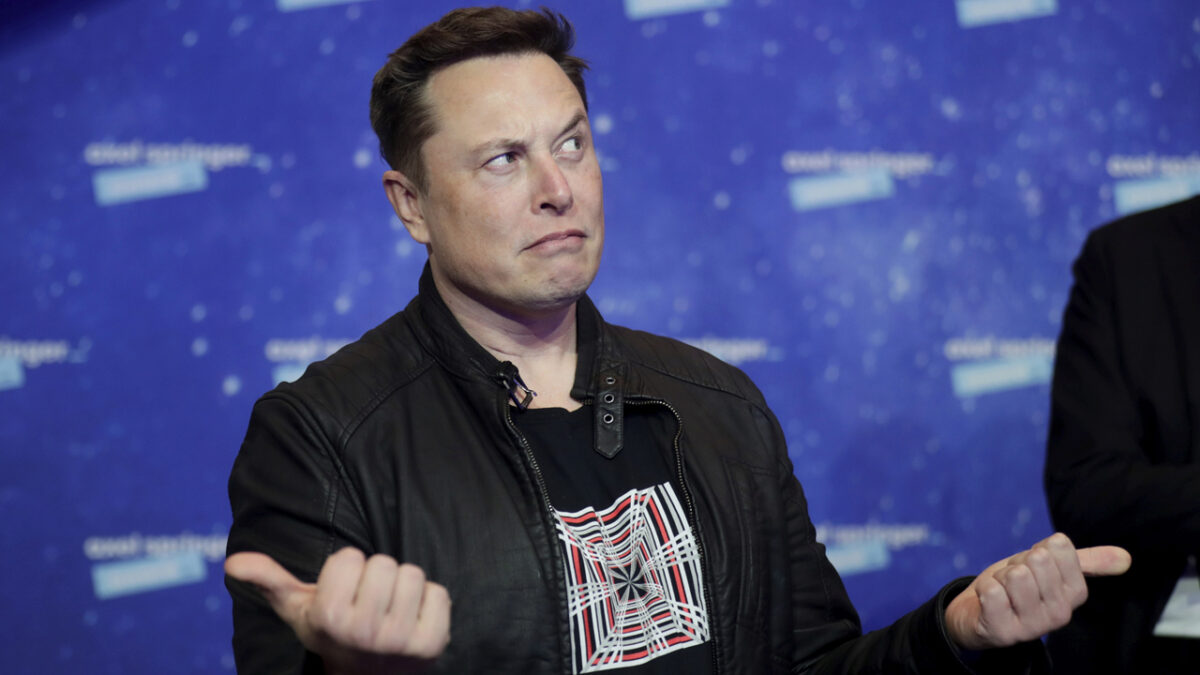
Hannibal Hanschke/Pool via AP
It’s become a bit of a cliché to complain that Elon Musk is ruining Twitter, but the latest idea to slither out of the billionaire’s drug-addled brain does pose an actual risk to the platform: eliminating the block function.
(One quick note: yes, I’ll acknowledge Musk renamed his social media platform “X,” but just like Prince attempted to change his name into an unpronounceable symbol for a few years, everyone is still referring to it as The Platform Formerly Known as Twitter, or, just, “Twitter.”)
On Friday, Musk replied to a tweet by the Tesla Owners Silicon Valley account that asked “Is there ever a reason to block vs mute someone?” by declaring that “Block is going to be deleted as a ‘feature,’ except for DMs.”
In subsequent tweets, Musk added that blocking “makes no sense” and advocated for the use of the mute function instead.
So far, Musk has not clarified when or how the block function might be eliminated — or if he might instead allow it only for verified users as yet another attempt to nudge more people to pay for the service.
He did get a word of support for using mute instead of block from Twitter founder Jack Dorsey, who has launched his own rival social media platform, BlueSky, which does allow users to mute and block accounts.
Possibly related, BlueSky was experiencing technical difficulties Friday shortly after Musk’s tweet started getting reaction.
(Also on Thursday evening, Dorsey tweeted he had deleted his Instagram account, despite being one of the first accounts and first angel investors for that platform, in the aftermath of Mark Zuckerberg’s Meta launching Instagram-based Threads, yet another rival text based social media platform.)
Other than Dorsey, though, Musk’s declaration he wanted to end blocking met with a broad range of critics across the political spectrum — including many who have previously defended his controversial tenure as Chief Twit.
Anyone who has ever engaged with a social media platform on any political topic whatsoever has experienced some level of spam, harassment, and unfortunately sometimes even doxxing and threats. Besides the reams of research showing how online harassment and abuse can be detrimental to mental health, especially for young people, the sad reality of users who take it too far and respond to online opinions with real world aggression means there are potential real world consequences for allowing abuse to fester.
And taking away the ability to block an abusive user means Twitter is essentially enabling the abuse by making it impossible for the target to get away from the abuser without leaving the social media platform entirely.
As many of Musk’s critics noted, the core functionality of “mute” and “block” are quite different, and while muting an account does mean you personally won’t be annoyed by reading that person’s tweets, they can still read your tweets and post replies that all your followers can see.
Add in Musk’s changes to the verified accounts, where those who pay the subscription fee to get a blue check get their tweets boosted to the top of the replies, and anyone intending to spread spam, trolling, harassment, or other abusive content is then more likely to get away with it if they’re muted, because their target won’t initially see the spammy or abusive reply they posted.
Blocking, on the other hand, means that troll can never reply to one of your tweets again and shove their abuse into your timeline. If your account isn’t private, they could always log out and screenshot a tweet and tweet something about it, but that’s on their timeline, not yours.
Musk likes to style himself as a “free speech warrior,” but he’s missing a critical component of free speech. While you have the right to use your free speech rights to speak your views, you can’t force me to publish or promote your words — because that infringes on my free speech rights.
Removing the ability to block forces minorities to carry racial slurs in their timelines, women to carry rape threats and misogynistic insults, Jewish users to carry images photoshopped by antisemitic trolls showing them or their families inside Nazi gas chambers, and so on.
None of these things “promotes dialogue” or “increases free speech.” And while it’s certainly true some Twitter users block people because they just don’t want to have a discussion with them, so what? Again, the right to free speech does not include a right to force anyone to listen to you; it certainly does not include forcing anyone to promote your words.
The Auschwitz Memorial account — which is frequently a target of antisemitic harassment and threats — had a thoughtful and logical response to Musk’s plan to end blocking, writing that it would deprive them of the “secure space” they need to fulfill their mission of honoring the victims of the Holocaust who were imprisoned, tortured, and killed at the Nazi concentration camp there.
“Failing to address the antisemitic and Holocaust denial comments that appear under our posts commemorating the victims of Auschwitz would be a disservice to their memory,” the account tweeted Friday, explaining that they block users “who promote denial and hatred,” because “[t]hese individuals do not seek discourse; they aim to inflict pain.”
Blocking such accounts, the tweet continued, was “a necessary step to ensure that these harmful voices don’t persist in their repetitive attacks on memory” of the victims. The memorial also pointed out that reporting abusive accounts all too frequently “remains an unanswered call,” a problem reportedly exacerbated by Musk’s steep cuts to Twitter’s safety and moderation staff.
“Blocking provides a way to protect the memory of people who suffered and were murdered in Auschwitz,” the memorial concluded.
Musk seems likely to run into a technological and legal obstacle to his plan: the terms of Apple’s app store require any app that has “user-generated content” to include “[t]he ability to block abusive users from the service.”
From Apple’s “App Store Review Guidelines” page:
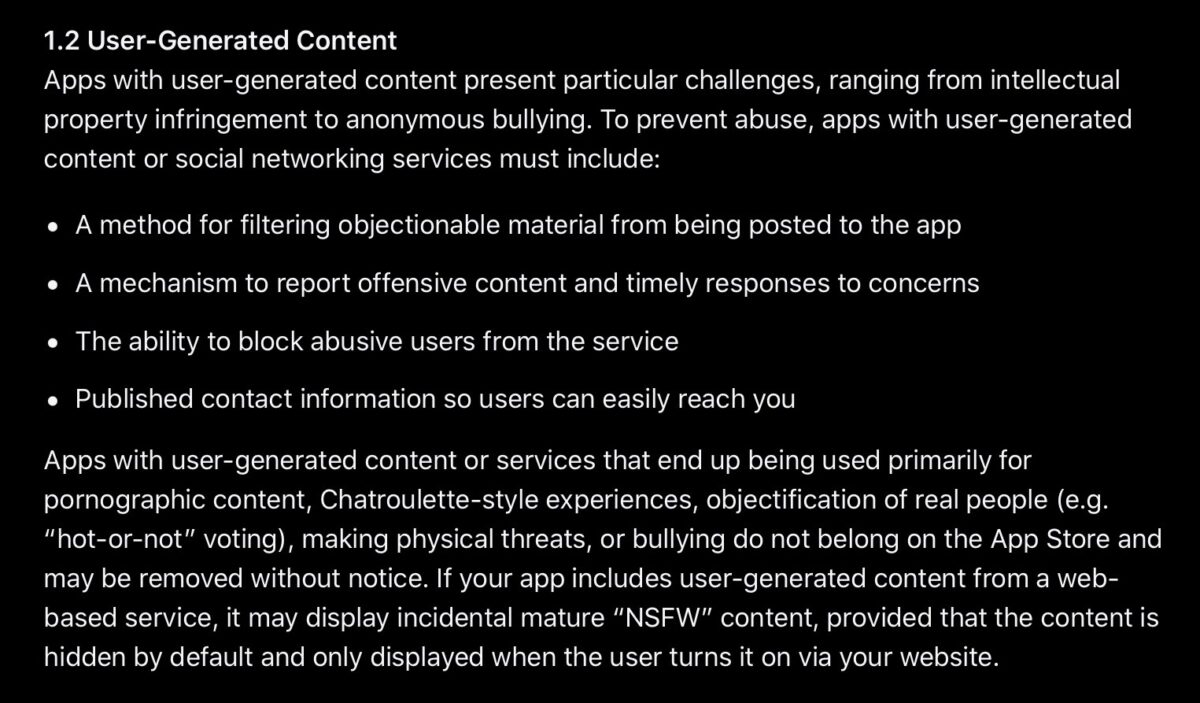
Screenshot via Apple App Store Review Guidelines.
UPDATE 3:00 pm ET: Several people have argued that this specific language does not expressly say that users themselves must have the ability to block abusive users, but as podcaster Andy Levy pointed out, there are documented instances of App Store rejection messages spelling out that exact requirement.
—
This is an opinion piece. The views expressed in this article are those of just the author.
New: The Mediaite One-Sheet "Newsletter of Newsletters"
Your daily summary and analysis of what the many, many media newsletters are saying and reporting. Subscribe now!











Comments
↓ Scroll down for comments ↓