Here’s What Hulu’s New Hillary Clinton Docuseries Missed About Her Famous ‘Bake Cookies’ Line

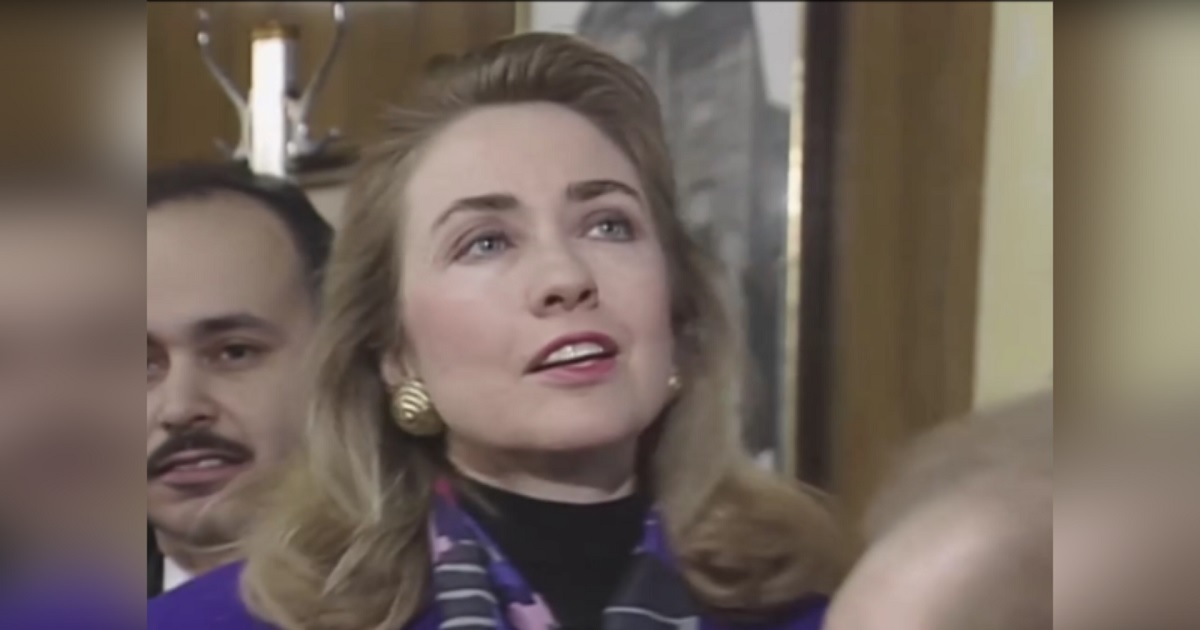
The new Hulu docuseries “Hillary” is a vastly entertaining and informative look at the life — so far — of iconic former Secretary of State Hillary Clinton that traces, among other things, her emergence as a culturally polarizing figure, symbolic of a growing generation of strong women for those who love strong women, and those who are threatened by them.
That phenomenon exploded in 1992 when Hillary made a remark about baking cookies that would set the course for decades of American politics. But there’s a little-known origin story to that remark that the Hulu doc didn’t tell.
In the pre-social media age, the remark got played like “Charlie Bit My Finger” by the networks, and was seen by many as a defiant rallying cry against the limitations that were (and still are) placed on women, while many others saw it as a cultural declaration of war on patriotic American housewives, but everybody saw it:
I suppose I could have stayed home and baked cookies and had teas, but what I decided to do was to fulfill my profession which I entered before my husband was in public life.
With that quote, Hillary instantly became a hero to many and a villain to many others, but the media played the “insult to women” angle to the hilt, which is why the context of Hillary’s remark was ill-understood at the time, and poorly-remembered now. Even all these years later, though, there is now new insight into that polarizing and iconic moment.
Hillary gave that remark during a press avail at the Busy Bee Diner in Chicago the day after the March 15 Democratic primary debate in Illinois. Early in that debate, Chicago institution Lynn Sweet set the table for fireworks when she asked Bill Clinton to respond to press reports attacking him over Hillary’s work for the Rose Law Firm, as well as the seeds of what would become the Whitewater “scandal”:
That question led to a heated exchange between Clinton and Democratic rival Jerry Brown, whose attack might sound familiar to voters in this year’s contest. Bill Clinton’s response might also ring a few bells:
The next day, the press grilled Bill Clinton about the exchange at the Busy Bee Diner, and Bill tossed the questioning over to Hillary. That’s when she made the comment that would define her for many people:
After Hillary’s remarks the following day, a national freakout ensued, and a few weeks later, she explained to The Today Show‘s Katie Couric what she had been driving at in more detail:
The only person I was trying to put down was Jerry Brown, I wasn’t trying to put anybody else down… What I was trying to say is that in response to some of the charges that he had leveled, there was an underlying message to what he had said. In response to a question about his father’s law firm doing business with the state while he was governor, he said “Well I don’t control my father!” And you know, it wasn’t very subtle. I was trying to point out that his attitude seemed to be that I should’ve only confined myself to the ceremonial role of a First Lady, and I’ve enjoyed that role, but I’ve also enjoyed, very much, doing the rest of my life.
With that response in mind, it is now possible to trace the exact moment the fuse was lit on that iconic moment. In a 1979 local television interview — a different portion of which was included in the Hulu series — then-Arkansas First Lady Hillary Rodham was asked a question that sounds suspiciously familiar:
One gets the impression that you’re not all that interested in state dinners and teas and garden parties, the kinds of things we tend to associate with governors’ wives.
Hillary answered the question with grace, but it, and the expectation that went along with it, obviously stuck with her, likely reinforced by countless variations on the theme. Decades later, that question helps explain how we ended up with a country where 3 million more people loved Hillary Clinton than felt threatened by her, and yet still elected Trump.
This is an opinion piece. The views expressed in this article are those of just the author.
New: The Mediaite One-Sheet "Newsletter of Newsletters"
Your daily summary and analysis of what the many, many media newsletters are saying and reporting. Subscribe now!





Comments
↓ Scroll down for comments ↓