Kyle Rittenhouse May Have a Legal Self Defense Claim But He’s No Hero For Second Amendment Rights

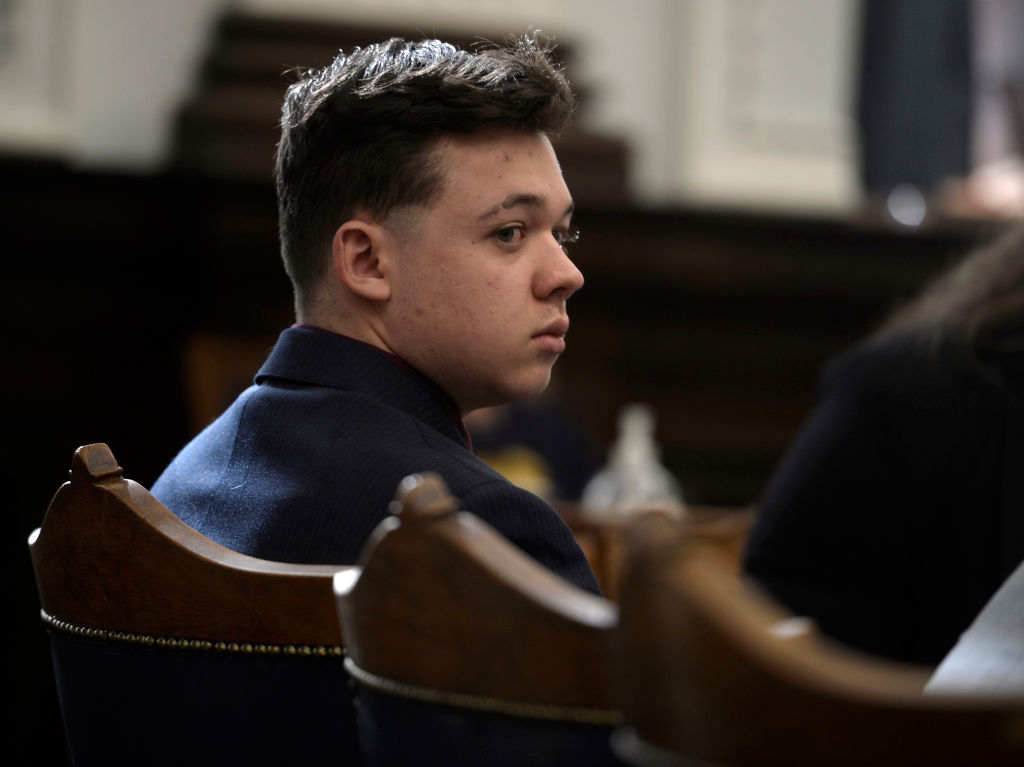
Sean Krajacic-Pool/Getty Images.
Kyle Rittenhouse is on trial for shooting three people, two of them fatally, amid the chaos of the protests in Kenosha, Wisconsin in the wake of the police shooting of Jacob Blake. The teenager has become a cause célèbre in certain conservative circles, with his claim of self defense embraced by Second Amendment advocates, but Rittenhouse is an extremely poor hero for the gun rights cause.
Rittenhouse was charged with first-degree intentional homicide, first-degree reckless homicide, and first-degree attempted intentional homicide for his alleged actions the evening of August 25, 2020. According to CNN:
The events of that night, almost all captured on video, are hardly in dispute: Rittenhouse, armed with an AR-15-style rifle, fatally shot Rosenbaum — who was chasing the teenager and threw a plastic bag at him — and then shot at three other people who confronted him. Rosenbaum and Anthony Huber were killed, and Gaige Grosskreutz was wounded…
Rittenhouse fired his rifle eight times in all during the chaotic protests following the police shooting of Jacob Blake. He shot Rosenbaum four times; fired twice at an unknown person who tried to kick him; fatally shot Huber, who had hit him with a skateboard; and shot Grosskreutz, armed with a gun, in the arm.
Only seventeen years old at the time of the shootings, Rittenhouse was a resident of Antioch, Illinois, about 30 minutes south of Kenosha. He testified that he had seen videos on social media of the protests in Kenosha getting out of control, devolving into vandalism, arson, and violence. He did not have a valid driver’s license at the time.
During the prosecution’s cross-examination, Rittenhouse admitted that he knew he did not have a legal right to possess the rifle he used in the shootings, and had given money to his friend Dominic Black to purchase the gun for him in May 2020 and keep it at Black’s stepfather’s house until Rittenhouse turned 18. The young man also testified that he had picked that particular style of gun because it “looked cool.”
Rittenhouse and Black joined several other young men who traveled to Kenosha with the stated purpose of helping defend property from the rioters. Rittenhouse had also previously worked as a lifeguard and had participated in a police cadet program, getting some first aid training. He wasn’t hired by any of the property owners or invited to come, but when he was interviewed on video by The Daily Caller’s Richie McGinnis several hours before the shootings, he claimed that his “job” was to “protect this business” and “help people”:
So, people are getting injured, and our job is to protect this business. Part of my job is also to help people. If there is somebody hurt, I’m running into harm’s way. That’s why I have my rifle, because I have to protect myself, obviously. I also have my med kit.
Additional video clips from that day showed Rittenhouse claiming to be an EMT, a misrepresentation which the prosecutor got him to admit he knew was false.
In addition to Rittenhouse’s own testimony, his defense counsel has called several witnesses to try to establish that Rittenhouse was acting in self-defense.
Without getting too far into the weeds of criminal procedure and evidentiary rules, the details of how and why Rittenhouse illegally obtained the rifle, illegally drove without a valid license across state lines, and voluntarily put himself in the middle of a scene of unrest and violence are not likely to negate his claims of self-defense, and the possibility he may be acquitted on one or more charges has already enraged many people. It’s likely that Rittenhouse may be able to convince the jury that he had a reasonable fear for his life during at least the initial confrontation with Rosenbaum, his first shooting victim, and be held to not be legally culpable.
However, Rittenhouse still remains morally culpable, despite how his actions have been praised by a disturbing number of commentators, mostly on the right. Fox News’ Greg Gutfeld is one of the more noteworthy examples, going so far as to laud Rittenhouse for doing “what the government should have done” to stop “these violent, disgusting dirtbags” from “roaming the streets.” For a far more prudent contrary view, Quin Hillyer writes for the Washington Examiner that Rittenhouse was a “vigilante” and “at clear moral fault for the two deaths” he caused, having traveled to Kenosha “expecting trouble, and he grievously exacerbated the trouble he found.”
A gun is a tool for humans to use, and I won’t be the first to compare firearms to automobiles: both require training and practice to operate competently, have legal restrictions on their use by minors, and — most importantly — can be dangerous, even deadly, when used improperly. Anyone using a gun or driving a car should be mentally and emotionally calm, physically healthy (including eyesight and hand-eye coordination), free from the influence of drugs or alcohol, and familiar with how to operate that specific model of firearm or vehicle.
I’ve been to multiple conservative conferences, political debates, and campaign events over the years where guns were a hot topic of debate; attended gun shows and shooting events, and taken concealed carry classes in both Texas and Florida. I have repeatedly heard critically important messages emphasized about gun safety: the importance of properly maintaining a firearm, getting adequate training and practice, being responsible regarding the storage and possession of guns, and being extremely cautious about the potentially deadly decision to point a gun at another human being, much less actually pull the trigger.
The NRA has rightfully been criticized over their bizarre messaging efforts and the organization’s egregious financial mismanagement, but they have developed a national network of certified firearm trainers, and the lessons those trainers impart have a strong focus on safety. Anyone handling a gun at an NRA class is expected to treat it like it’s always loaded, to never point it in the direction of another person or anything other than the designated target, to exercise strict trigger discipline, and to just maintain full awareness and control over the weapon at all times.
This messaging is in direct conflict with everything we know about Rittenhouse, how he obtained his weapon, why he decided to go to Kenosha, and his actions that fateful night.
Rittenhouse bought his rifle because his friend had one and he thought it “looked cool.” Since he wasn’t legally allowed to possess it, his friend held the gun for him. With the gun being purchased the May before the August shootings and being kept away and inconvenient for Rittenhouse to access, he had not had much time to familiarize himself with it. He described how he had purchased the strap for the AR-15 so he could walk around with the gun strapped to his back.
He had seen video of the riots in Kenosha, knew there had been arson and violence. In spite of that, he still decided to drive into town and walk around with that large, very obvious rifle. Being only 17 years old, and not actually a police officer, and not actually an EMT, his outward appearance was a man with a large gun and a fanny pack. Showing up like that in the middle of a riot made him the proverbial match, willingly jumping into a vat of gasoline. His own illegal actions, dishonesty, and poor decision making made an already chaotic situation even worse.
Even if we accept for the sake of argument the point made by Gutfeld and others that the local authorities in Kenosha had failed and citizen action was necessary and justified, we don’t call on children to fight our battles.
We don’t draft children to join the military; that’s literally a war crime. We don’t allow children to become police officers, firefighters, or EMTs. Rittenhouse playing apprentice cop in a cadet program was an educational opportunity for high schoolers; the cadets aren’t sent out to arrest criminals or respond to emergency calls.
There were real, very serious problems in Kenosha last year — millions of dollars of property were destroyed, people were hurt and even killed — but a kid from Illinois was not the solution.
As a final note, I might be more inclined to be more charitable towards the efforts to make Rittenhouse a poster boy for Second Amendment rights if there hadn’t been such an appalling hesitancy from these same quarters to speak up on behalf of the Second Amendment rights of Philando Castile, who was actually a legally licensed gun owner.
This is an opinion piece. The views expressed in this article are those of just the author.
New: The Mediaite One-Sheet "Newsletter of Newsletters"
Your daily summary and analysis of what the many, many media newsletters are saying and reporting. Subscribe now!




Comments
↓ Scroll down for comments ↓