Rudy Giuliani’s Borat Scene Was Bad … But Was it Made Worse by Selective Editing?

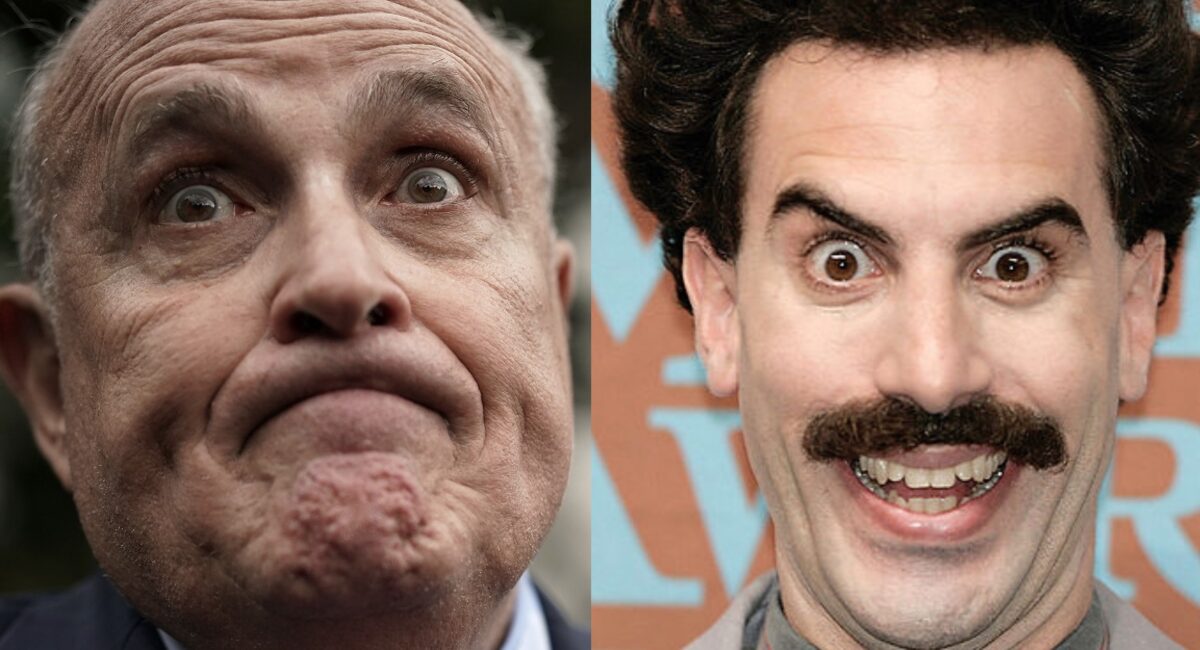
When someone opens a comment with, “I don’t mean to be rude or disrespectful,” that tends to be an acknowledgment that what they are about to say is, in fact, quite rude or disrespectful.
This comes to mind, as I’d like to open this potentially controversial dissection of the Rudy Giuliani scene in the new Borat sequel, by proclaiming that this is NOT Giuliani apologia. Full Stop. But after comparing the breathless and pearl-clutching reactions on Twitter to the actual scene, which I have now seen with my own eyes, I have to say that it is not nearly as bad as people made it out to be.
Sure, the scene is cringeworthy. Really tough to watch. But anyone familiar with the dark art of post-production can spot some rather gaping holes in the chronology, the video, and audio edits that are almost certainly designed to portray the personal attorney to President Donald Trump in the least favorable light. In the event that you have not yet seen the 75 seconds or so of pure cringe, check it out:
https://twitter.com/tommyxtopher/status/1319485539666563072?s=20
It’s important to first note that Borat filmmaker and star Sacha Baron Cohen has no journalistic obligation to the truth here. He is purely an entertainer, and his goal to craft the most uniquely cringeworthy moments featuring known personalities, regardless of the broader context and what actually transpired.
This isn’t just the case for Borat. The “no-standards but comedy” standard has long been the guiding principle at most narrative nonfiction, reality shows, and fake news programs. Field pieces at The Daily Show, for example, also felt no obligation to portray the truth. I know that because I produced two field pieces there before I was not offered a contract (womp) and have directed episodes of the broadcast reality show Wife Swap.
Secondly, post-production editors are remarkably skilled at crafting an entirely new context and narrative by stripping audio tracks, or adding footage filmed at a later date, that helps build tension and, frankly, paint the subject in the most or least favorable light designed. Again, their goal is not to portray the truth but to produce the most entertaining clip.
So what can we assume to be true in the Giuliani Borat clip? That Giuliani entered the bedroom with his interviewer, and patted her on the lower back, while he was sitting on the bed. By any measure, that’s fairly creepy behavior. I personally sensed that America’s mayor was clearly thinking he was taking a trip to the boom-boom room, so to speak.
But there are a lot of other suggested variables presented in the clip. We hear Giuliani’s interviewer (Borat’s “daughter” Turat) invite Giuliani into the bedroom for a drink, which the viewer sees as the reason why they end up in the bedroom. But we don’t actually see her say those words, which means it could have been said in some other context or even added after the scene was filmed in a sound room. Sounds crazy, but that happens all the time.
Viewers also hear Giuliani saying “if you give me your phone numbers and your address,” while he is sitting on the bed and patting Turat on the back before she curiously starts to remove his microphone. The combination of video and audio at that moment is suggestive, but again, viewers do not see those words coming out of his mouth. It is just as plausible that Giuliani said that at a more innocent time during the interview — or that there is a piece of missing context — than apropos of nothing while creepily patting her on the back.
Then there is the moment in which Giuliani is lying on his back with his hands down his pants. When reports of the film first emerged, the suggestion was that the former mayor was fondling himself. But from my perspective — and others, now that the scene is public — it seems clear that he was tucking in his shirt. “Who lies down to tuck in his shirt?” is a reasonable question to ask, but in this instance at least, the answer could be Rudy Giuliani.
And of course, there is the suggestion that Giuliani was intentionally trying to hook up with a 15-year-old, the age of the character Turat. But there is no evidence that Giuliani knew the age of the character (played by a 24-year-old actress) until Borat busted in at the end of the scene.
Over the last few years, Rudy Giuliani has been a fierce defender of his client and friend President Trump. Some may say that his defensive tactics have gone way too far and perhaps were even pernicious to the greater good. I am one of those people. But in the interest of fairness, it is my opinion, as a former television producer who has spent thousands of hours in dark, post-production edit bays, this scene isn’t nearly as bad as it was initially made out to be.
Giuliani is a creep in the eyes of many. There is no question that the public reputation of America’s Mayor has fallen precipitously from the bipartisan praise he received in the months that followed the attacks of 9/11. Giuliani has now been relegated to curiously unhinged cable news appearances and being the clearinghouse of unverified opposition research that may or may not be tied to foreign election interference.
But even creeps deserve a fair and honest portrayal. And there is good reason to be reasonably suspicious of how he has been portrayed. The smart bet is to assume Baron Cohen went well out of his way to make him look as bad as possible.
Not unlike how, I should note, Rudy Giuliani has treated Hunter Biden.
This is an opinion piece. The views expressed in this article are those of just the author.
New: The Mediaite One-Sheet "Newsletter of Newsletters"
Your daily summary and analysis of what the many, many media newsletters are saying and reporting. Subscribe now!








Comments
↓ Scroll down for comments ↓