
Wall Street’s Migration to Bitcoin: Why Institutions Are Embracing Crypto


Bitcoin’s role on Wall Street is no longer theoretical, it’s becoming foundational. By 2025, institutional demand hit a decisive turning point as U.S. Bitcoin ETFs amassed more than $1.2 trillion in cumulative inflows, signaling one of the fastest shifts in capital allocation in modern financial history.
The surge reflects a marketplace that has matured beyond speculative mania. Clearer regulations, stronger custodial infrastructure, and deepening integration with traditional finance are pulling Bitcoin into the center of institutional strategy. What was once a fringe asset is now being treated as a long-term portfolio cornerstone.
The Institutional Influx
Capital influx from institutions into Bitcoin has remained consistent throughout 2025, reaching $524 million in a single day in November. Similarly, in September, inflows surged by $553 million. As such, even amid liquidation events that triggered $19 billion in liquidations, Wall Street continues to allocate capital.
Wall Street’s involvement in crypto is seen as positive. Institutional entities collectively hold 961,700 BTC in treasuries, representing 4% of the total Bitcoin supply. Moreover, Assets Under Management (AUM) have increased, with reports indicating daily trading volumes of $1.45 trillion. Notably, Bitcoin investment strategies have shifted from speculative, risk-on positions to genuine diversification tools. As such, increased institutional presence underscores the sector’s maturity and Wall Street’s ability to contribute.
The Compliance Revolution Making Crypto Safer for Wall Street
One of the key hurdles for large-scale institutional adoption of crypto has been counterparty risk, not just the volatility of tokens, but the risk that platforms, custodians or exchanges may be weak on compliance, exposing institutions to reputational and regulatory liability. In this context, Binance’s efforts to reduce exposure to illicit flows provide a meaningful signal of the crypto market’s evolving readiness.
Chainalysis and TRM Labs data cites Binance’s direct exposure to illicit-fund flows fell by 98% between early 2023 and mid-2025. During the same period, among the largest centralized exchanges by volume, only about 0.018-0.023 % of total transaction volume was traced to illicit addresses as of June 2025. Binance’s reported figure stood at roughly 0.007 % of its volume linked to illicit activity, more than 2.5× better than peer averages.
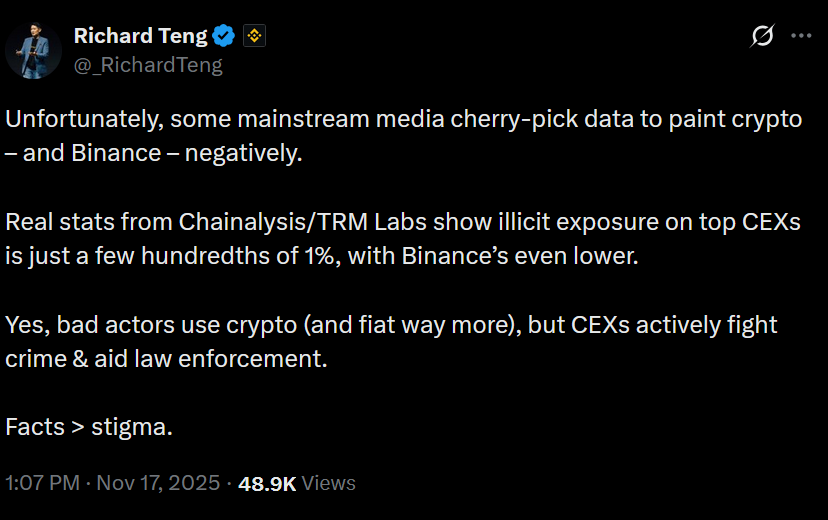
In a recent X post, Binance CEO Richard Teng commented on the difference between perception and the reality of the exchange’s ability to drive illicit activity to nearly zero, “Unfortunately, some mainstream media cherry-pick data to paint crypto – and Binance – negatively. Real stats from Chainalysis/TRM Labs show illicit exposure on top CEXs is just a few hundredths of 1%, with Binance’s even lower. Yes, bad actors use crypto (and fiat way more), but CEXs actively fight crime & aid law enforcement.”
How does Binance deliver these results? Key elements include:
- A multi-layer compliance framework rooted in heavy investment in transaction monitoring, KYC/AML, and investigation staffing. Binance reports over 1,280 specialists (about 22 % of its workforce) focused on compliance and risk functions.
- Deep collaboration with law enforcement and intelligence sharing. Binance has responded to hundreds of thousands of requests and partnered in global crime-fighting initiatives.
- Participation in real-time industry-wide anti-crime networks, such as the Beacon Network, which connects exchanges, stable-coin issuers and law-enforcement for live intelligence sharing.
From the institutional investor’s lens, this progress matters for several reasons:
- Reduced operational risk: When major trading venues demonstrate very low exposure to illicit flows, large buyers can more confidently assume their crypto investments avoid regulatory entanglements.
- Improved regulatory optics: Institutions (and their fiduciaries) face scrutiny over counter-party and wash-trading risks; a track record of compliance helps ease that due-diligence burden.
- Market-wide spillover: When liquidity hubs like Binance improve their resilience, the entire ecosystem becomes more accessible to asset-managers who demand enterprise-grade infrastructure and risk controls.
In short, the recent maturation of security and compliance frameworks, as exemplified by Binance’s initiatives, is a critical pillar supporting the broader institutional embrace of Bitcoin and crypto. As capital moves from “wait-and-see” to “execute” mode, the underlying infrastructure finally appears to be catching up with investor expectations.
Regulatory Clarity Removes Barriers
ETFs provide institutions with more efficient and transparent ways to acquire Bitcoin. BlackRock’s iShares Bitcoin Trust ETF is a notable example of Wall Street’s embrace of Bitcoin through ETFs. The IBIT stock surpassed $100 billion in assets under management in less than 18 months.
Additionally, the introduction of a Bitcoin Strategic Reserve has helped strengthen market legitimacy. Through a Bitcoin Reserve, $75 billion in recovered illicit funds can be moved into the funds, signaling state-level recognition for Bitcoin and indirectly supporting Wall Street’s increased exposure to digital assets.
Furthermore, broader macroeconomic settings have influenced institutional perspectives. According to Morgan Stanley researcher Michael Cyprys, Bitcoin is increasingly viewed as a hedge against inflation, even as long-term holders have reduced their positions by 327,000 BTC. Despite easier market access through regulated investment vehicles, some institutions remain cautious in their approach to risk exposure.
Institutional Demand Normalizes Bitcoin
Institutional adoption of Bitcoin marks a significant turning point for the financial sector. According to a recent survey by Sygnum, 61% of global institutions aim to increase their Bitcoin exposure, while 73% attribute Bitcoin as a high-return asset.
Inflow consistency emphasizes that Wall Street is increasingly supporting Bitcoin and opposing its speculative narrative. The increase in institutional BTC allocations is contributing to market stabilization and reduced price volatility. Furthermore, they could play a pivotal role in integrating Bitcoin into traditional financial systems and expand adoption at a global scale.
Finally, Strategy’s potential inclusion in the S&P 500 could serve as an early indicator of Bitcoin’s growing legitimacy, helping to reduce perceptions of volatility and risk while normalizing exposure among Wall Street investors.
Members of the editorial and news staff of Mediaite were not involved in the creation of this content.
New: The Mediaite One-Sheet "Newsletter of Newsletters"
Your daily summary and analysis of what the many, many media newsletters are saying and reporting. Subscribe now!










Comments
↓ Scroll down for comments ↓