Rubio Appeals to Cuba in 5-Minute Video in Spanish as Trump Ramps Up Pressure Campaign

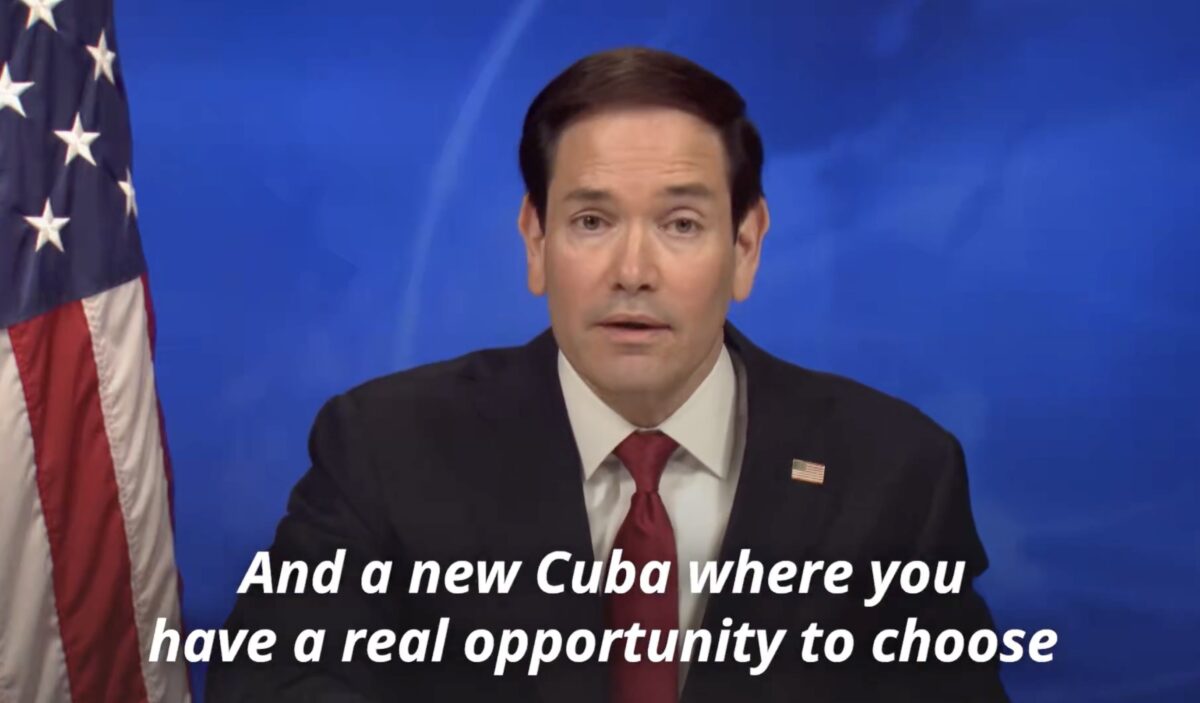
Screenshot via X.
Secretary of State Marco Rubio posted a video addressing the Cuban people amid escalating rhetoric from President Donald Trump and others in his administration about potentially indicting Raúl Castro and seeking to takeover the island nation.
Rubio, who was born in Miami to Cuban immigrant parents, has long been a vocal critic of the Castro regime and the “incompetent communists” running the government, including current leader Miguel Díaz-Canel. Trump has repeatedly made threats to use military action against Cuba, suggesting the U.S. would take a similar approach as when it captured Venezuelan dictator Nicolás Maduro in early January.
Numerous media outlets have reported that the Trump administration intends to indict Raúl Castro, the 94-year-old brother of the late dictator Fidel Castro, this week. Raúl Castro led Cuba after his brother became ill and then turned over the position to Díaz-Canel in 2021. Thus far, the Cuban government remains defiant and has vowed they are ready to defend against any U.S. attacks.
On Wednesday — the day recognized as Cuban Independence Day, commemorating the creation of the Republic of Cuba in 1902 — Rubio posted a video message, in Spanish with English subtitles, on his social media addressing the Cuban people.
Rubio spoke at length about the “unimaginable hardships” Cubans were currently suffering, saying that the blame belonged to the Castro regime and the U.S. was “offering to help you, not only to alleviate the current crisis, but also to build a better future.”
“The reason you are forced to survive 22 hours a day without electricity is not because of an oil ‘blockade’ by the United States,” Rubio continued. “The real reason you don’t have electricity, fuel, or food, is because those who control your country have plundered billions of dollars, but nothing has been used to help the people.”
The culprit, Rubio said, was a company called GAESA that Raúl Castro had founded thirty years ago. GAEAS (Grupo de Administración Empresarial S.A.) was described by The New York Times in a recent investigative report as a “secretive military-run conglomerate” that is “estimated to control between 40 percent and 70 percent of the Cuban economy.” Much of the island’s tourism industry, including the top luxury hotels, resorts, restaurants, and recreational facilities that cater to foreign visitors are controlled by GAESA, as well as grocery stores, gas stations, banks and currency exchanges.
Rubio pointed out that the people in neighboring countries had more freedoms, including voting rights and economic rights, than Cubans. “If owning your own business and having the right to vote is possible all around Cuba, why is it not possible for you inside Cuba?” he asked. “This is not impossible. All of this exists in the Bahamas, in the Dominican Republic, in Jamaica and even just 90 miles away in Florida.”
The Cuban government kept asking its people to make “sacrifices,” Rubio said, while all the money flowing through GAESA was not used to benefit them “and repressing anyone who dares to complain.”
Trump was “offering a new relationship between the U.S. and Cuba,” Rubio said, “but it must be directly with you, the Cuban people, not with GAESA.”
This would include “$100 million in food and medicine for you, the people,” he continued. “But they must be distributed directly to the Cuban people by the Catholic Church or other trusted charitable groups — not stolen by GAESA to sell in one of their stores.”
“The Cuban people are not interested in permanent charity,” Rubio said. “You want the opportunity to live in your own country the way your relatives live in the U.S. or in other countries of the world.” He mentioned how Cubans were represented at the “top of virtually all industries,” including media, entertainment, sports, politics, and business, “in all countries, except one: Cuba.”
In Cuba, Rubio said, only those who were part of the “GAESA elite” or close to it were able to have profitable businesses, but the U.S. was “offering a new path…a new Cuba, where you, the ordinary Cuban, and not just GAESA, can own a gas station, or a clothing store, or a restaurant…can open a bank or have a construction company. A new Cuba where you, and not just the Communist Party of Cuba, can own a television station or a newspaper…you can complain about a failing system without fear of going to jail or being forced to leave your island…where you have a real opportunity to choose who governs your country and vote to replace them if they are not doing a good job.”
The U.S. was “ready to open a new chapter in the relationship between our people and our countries, and currently, the only thing standing in the way of a better future are those who control your country,” he concluded.
Wall Street Journal national security reporter Vera Bergengruen shared Rubio’s video, and highlighted a change in his usual rhetoric about the Cuban government.
“Interesting thing about Rubio’s 5-min Spanish video to Cubans is that he largely stays away from the usual vocabulary – he doesn’t call Cuba a dictatorship & mentions Communist Party only in passing,” she wrote. “Instead he’s making an economic case against military-run conglomerate GAESA.”
New: The Mediaite One-Sheet "Newsletter of Newsletters"
Your daily summary and analysis of what the many, many media newsletters are saying and reporting. Subscribe now!





Comments
↓ Scroll down for comments ↓